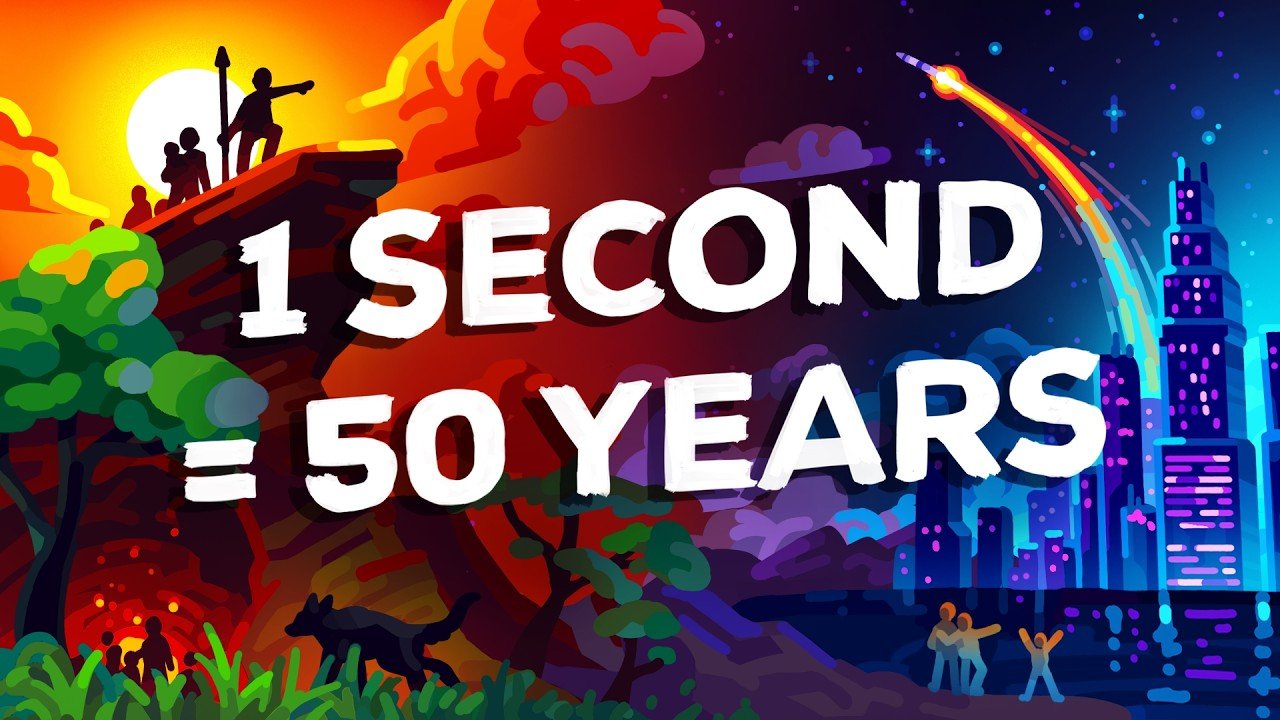
Somewhere in East Africa, roughly 200,000 years ago, a small band of Homo Sapiens crouched around a fire under animal skins, carrying obsidian hundreds of kilometers to fashion into cutting tools without maps, without shoes, and without any concept that their wandering would eventually populate an entire planet. That is the opening frame of Kurzgesagt‘s sweeping journey through all of human history, compressed into a single hour at the rate of two generations, or 50 years, per second. The stakes are quietly enormous: understanding how a single species with no particular physical advantages came to reshape every landmass on Earth, and what that arc might mean for wherever we are headed next.
The journey begins inside an Ice Age, with glacial sheets pushing across most of the globe while East Africa stays temperate enough to shelter our earliest ancestors. They were already formidable: skilled hunters wielding spears and fire, living in communities that shared grief and celebration in equal measure. They were not alone, either. Multiple other hominin species occupied the same world, some millions of years older than us, and the question of whether they were cousins or ancestors remains genuinely unresolved.
How a species with no plan ended up everywhere
Human expansion was never a coordinated march. There was no map, no destination, and movement was just as likely to double back toward Africa as to push outward. The island of Madagascar, separated from the continent by a short stretch of sea, went untouched until 2,000 years ago precisely because the means to cross it simply were not available. Crossing the Sahara itself required a specific stroke of luck: an unusually long wet period called the Abbassia Pluvial transformed deserts into swamps and rivers, opening a green corridor that drew more groups northward into encounters with Neanderthals, whose DNA now makes up one to four percent of the modern human genome.
By 120,000 years ago, footprints of humans walked alongside those of many animals on the shore of an ancient lake in what is now Saudi Arabia, at a time when the entire Arabian Peninsula was covered in wetlands and green grass. Entry into the Americas came later, when the Last Glacial Maximum dropped sea levels by 120 meters and turned today’s Bering Strait into a walkable land bridge. Groups that crossed it descended the full length of the Americas to the southern tip in only a few thousand years, moving fastest along coastlines while navigating jungles, mountain ranges, and predators including Short-faced Bears and Saber-Toothed Tigers.
The small things that outlasted the megafauna
Some of the most striking details belong not to civilizations but to objects. The oldest musical instrument on record is the Hohle Fels Flute, carved from a vulture’s wing bone with five holes and dated to up to 40,000 years ago, discovered in a German cave. The first known statue is the Lion Man from that same era: a human figure with a lion’s head, also from a German cave, suggesting that the capacity for mythology arrived well before agriculture. Shells perforated for stringing as jewellery appear 125,000 years ago, alongside red ochre pigment used for painting. As Kurzgesagt put it plainly, our ancestors ‘had an eye for beauty, just like us.’
The Toba supereruption in Indonesia nearly ended the story entirely, shrinking the human population to fewer than 10,000 individuals. The survivors were the ones who could scavenge, find shelter, and were simply fortunate enough to live in less affected regions. It is the kind of near-miss that gives the rest of the timeline a different weight.
The Hohle Fels Flute, 40,000 years later
A vulture’s wing bone, five holes drilled by hand, sitting in a cave in Germany for tens of thousands of years before anyone found it.
The hour ends 12,000 years ago at Gobekli Tepe in modern Turkey, where people built a giant structure requiring a level of collaboration that had never existed before. Dogs and cats followed humans into settled life. Villages became cities. Writing fixed laws and stored knowledge across centuries. Every civilization that followed built on the ruins and innovations of the one before it, and that accumulation is what the present moment actually is: 10,000 generations of work, with each individual life nearly invisible in the full span, yet entirely responsible for carrying it forward.