A 12-ounce ribeye steak sat on a mountaintop in New Mexico, waiting to be cooked by an actual lightning bolt. That was the plan, anyway. The larger ambition behind it was something engineers have fantasized about for centuries: capturing the electrical charge of a lightning strike and storing it, turning a few seconds of raw atmospheric fury into usable, rechargeable power. Mark Rober and his team at Crunch Labs spent just over three years, 28 failed rocket attempts, two complete design rebuilds, and eight uncooked steaks finding out exactly how hard that turns out to be.
How you send a lightning rod into a storm cloud at 500 mph
The experiment began as a lunchtime bet between Rober and a colleague named Eden about recreating Benjamin Franklin’s kite experiment. Franklin’s original goal, Rober explains, was never to get the kite struck by lightning. He simply wanted to prove that the giant atmospheric discharge was the same phenomenon as the small shock you feel reaching for a metal door handle, just scaled up by about a billion times. After their own kite run produced results that were ‘less extraordinary,’ the question naturally escalated: if there are 4 million lightning strikes per day worldwide, what would it actually take to capture that electricity?
The answer involved a mountaintop lab in New Mexico operated by two college students named Tobler and Broden, working at what Rober described as the only mountaintop lightning lab in the United States. Their approach was deceptively simple: a rudimentary model rocket powered by off-the-shelf hobby motors, fitted with a component called a bobbin. Inside each bobbin sits copper-coated steel wire that spools out behind the rocket as it climbs, creating an improvised lightning rod stretching roughly 1,000 feet into the storm. The wire-spooling mechanism was lifted directly from a World War II-era solution for deploying telephone lines across battlefields, which is why every single one of the lab’s bobbins is over 75 years old, sourced from an army surplus store.
Timing is the central problem. ‘Some storms have regular pulses,’ one of the researchers explained. ‘Right before it’s going to do it by itself, we steal it.’ The rockets are launched pneumatically, using air-filled syringes to press the trigger button, because any direct wire connection from the bunker to the launch pad would create a dangerous path straight back to the people inside.
The failure that taught them what real lightning actually does to electronics
After the first successful rocket-triggered strike, the team’s capture device went dark on the oscilloscope the moment the bolt hit. Post-storm inspection confirmed the worst: the diodes in the capture system, designed to act as one-way doors for electricity so the charge could be funneled into a capacitor bank, had been hit with roughly a thousand times more voltage than they were rated for. Lightning, it turns out, dumps its electricity so fast that even well-spec’d electronics simply cannot absorb the initial impact.
The fix required a full redesign. A snubber capacitor was bolted directly onto each diode to cushion the first hit, keeping the one-way doors functional long enough for the main capacitor bank to do its job. To verify the new design before returning to the mountain, the team built their own indoor lightning simulator using a bank of surplus capacitors slowly charged off a wall outlet and then discharged all at once, hitting the capture device with the same 30,000 amps as a real strike. It held. The same could not be said for a nearby bushel of fruit.
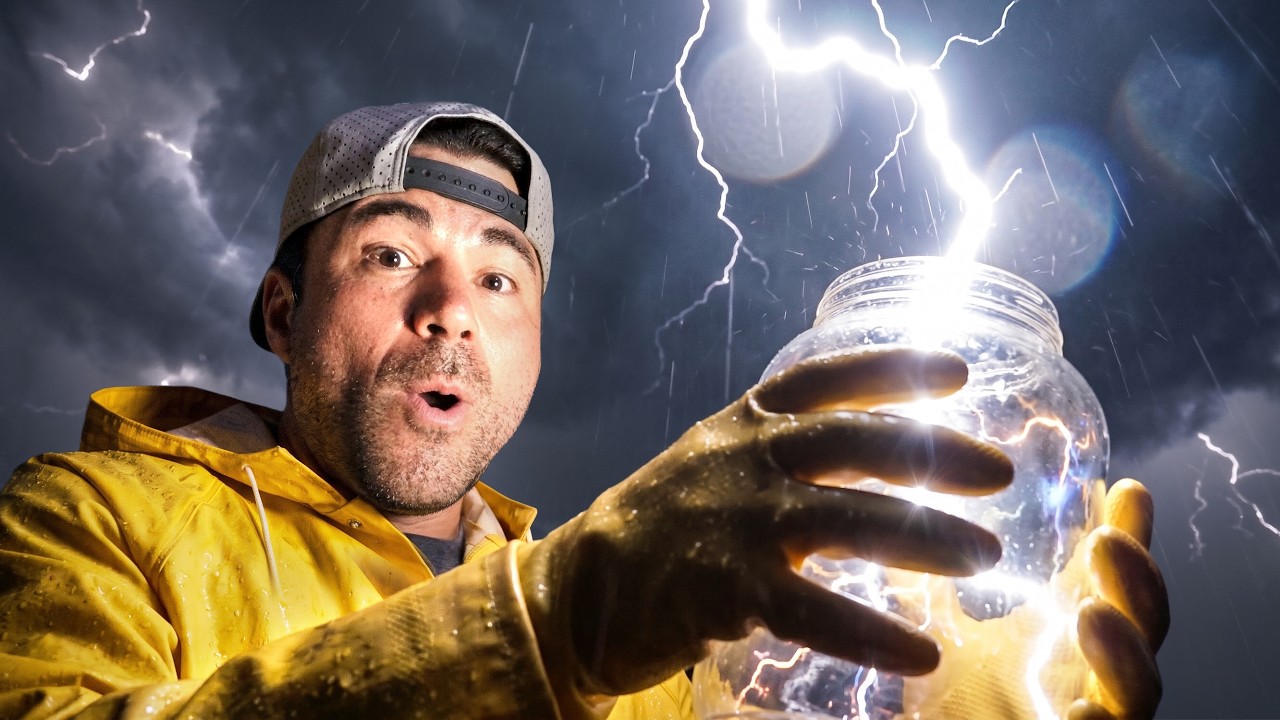
On the first storm of the following season, after three years, the rocket climbed, the bolt came down, and the oscilloscope stayed on. A small cylinder in a team member’s hands held the electrical charge of an actual lightning strike. They transferred it into a bottle-shaped capacitor and called Rober with what he described as the greatest voicemail he had ever received.
As for the ribeye: the bolt blasted a hole clean through it rather than cooking it, because electricity, as Rober put it, is lazy and took the path of least resistance straight through the metal rocket tubing instead. The Rivian charged too, technically, moving the car a measured 6 inches before the captured energy was exhausted. ‘This was like sticking a straw into Niagara Falls and taking one sip,’ Rober said.
The steak that did not get cooked
The ribeye with the hole blasted through it sat on a table next to the one that had been waiting for a lightning-fired cookout. No char marks. No sear. Just a puncture, clean through the center, as if the bolt had simply decided the steak was an inconvenient detour.
Rober was not particularly surprised, only slightly deflated. The electricity had done exactly what electricity always does: it found the easier route and ignored the high-resistance obstacle in the middle. Three years of engineering, and the steak had essentially been invisible to the storm the whole time.
 Wake up to Only Happy News!