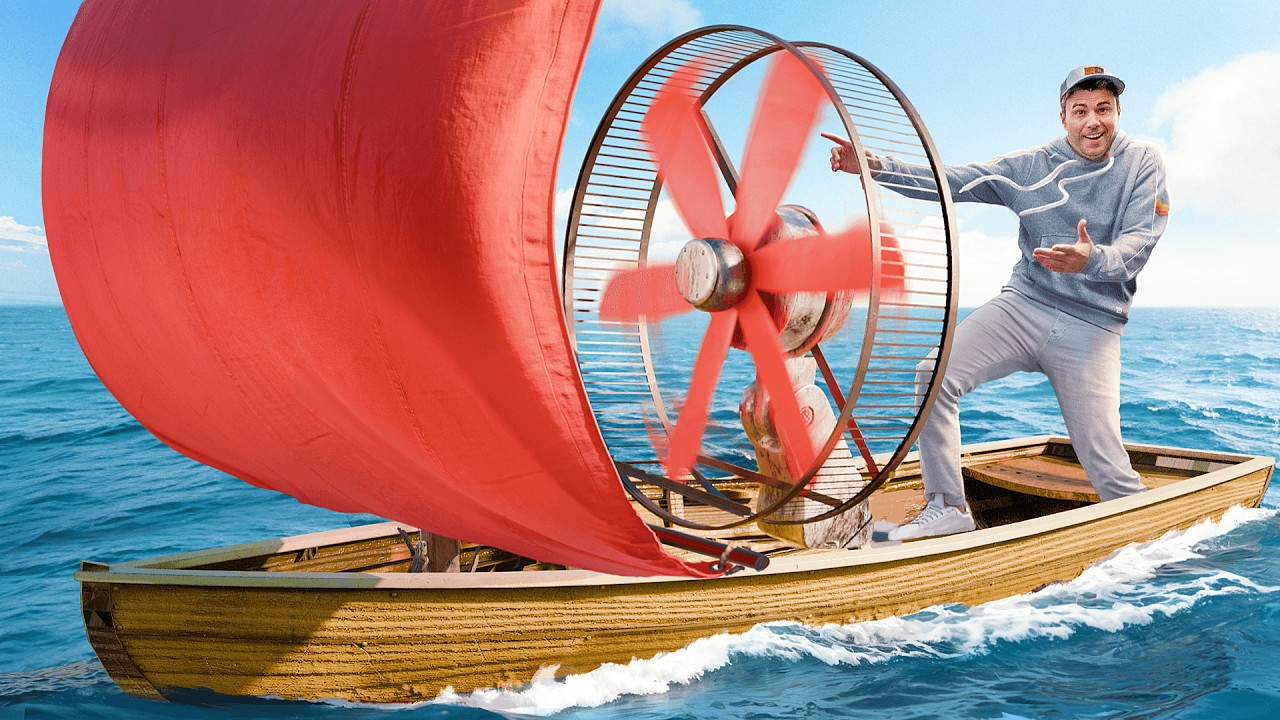
Mark Rober stood on a line painted across the ground in Ecuador, one foot in the northern hemisphere and one foot in the southern, watching a man pour water into a small basin and give the container a subtle twist at the wrist. The crowd leaned in. The water swirled. The demo looked like science. It was not. That single tourist attraction in Ecuador became the anchor for a seven-puzzle physics journey that stretched from a lake with a fan-powered sailboat to a rope long enough to circle the entire Earth, built around one stubborn idea: knowing the right answer is almost useless without knowing why it is right.
Why a balloon full of air hits harder than an empty one
The journey opens with one of those facts that sounds wrong until the demonstration makes it obvious. When Rober throws an empty balloon at a small sign, it bounces off without tipping it over. He then fills the exact same balloon with air and throws it again, and the sign goes over. The only change was adding air, which means air has mass, which means it weighs something, which means the invisible fluid around us is part of every physics equation we think we already understand.
That principle is what explains the birthday-party balloon puzzle: when a driver slams the brakes, a helium balloon in the back seat moves backward instead of lurching forward like the cake on the seat. The air in the car sloshes forward when the car stops, and because that air is denser than the helium inside the balloon, it cuts to the front and physically forces the lighter balloon backward. Rober describes it as the heavier, denser thing rudely cutting to the front of the line.
The ellipse entry carries a different kind of surprise. Any laser fired from one of the two focus points of an ellipse will always, regardless of angle, bounce off the curved wall and strike the other focus point. Rober demonstrates this with a mirrored elliptical surface, a laser pointer, and a ball of wax. The same geometry governs sound: in a full-sized elliptical room, a whisper from one focus point reaches the other with startling clarity across hundreds of feet. That room, he notes, was built inside the US Capitol, and John Quincy Adams placed his desk directly on top of one of the focus points to overhear his opponents across the hall.
The tourist demo and the GPS coordinates that gave it away
The equator demonstration turns out to be a layered debunking. The Coriolis effect is real: it is the reason hurricanes spin counterclockwise in the northern hemisphere and cyclones spin clockwise in the southern, because water near the equator moves faster with the Earth’s rotation than water closer to the poles, producing a natural rotational bias at large scales. But a standard sink is nowhere near large enough for that effect to dominate. What actually governs a small basin is residual motion in the water before the plug is pulled, and the direction of any pour.
The tourist performer, Rober found on close inspection, finishes each pour with a subtle wrist twist in the direction he wants the water to swirl, then moves the basin a few feet and twists the opposite way. As a final detail, looking up the GPS coordinates of the demonstration site places it more than a football field away from the actual equator, meaning the entire performance took place in the southern hemisphere throughout.
The rope puzzle lands as the episode’s most counterintuitive pure-math moment. To lift a rope tied around the entire Earth exactly one foot off the ground, the only additional length needed is 6.28 feet, roughly two pi, the same amount required to do the same thing around a basketball. The radius cancels out in the algebra, which means the size of the sphere is irrelevant. Rober makes the algebra visible by replacing the circle with a square: raising a square rope one foot at each corner adds exactly two feet per corner, eight feet total, and a square TV produces nearly the same answer.
The floating backpack and the cadence problem
Rober ordered a floating backpack from a Kickstarter campaign that claimed to reduce impact forces by 80 to 90 percent by suspending the load on an elastic track, letting a hiker’s body bounce up and down while the pack stays relatively still. After hiking several miles comparing it directly against a standard backpack loaded with the same weight, his verdict was specific: ‘If you hit the right cadence, it’s magical. If it’s not the right cadence, it’s the opposite of magic.’ On flat, predictable ground, the suspension system can help. On rough or variable terrain, the out-of-sync rocking adds instability that outweighs the benefit, plus the frame hardware adds four pounds before any gear goes in.
The fan-and-sail test, the question that opens the whole journey, closes its own loop cleanly. Rober connects a fan to a train car with a sail and demonstrates that the thrust from the fan and the resistance of the sail cancel each other out exactly, producing no movement. The viral leaf-blower-and-umbrella skateboarder, replicated exactly, also goes nowhere until Rober points out the battery compartment built into the underside of the board.
The moon, still sideways over Ecuador
At the equator, the moon appears sideways rather than right-side-up or upside-down, because a person standing there is oriented perpendicular to both poles. The geometry holds, and Rober confirms it in person.
The GPS coordinates of the tourist equator site are now public record, sitting more than a football field south of the actual line, a detail that no amount of wrist-twist artistry can move.