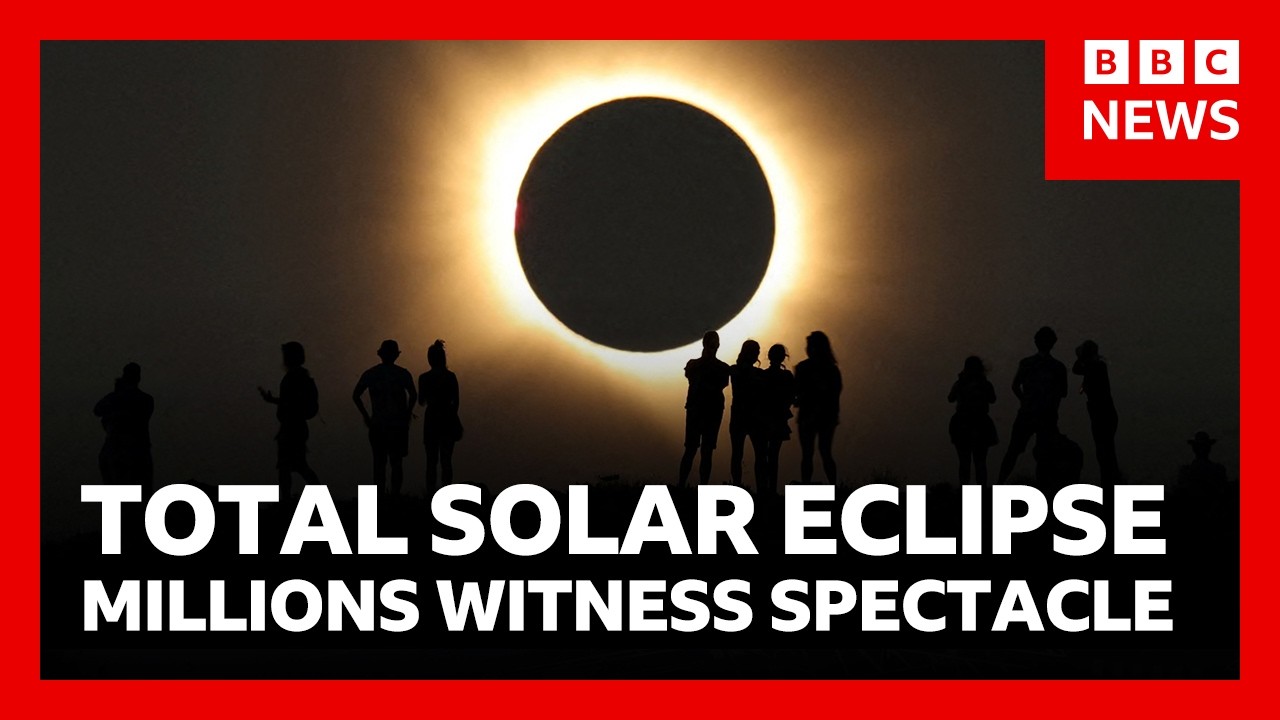
On the cliffs and beaches of Cornwall, crowds pressed together under open blue skies, tilting their faces upward through eclipse glasses as the moon began its slow, deliberate march across the face of the sun. This was a celestial event that millions across Europe had waited years to witness, and for those lucky enough to have clear skies, it delivered something far beyond what most had dared to expect. The last time an eclipse of this quality had passed over Cornwall was 1999, and that day had been smothered by clouds. This time was different.
A slow burn that kept everyone watching
The peak of the eclipse arrived in Cornwall with the moon blocking out almost 96% of sunlight. Temperatures dropped. The coastal light shifted into something strange and half-familiar, the kind of dimness that sits wrong in the body because it arrives at the wrong hour. BBC reporter Rebecca Morell, standing among the crowds at a coastal spot in Cornwall, described the sensation plainly: ‘It is just absolutely amazing to get a view like this. The lights here have dimmed. The temperature has dropped too and it is a really almost eerie feeling. It’s taken about an hour to get to this point. It really is a slow burn event, but you just can’t take your eyes off this thing. You really just want to drink every moment in.’
For spectators who had never seen anything like it, the experience landed hard. ‘I thought it was good,’ one person in the crowd said. ‘It could be a one in the lifetime and you just want to make it last.’ Another admitted they had underestimated just how much of the sun would disappear. A third, experiencing their first-ever eclipse, simply could not stop smiling.
Across the UK, between 88 and 96% of the sun was covered depending on location. People gathered on Calton Hill in Edinburgh, along streets in Belfast where the lights came on as midday briefly mimicked midnight, and at famous landmarks in London where the spectacle unfolded above stone and steel.
Totality over Spain and the diamond ring in the sky
For those in northern and central Spain, the experience went further. The moon shadow crossed from Galicia eastward, passing through several major cities before reaching the Balearic Islands, and for a minute or two, observers standing beneath totality saw the sun’s corona, the shimmering outer atmosphere normally invisible to the naked eye, blazing in full. At the edges, red arcs appeared. These were solar prominences, nuclear eruptions many times the size of the Earth itself.
One astronomy enthusiast watching from Burgos put it directly: ‘It is so much better live. People can look at all the photographs they want, but when you are here and you feel it and experience it, there is nothing else like it.’ Another observer, goosebumps visible on their arms from more than the cold, said it was not just a visual event. ‘This reminds us of what it is to be human, that we are a small planet in a vast cosmos.’
On the western coast of Iceland, the full eclipse descended and turned day into night entirely. In Reykjavik, the shadow arrived through the clouds. In Rome, tourists watched the sun vanish behind the stones of the Colosseum.
The children who wanted more
Back in Cornwall, once the sun had set and the crowds began to drift home, Rebecca Morell noted something specific about the young people in the crowd. The kids who had seen it wanted to see it again. They were already talking about chasing the next one.
For anyone hoping to experience this kind of coverage over the UK again, the wait is not short. The next eclipse of comparable scale over Britain will not arrive until 2081. A total solar eclipse visible from UK soil is not due until 2090.
That same night, the Perseid meteor shower was reaching its own peak, offering one more reason to stay outside with a blanket and keep looking up.