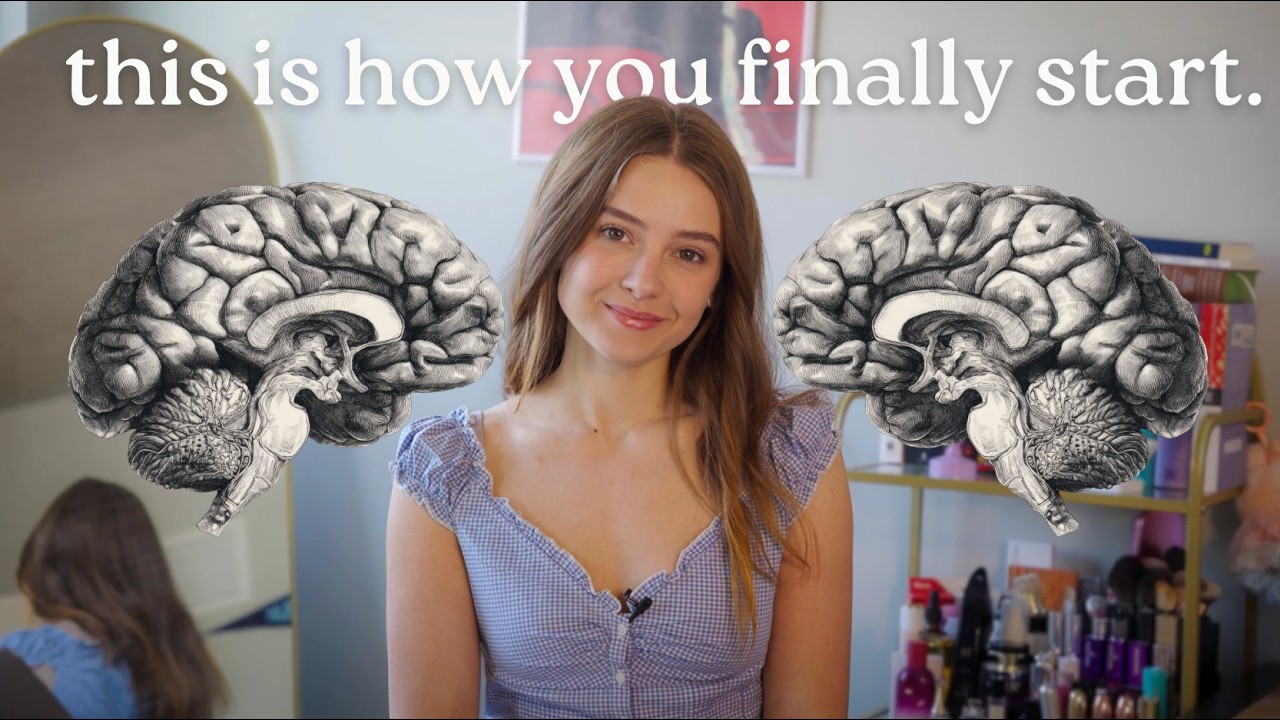
Olga Loiek had spent four years studying how the human mind works at the University of Pennsylvania before she landed on what she calls the most fascinating and most useful thing she learned. It has nothing to do with intelligence, ambition, or willpower. It has to do with a loop your brain is running on you right now, quietly, without your permission. The stakes are genuinely high: every creative project you have shelved, every application you have not submitted, every business you have read ten books about but never started, is being held in place by the same neurological mechanism. And once you see it, the fix is almost offensively straightforward.
Why your brain treats your goals like a threat
Procrastination researcher Tim Pychyl spent decades on a single question: why do people fail to do the things they promise themselves to do? His finding reframes the entire problem. Procrastination is not a time management failure. It is an emotion regulation failure.
Here is the sequence. You think about starting something important, a workout, an essay, a job application. That thought generates a negative emotion: self-doubt, overwhelm, the fear that the result will not be good enough. Your brain’s alarm system, the amygdala, reads that emotion as a threat and issues a straightforward directive: run. So you clean your desk instead. You pick up your phone. The dread dissolves and you feel relief. That relief is a reward. In psychology, behaviors that get rewarded get repeated.
Over time, your brain physically strengthens the neural pathway for avoidance. The procrastination circuit runs faster, becomes more automatic, and your discipline circuit weakens like a muscle you stopped using. Meanwhile, a second brain region, the dorsal anterior cingulate cortex, is supposed to take the fear signal from the amygdala, shut it down, and push you toward the task. When you procrastinate, the amygdala wins. Neuroscientists call this an amygdala hijack.
The loop has two disguises that make it especially hard to catch. The first is perfectionism. Research shows that more perfectionist professors actually publish fewer papers than their less perfectionist colleagues, even when controlling for how hardworking they are. Perfectionism keeps you from starting so you can never fall short. The second disguise is what Pychyl calls short-term mood repair: you swap the scary task for a safer one that still feels productive. You color-code your notes instead of writing the essay. You perfect your resume for the fifth time instead of applying. As Loiek put it directly: ‘Instead of starting a business that you’ve dreamt of starting for years, you read 10 books on how to start a business.’
The study that proved the dread is almost always worse than the task
Pychyl ran a study that illustrated the gap between anticipated suffering and actual experience. He gave 45 students pagers and contacted them eight times a day for five days leading up to an academic deadline. Each time the pager went off, students reported what they were doing, how they felt, and how they felt about the assignment. The pattern was consistent: students procrastinated on difficult tasks and replaced them with more enjoyable ones, all while justifying the delay with ‘I work better under pressure’ or ‘I’ll feel like it tomorrow.’ When the deadline finally forced them to start, not one student said they were glad they had waited. Every single one wished they had started earlier and reported the task was not as bad as they had feared.
You are not avoiding the task. You are avoiding the way you think the task is going to make you feel. And your brain is wrong about that almost every time.
The solution Pychyl arrived at after 20 years is this: just start. Not finish, not perform well, just begin for five to ten minutes without thinking about the outcome. Step one is to catch the avoidance and name the emotion you are feeling. Naming it is enough to shift you from your emotional brain back into your rational mind. Step two is to make the task stupidly small: not ‘write an essay tonight’ but ‘open the document and write for ten minutes.’ Not ‘do an hour-long workout’ but ‘put on your shoes and go outside.’ Interrupting the loop, even briefly, begins to rewire it.
A pager, a deadline, and 45 students who all wished the same thing
The pager study’s most striking detail is not the procrastination data. It is the unanimity at the end. Forty-five different students, five days of diverging choices, and when the deadline arrived, every single one landed in exactly the same place: wishing for more time they had already had.
The avoidance loop runs on a prediction your brain makes before you ever touch the task. Start for ten minutes and you give your brain the one piece of data it is missing: evidence that the prediction was wrong.