The toe bone from a baby dinosaur fits in the palm of a human hand. That single object, small enough to carry without effort, sits at the center of what paleontologists are calling the most productive era of dinosaur discovery in history. Scientists are currently uncovering roughly one new species per week on average, and each find is forcing a rewrite of assumptions that have stood for decades.
A bone bed the size of a mass grave
In Alberta, Canada, an active dig site holds what Dr. Emily Bamforth, the paleontologist in charge of the excavation, describes as one of the densest dinosaur bone beds in North America. The site contains the remains of a herd of Pachyrhinosaurus, a horned dinosaur with a large bony bump called a boss on the front of its nose, a bony frill, and horns on the back of its head. The estimated number of animals buried in a single deposit ranges from 6,000 to 10,000 individuals. Adults, teenagers, and babies are all present. The herd appears to have died simultaneously, possibly in a natural disaster such as a flood, and was subsequently buried in mud that hardened over 73 million years.
The bones are not arranged as individual animals. They are mixed together in what Bamforth calls the ‘Pachyrhinosaurus omelet,’ making the work of reconstruction unusually difficult. Putting together a dinosaur from this kind of deposit, as Bamforth describes it, is like doing a puzzle where ‘you don’t know what the picture on the front of the box is, you’re missing half the pieces, there’s pieces from other puzzles thrown in, and then the pieces sometimes are ripped and torn so they don’t fit properly.’
Among the dense scatter of bones, the team recently uncovered a rare intact skull. Touching it, Cleo noted it felt like a rock. Bamforth confirmed: ‘It basically is a rock.’ All dinosaur fossils are mineralised, meaning the original bone material has been replaced cell by cell with minerals over millions of years. What fills every museum display case is a stone replica of what was once a living animal.
The T-Rex was chunkier than anyone imagined and the Velociraptor had feathers
The physical reality of some of the most famous dinosaurs has shifted significantly. Early reconstructions of the T-Rex depicted it standing upright like a kangaroo with its tail dragging on the ground. Computer modelling later showed that posture would place too much strain on its hips, while leaning forward created a far more stable configuration. As researchers explained, the animal is now understood to be more like a teeter-totter balanced at the hips. A further revision came in 2018, when rib-like bones associated with the famous T-Rex skeleton known as Sue were re-examined and found to have floated in the abdomen, as they do in modern crocodiles. That discovery indicated the T-Rex was considerably heavier and bulkier than previous models showed, which suggests it was probably an ambush predator rather than a pursuit predator.
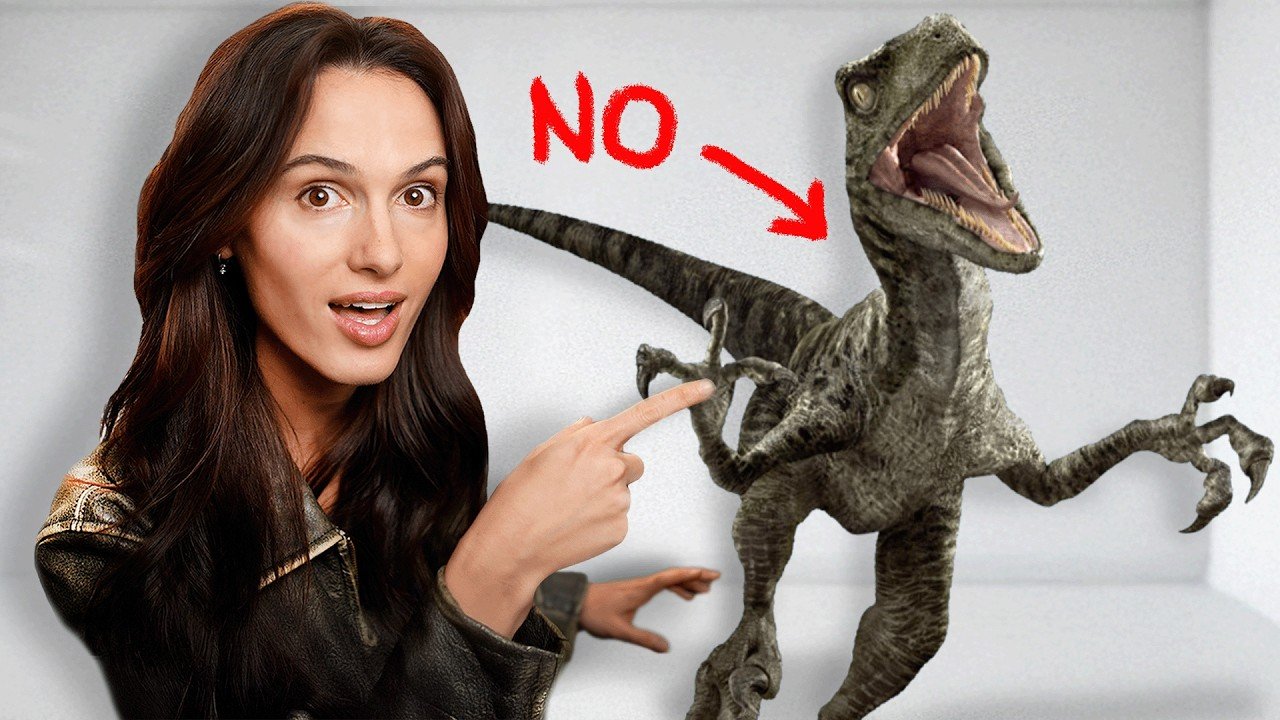
The Velociraptor has also been revised. In real life, Velociraptors were considerably smaller than their depiction in Jurassic Park. A 1998 discovery in China also confirmed that this category of dinosaur had feathers. The filmmakers of Jurassic Park were, as one researcher acknowledged, working with the knowledge available at the time: ‘The reason the Velociraptors don’t have feathers is ’cause we didn’t know that those kind of dinosaurs had feathers at the time.’ Subsequent discoveries have confirmed that more dinosaurs had feathers than previously thought. Colour remains partially uncertain, though fossilised feather pigments have revealed that some feathered dinosaurs were black and white with shiny plumage, while others carried rust or deep red tones. Some skin fossils show evidence of shading that suggests stripes existed, though the specific colours of those stripes have not been confirmed.
A broader problem in how dinosaurs have been depicted is what researchers call ‘shrink wrapping,’ the practice of illustrators placing skin directly over the skeleton without accounting for muscle, fat, or loose tissue. When the same technique is applied to a modern zebra, baboon, or hippopotamus, the results look monstrous and bear no resemblance to the living animal. Scientists and artists are now actively working to correct dinosaur reconstructions with more accurate volumes of soft tissue.
The scale of dinosaurs also spans a wider range than popular culture suggests. The Anchiornis was slightly larger than a basketball. The Compsognathus reached the size of a small chicken. The Nyasasaurus was approximately the size of a German Shepherd. The Pachyrhinosaurus was considered medium-sized among dinosaurs, while the Triceratops reached roughly the height of an Asian elephant but was considerably longer. At the far end of the scale, the Argentinosaurus was approximately as long as, and heavier than, a commercial airplane.
A common assumption about these animals is that they all coexisted. They did not. Dinosaurs ruled the Earth for 180 million years, and the species that are most familiar to modern audiences were spread across that enormous span of time. As one researcher noted: ‘There is more time that separates Stegosaurus from T-Rex than separates T-Rex from us.’ The Stegosaurus was an ancient relic by the time the T-Rex existed.
The definition of what counts as a dinosaur has also expanded in ways that most people have not encountered. Pterosaurs, Mosasaurs, Plesiosaurs, and Ichthyosaurs are not dinosaurs by scientific classification, despite living in the same era. Crocodiles, which were alive at the time, branched off earlier and are also excluded. What does qualify, by the phylogenetic definition, is birds. Birds are not the descendants of dinosaurs. They are dinosaurs, a distinction scientists are careful to make. Dinosaurs are not extinct.
The extinction event that ended the reign of the large non-avian dinosaurs began 66.04 million years ago. A rock wider than Mount Everest is tall, travelling at between 20 and 30 kilometres per second, struck the Earth and vaporised on impact while launching debris beyond the atmosphere. The immediate consequences included a thermal pulse, a wave of heat, and mega-tsunamis. The longer-term consequence was a planet-wide dimming as ejecta blocked sunlight, killing plants and collapsing the food chains that depended on them. The animals that survived were, broadly, small ones at or below the size of a German Shepherd, or those with access to water or underground shelter. As one researcher observed: ‘ultimately a bad day on planet Earth for the dinosaurs but a really great day for mammals.’
Almost half of all known dinosaur species are currently represented by a single specimen, many of them incomplete. New species continue to arrive at roughly one per week. The warehouse laboratories connected to dig sites like the one in Alberta hold tyrannosaur teeth with serrated edges still sharp enough to suggest their purpose, and bones that show evidence of healed fractures and what researchers believe may be osteoarthritis or bone cancer, physical records of individual lives lived across millions of years.
The moment Cleo almost chipped through a cross-section
Working horizontally at the Alberta dig site, following the two rules Bamforth’s team uses, Cleo found what appeared to be bone fragments just below the surface. A nearby researcher pointed to a section that had gone unnoticed and explained the identifying feature: small white specks in the interior texture, the porous cross-section of fossilised bone rather than its outer surface. The visitor had been about to scrape directly through it.
The bone was covered in a protective paste, left to dry, and brought back to the lab for cleaning. Under preparation, its surface revealed the shiny chocolate-brown colour that distinguishes a fully cleaned fossil. That same preparation process, replicated on thousands of specimens across dozens of countries, is gradually building out a picture of animals that ruled the planet for 180 million years, long before the toe bone of a single baby Pachyrhinosaurus ended up in a human hand in Alberta.
Source: Watch original
This article was reported in June 2026.
OHN Editorial Note: This article is based on publicly available sources. If you spot an error or have updated information, contact us at editorial@onlyhappynews.com. We correct mistakes promptly.