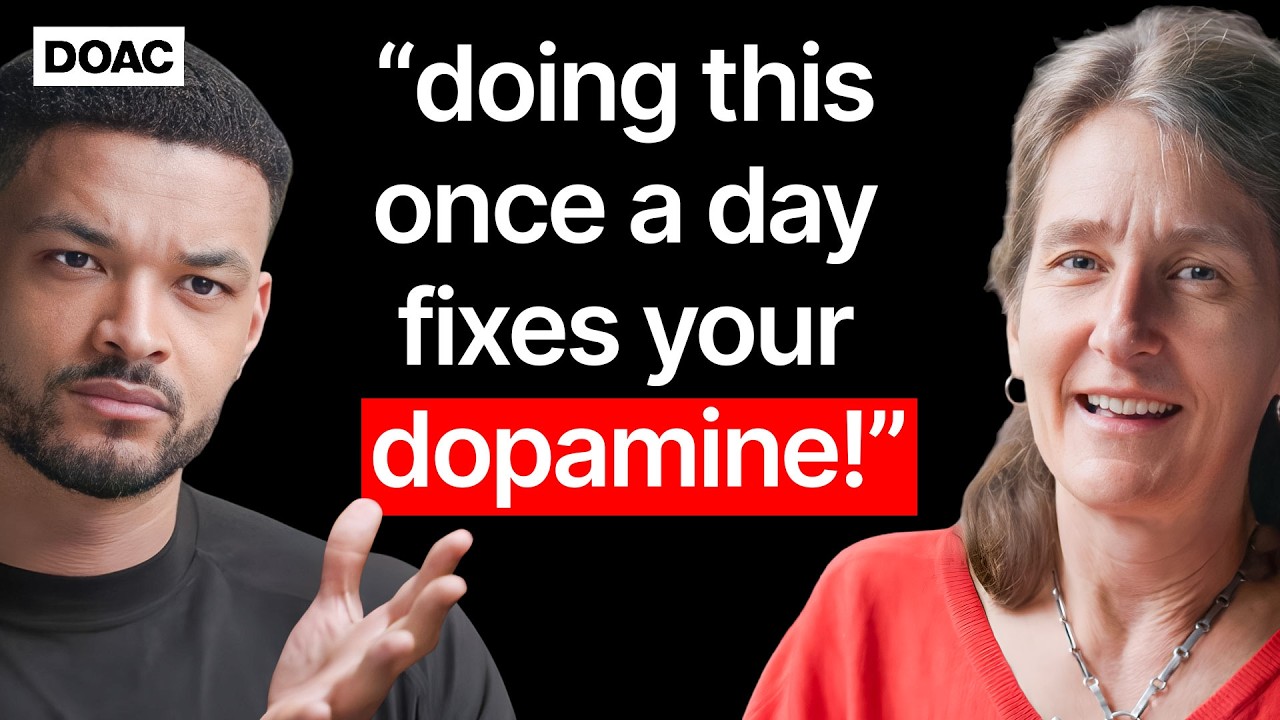
There is a famous experiment in which rats were engineered to have no dopamine in their brain’s reward pathway. Scientists found that if they placed food directly in the rat’s mouth, it would eat. But move that food even a body length away, and the rat would starve to death. Dr. Anna Lembke, Professor of Psychiatry at Stanford and chief of the Stanford addiction clinic, opens with that image for a reason: it places the stakes of the conversation in the body before they reach the mind. Dopamine, she explains, is not primarily a pleasure chemical. It is a survival chemical, the force that motivates every organism to move toward the things it needs. Understanding what happens when that system goes wrong, and how to fix it, is the work that has consumed most of her career.
How a bottle of whiskey on a set of scales explains addiction
Sitting across from the interviewer with a physical balance scale between them, Lembke uses three bottles of alcohol to demonstrate what neuroscience has been quietly establishing for 75 years: pleasure and pain are processed in the same parts of the brain, and they work like opposite sides of that scale. Pour alcohol into the pleasure side, dopamine floods the reward pathway, the scale tips. But the brain, always chasing what it calls homeostasis, immediately sends what Lembke calls ‘gremlins’ to hop onto the pain side and bring it level again. The problem is those gremlins overshoot. They stay on the pain side past the level point, pressing it down into discomfort. That is the hangover. That is the come-down. That is the craving for one more.
Repeat that cycle across days, months, and years, adding in pornography, social media, sugar, and cannabis alongside the alcohol, and the gremlins never leave. They camp out on the pain side permanently. The brain’s reward threshold shifts. Now a person is not drinking to feel good. They are drinking just to feel normal, chasing a level position their brain no longer reaches on its own. Brain scans taken two weeks after people stopped using cocaine, methamphetamine, alcohol, and heroin showed almost no dopamine transmission in the nucleus accumbens, the brain’s primary reward hub. Their brains were in a chronic dopamine deficit even after they stopped.
Lembke is careful not to let the mechanism become an excuse for paralysis. The same scale that works against addicts, she points out, works in their favor when pressed from the other direction. Cold water immersion, intermittent fasting, and exercise all push down on the pain side first. The gremlins then hop onto the pleasure side to compensate. Dopamine rises gradually during exercise and stays elevated for hours afterward without ever crashing below baseline. ‘Movement as medicine,’ she calls it, and she means that literally, not as a slogan.
The 30-day reset and why 14 days is not enough
For anyone caught in a compulsive loop, whether the substance is pornography, gaming, sugar, or romance novels, Lembke recommends a 30-day dopamine fast from that specific behavior. Not from dopamine itself, which is impossible, but from the trigger. Two weeks, she explains, is not enough. The imaging data shows the brain is still deep in deficit at that point. Clinical experience across many practitioners places the turning point at around 30 days, when cravings begin to lift and the idea of a different life starts to feel imaginable rather than theoretical. She is direct about the early stretch: ‘You will feel worse before you feel better, but that is withdrawal-mediated suffering.’ The first 10 to 14 days map almost exactly onto the timeline for those brain scans to begin showing dopamine recovery.
She adds two firm warnings. Anyone whose drug of choice carries a risk of medically dangerous withdrawal, specifically alcohol and benzodiazepines, should not attempt this without a physician. And anyone who has repeatedly failed to quit alone should seek professional help rather than treating this as another individual willpower challenge.
Lembke shared her own version of the fast after she developed what she now recognizes as a genuine addiction to erotic romance novels. She had graduated to a Kindle, which removed the social friction of being seen with a physical book, and became what she calls a chain reader, moving from one novel to the next the way a smoker lights a new cigarette from the last. She hid her reading behind other books when her family entered the room. The first 24 hours without the novels produced anxiety and complete insomnia. She had, she realized, fully unlearned how to fall asleep without a digital narrative running. By weeks three and four, her work felt interesting again. Her children felt present again. The world had color it had lost without her noticing.
A word she keeps coming back to
Lembke’s clearest practical tool is what she calls self-binding: creating physical and structural barriers between yourself and your drug of choice before desire arrives, not during it. A kitchen safe for a phone. Alcohol out of the house. A drug dealer’s number deleted, with a message not to call. ‘If we rely on willpower alone,’ she says, ‘we will not be successful, especially living in this drug-enriched world.’ The barriers are not weakness. They are strategy.
The patient who found a way around sobriety
One of Lembke’s cases never left her. A woman with severe alcohol addiction achieved genuine sobriety, then discovered that drinking enormous quantities of water could lower her blood sodium enough to induce delirium. She had found a path to dissociation that did not involve alcohol. The case illustrates something Lembke returns to throughout: the brain that has learned to reach for relief will find a route, any route, when the original one is closed. The woman later took her own life.
The addiction was never really about alcohol, or water. It was about pain, and the overwhelming physiological drive to escape it long enough to breathe.
 Wake up to Only Happy News!