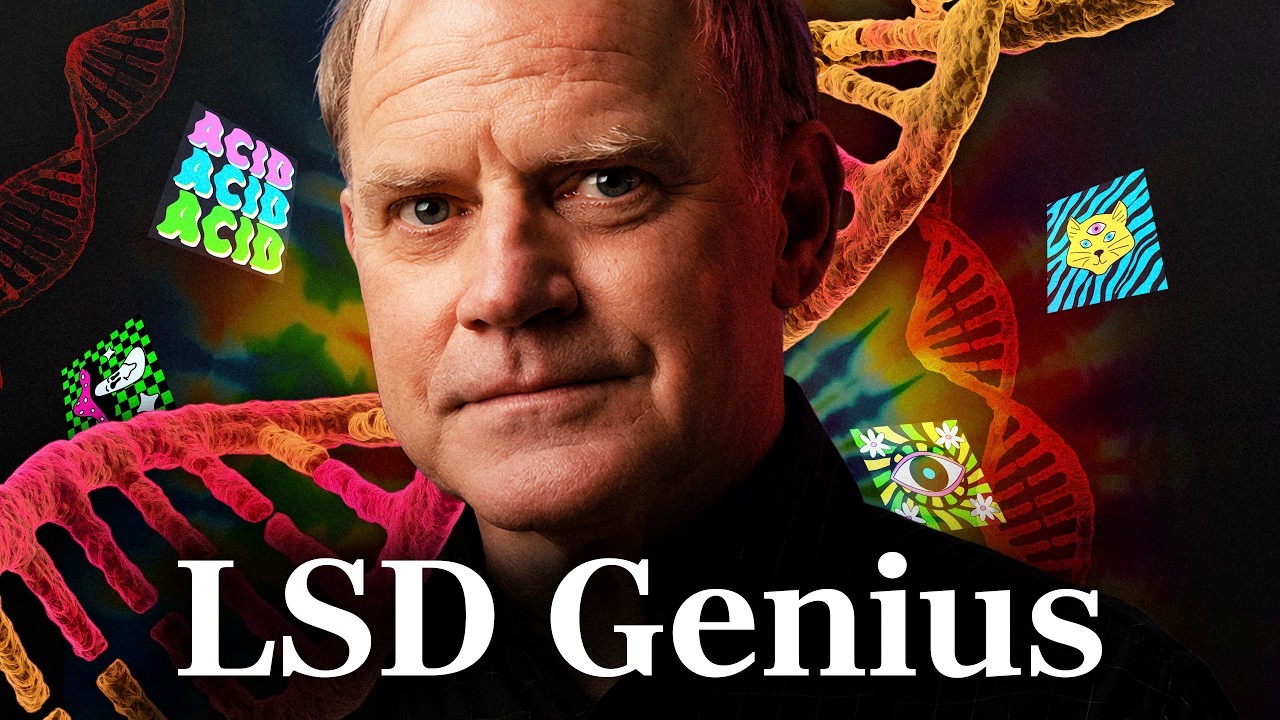
On a Friday night drive through the California mountains in the spring of 1983, Kary Mullis let his mind drift away from the road and into the structure of DNA itself. What happened next would eventually free hundreds of wrongfully convicted prisoners, reunite families separated by war, and form the backbone of every COVID test administered during a global pandemic. It began not in a laboratory, but behind a steering wheel, with a gas station receipt and a racing mind.
The bored chemist with too many DNA snippets
Mullis arrived at Cetus Corporation, one of the first biotech companies in the world, not through a formal recruitment pipeline but through a chance encounter at a bakery. A colleague named Tom White walked in one day, struck up a conversation, and recommended Mullis to his superiors with an unusual endorsement: ‘Hire this guy Mullis, he’s an excellent synthetic chemist. I knew he was a good chemist because he’d been synthesizing hallucinogenic drugs at Berkeley.’
At Cetus, Mullis was assigned the least glamorous task in the building: manufacturing short snippets of DNA called probes, the same radioactive bits used as molecular detectives inside a technique known as the Southern Blot. The Southern Blot could theoretically detect a single genetic mutation, like the one responsible for sickle cell anemia, buried inside six billion letters of DNA. Mullis once described the challenge as reading a license plate on Interstate 5 in the dark from the Moon. The test worked, but it took days, required technicians to handle radioactive materials at every step, and was nowhere near commercially viable.
Then the machine arrived. A new synthesizer automated the probe-making work that had consumed Mullis’s days, completing roughly a month of his output in a single day. Suddenly he had free time, a stockpile of DNA snippets, and very few colleagues willing to spend lunch with him. So he started taking weekends at a cabin in Mendocino County.
The idea that arrived between the mountains and his eyes
Driving north that Friday night, Mullis was turning the sickle cell problem over in his mind when the answer arrived in a form that felt almost physical. He described it afterward: ‘Blue and pink images of electric molecules injected themselves between the mountain and my eyes.’ He pulled over and scrawled the core of it on the back of a gas receipt.
The insight was deceptively simple. Instead of building a more powerful way to detect a single copy of a DNA sequence, he would make a billion copies of it. By heating DNA to unzip its two strands, then introducing short synthetic primers designed to flank a target region, then using a naturally occurring protein called DNA polymerase to extend those primers across the target, he could produce two copies where there had been one. Repeat the cycle and those two become four, then eight, sixteen, thirty-two. After thirty cycles: more than a billion identical copies of that one specific segment. He called it the polymerase chain reaction, or PCR.
Back at Cetus on Monday, his colleagues were skeptical. They had heard his ideas before. Several left the room before he finished presenting. The objection that stung most was not that the idea was wrong, but that it seemed too obvious: it had to have been tried already.
It had not. But proving it would take two more years and a team Mullis could not have managed alone. After months of inconclusive results and at least one fist fight with a colleague, Mullis was placed on a one-year probationary period. Tom White, Norman Arnheim, and Henry Ehrlich assigned additional scientists to the project. By spring 1985, the group had definitive proof that PCR worked, and their new sickle cell diagnostic method ran in under ten hours.
One obstacle remained. Every cycle required heating the sample to 95 degrees Celsius to unzip the DNA, which destroyed the E. coli-derived polymerase being used. A technician had to manually add fresh polymerase at each of thirty cycles, making the process expensive and exhausting. The solution had been sitting in a database for sixteen years.
In 1964, a microbiologist named Tom Brock visited Yellowstone National Park and noticed that the boiling hot springs were producing vivid yellows and oranges that looked biological. His undergraduate student, Hudson Freeze, spent four days collecting samples and checking test tubes before something finally appeared growing at the bottom. ‘I still get goosebumps,’ Freeze recalled. ‘I looked at it, and here are all these worms just crawling around. I thought, my god, I’m the first person in the world that ever sees this.’ The organism was named Thermus aquaticus, or Taq, and its enzymes were adapted to function at temperatures that would destroy almost any other biological molecule.
Mullis found the Brock and Freeze publication and immediately recognized what it meant. The team isolated the polymerase from Taq and ran a PCR cycle with it. David Gelfand, the Cetus scientist who purified the new polymerase, described the result: ‘It worked like a charm. It worked better than anything we have ever fantasized. The holy grail had been achieved.’ Taq not only survived the heat, it performed better at high temperatures, because the primers would only bind to their exact target region, eliminating the messy background noise that had plagued earlier attempts.
The billion-copy machine that reshaped everything
PCR spread into every corner of biology almost immediately: DNA cloning, cancer detection, HIV diagnosis, vaccine development, forensic analysis. Hundreds of wrongfully convicted people were freed. Families separated by war were reunited using DNA matches that would have been impossible before. Scientists attempted to apply PCR to ancient DNA recovered from insects preserved in amber. And in 2020, PCR tests became the primary tool for diagnosing COVID-19 across the world.
In 1993, Mullis received the Nobel Prize in chemistry for the invention, an honor that arrived alongside fierce private criticism from the colleagues who had spent years turning his roadside idea into a working machine. As Henry Erlich remarked, ‘To Kary, rewriting history was more important than writing papers.’ Mullis left Cetus shortly after the technology matured and, by his own trajectory, largely stopped practicing science. He died in August 2019 at the age of 74.
The gas receipt in the glove box
Somewhere in the archive of a Friday night in 1983, there is the back of a gas receipt covered in handwriting: primers, polymerase, exponential copies, a chain reaction sketched in the dark on the side of a mountain road.
The mountains that night did not change. The receipt did.
The world followed.