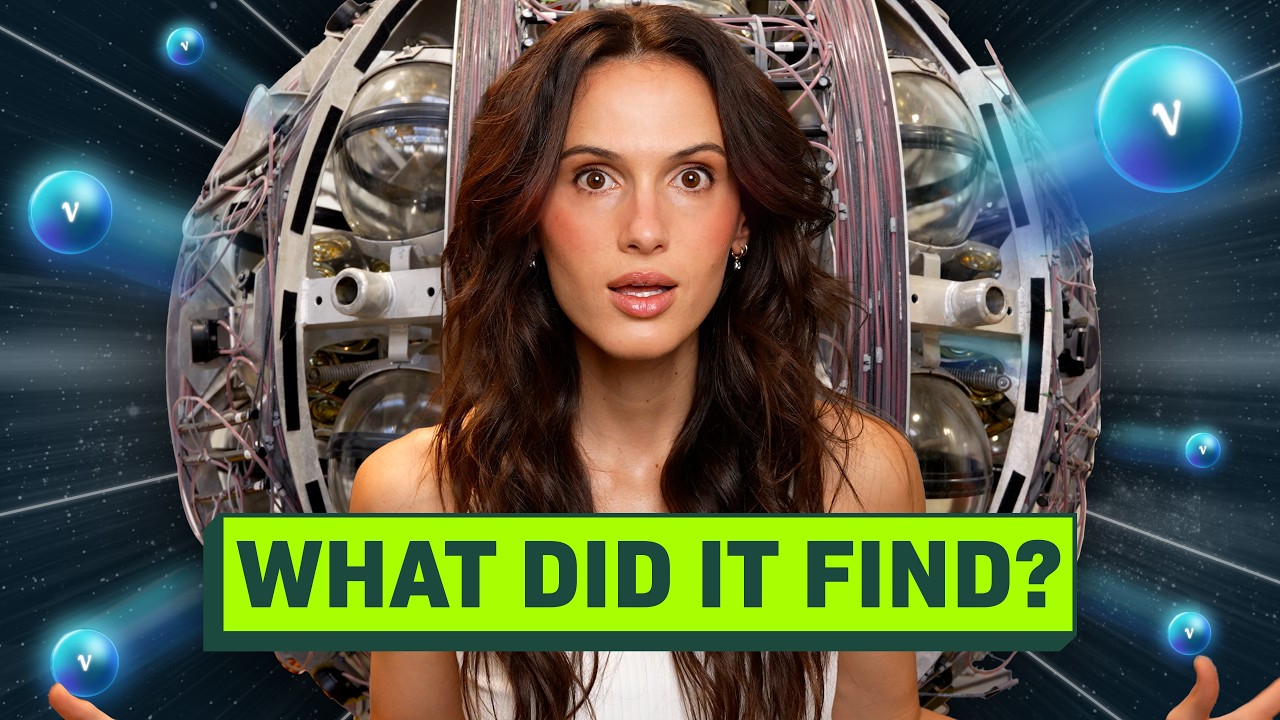
Off the coast of Sicily, 3,500 meters beneath the surface of the Mediterranean Sea, more than 900 glass spheres hang in the dark on long strings, unrolling to nearly twice the height of the Empire State Building. They drift there silently, waiting for something that passes through planets without slowing down, something that travels billions of light years in a straight line and almost never bothers to stop. Every second, 100 trillion of these particles, neutrinos, pass through your body. Hold up your thumb. That is happening right now. The challenge facing a global team of physicists is not finding more of them. It is catching even one.
Neutrinos are, by almost any measure, the strangest objects in physics. If you scaled a single neutrino up to just one millimeter in size, a human being would be roughly the size of an entire galaxy. Their nickname is the ‘ghost particle’ because they pass through basically everything: stars, planets, walls, and people. That invisibility is exactly what makes them scientifically priceless. Light gets blocked and warped on its way across the universe. Cosmic rays get tossed around by magnetic fields. Gravitational waves can tell scientists that something massive happened, but not what it was made of or what it did. Neutrinos carry none of those liabilities. They travel in a straight line, carry no charge, and arrive telling scientists precisely where they came from and what made them.
Inside the lab where they build the eyes of the deep
In Caserta, Italy, technicians assemble the detectors by hand. Each sphere is called a DOM, and it is fitted with 31 photo multipliers, sensors sensitive enough to detect a single photon. The comparison that lands hardest: standing in the middle of a hurricane and hearing one raindrop hit one leaf. The DOMs are loaded onto strings, the strings are spooled into large balls called LOMs, and then the whole assembly is lowered into the sea. From the base of each string, orange cables run all the way to the shore, where a repurposed abandoned winery now houses the computers that watch for something extraordinary.
What those sensors are actually looking for is not the neutrino itself. ‘We actually cannot see neutrino,’ as one of the scientists on the floor in Caserta put it plainly. What they can see is the aftermath. When a neutrino by sheer statistical chance collides with a proton inside a water molecule, it converts that proton into a heavier particle, which then tears through the water faster than light travels in water. The result is a cone of blue light, a phenomenon that works exactly like a sonic boom, just with light instead of sound. Those faint, fast flashes are what 4,000 DOMs at the bottom of the Mediterranean are listening for.
What they found when the machine finally spoke
In 2017, the sister experiment buried in Antarctic ice, IceCube, detected a high-energy neutrino and triggered telescopes worldwide to pivot in the same direction. They found a blazar, a flaring active galaxy more than 4 billion light years away, and confirmed for the first time that it was a cosmic engine: a source of cosmic rays and of the heavy elements that make up everything, including the iron in human blood. The paper announcing that discovery carried nearly a thousand authors. In 2022, IceCube looked inside an active galaxy roughly 50 million light years away whose core was completely hidden behind gas and dust. Light could not escape it. Neutrinos could, and did, giving astronomers the first ever look inside a cosmic engine that no other tool could have opened.
Then in 2023, KM3NET recorded the most powerful signal ever seen from a particle of its kind, something far smaller than an electron arriving at nearly the speed of light, triggering a response roughly 30 times stronger than anything previously recorded. Telescopes swung toward the source. They found nothing. The origin remains unknown.
The factory worker who builds windows into the universe
On the assembly floor in Caserta, one of the technicians fitting DOMs by hand mentioned, almost in passing, that he was a factory worker before joining the project. The fact settled quietly over the room.
KM3NET is still years from full capacity, and IceCube has been operational for over a decade. Together they cover opposite hemispheres of the Earth, each catching the neutrinos the other cannot see, completing each other across a distance of roughly 13,000 kilometers of rock. What began as a search for the most elusive particle in physics has become something else: a fourth way for humanity to read the universe, one blue flash at a time.