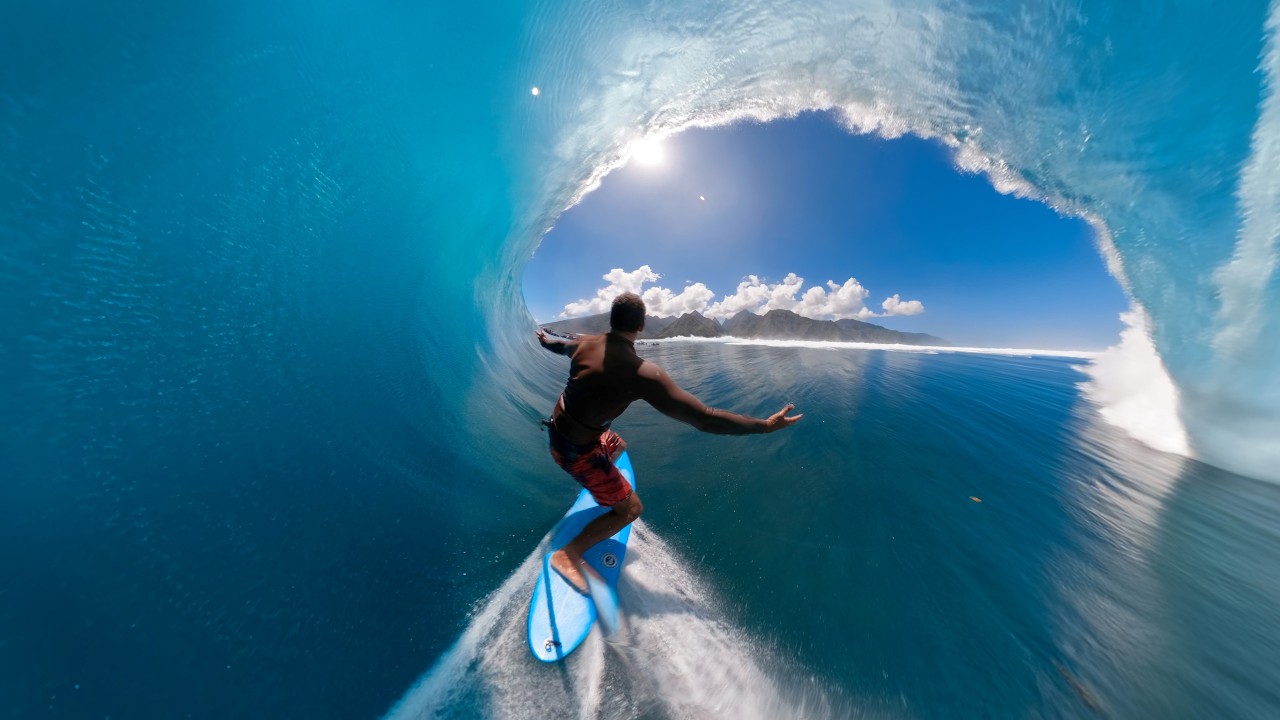
At 6:00 a.m. on a Tahiti morning, surf legend and GoPro athlete Terrevor David was already strapping a 360-degree camera to his chest while perfect barrels stacked up at Teahupo’o, one of the most powerful waves on the planet. For the millions of surfers who dream of waves they will never ride, Teahupo’o occupies a specific category: the wave you do not want to surf, but desperately wish you could see. Chris Rogers was there to close that gap, armed with a piece of gear and a technique that makes the footage feel, in his own words, ‘like a real life video game.’
The assignment was straightforward in theory. Document a single day at Teahupo’o from Terrevor’s perspective, using the GoPro MAX2 paired with a body harness from the Sale Video System. The harness angle, however, created an immediate practical problem: the shutter was slightly out of reach. Rogers solved it by fitting Wi-Fi remotes to Terrevor’s wrist so he could trigger recording without breaking focus or risking a wipe-out fumble.
Why a laptop ended up on a boat at one of the gnarliest waves in the world
Filming at Teahupo’o introduced a logistical wrinkle that most camera operators never face. Every time Terrevor caught a wave and paddled back, he handed the MAX2 directly to Rogers, who swapped memory cards and immediately backed the footage to a laptop sitting on the boat. The reasoning was blunt: if a camera went missing or a card was lost in that water, the footage was already safe on shore. ‘This is not usually the type of scenario I bring my laptop out in,’ Rogers noted, ‘but you don’t want to lose any epic footage.’
Beyond card management, the 360 format brought a second technical fight: water drops on the lenses. A single bead of water can render a shot unusable, and at Teahupo’o the camera is submerged repeatedly. Rogers’s fix was counterintuitive. He burns off the lens’s hydrophobic coating by applying dishwashing soap or saliva, letting it set, then licking both lenses and dunking the camera once before entering the water. The result is a surface that sheds water cleanly rather than holding it.
The point-of-view shot almost nobody on earth will ever replicate
The body harness covered the wide surfer’s-eye view, but Rogers wanted something tighter: exactly what Terrevor sees while he is standing inside a barrel. For that, he mounted a standard GoPro on a bike mount positioned at head height, giving viewers a locked, intimate perspective from inside one of the most coveted positions in surfing. It is, Rogers pointed out, a vantage point ‘very few people will ever get to experience.’
Once the surf sessions wrapped, the crew spent two additional days exploring Tahiti and a neighboring island, picking up landscape footage with Terrevor as a local guide through his own home waters. French Polynesia left a clear impression on Rogers, who described it as ‘truly one of the most beautiful places I’ve ever traveled to.’
A memory card swap in the middle of the Pacific
Terrevor surfacing after a set wave, pulling the MAX2 from the harness and paddling it directly to the boat, while Rogers readied a fresh card and the laptop screen reflected open water.
Teahupo’o became the centrepiece of the 2024 Paris Olympic Games surf competition despite sitting thousands of miles from France, in the middle of the Pacific Ocean. On the morning Rogers and Terrevor paddled out, none of that context was visible from the channel. What was visible was a six-foot wall of moving water, a wrist-mounted remote, and a camera pointed at the inside of something most people will only ever watch from a boat.