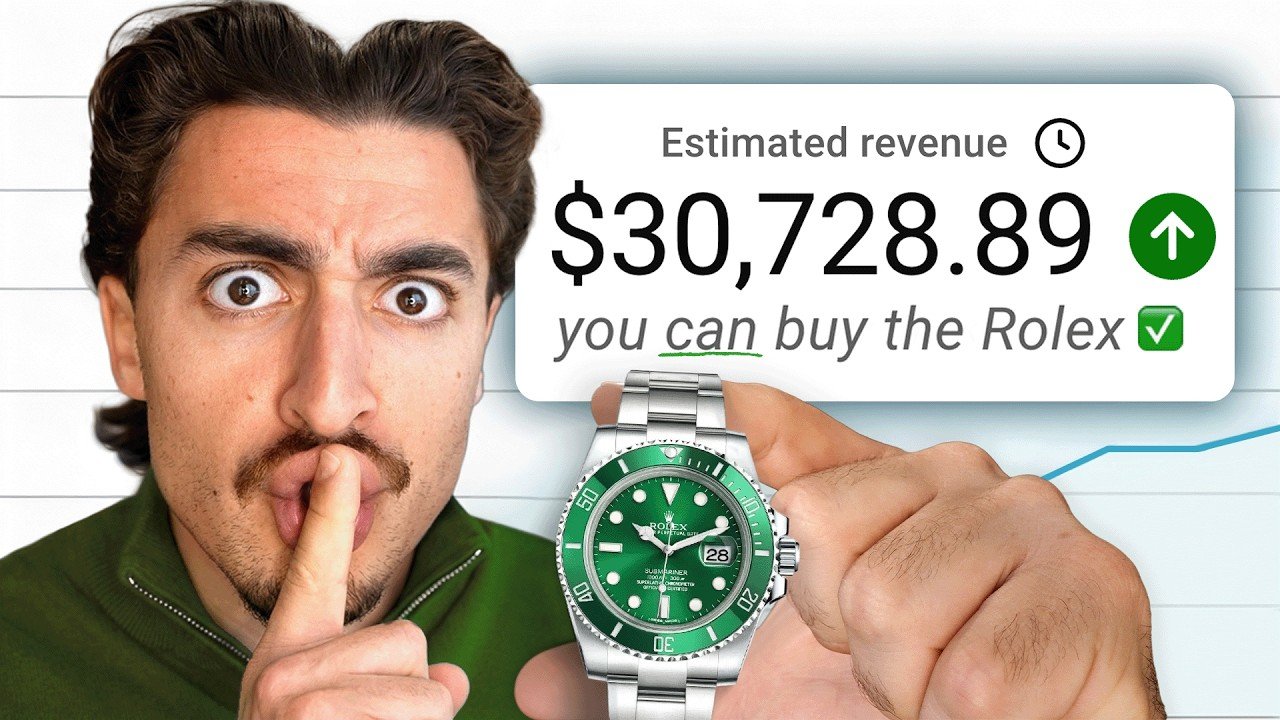
The Rolex was already gone before the plan even started. About a month before posting the first video on a brand-new channel, the creator had smashed his watch and dropped it off at Rolex for repairs, only to be told the process would take 10 weeks. That timeline lit a fuse. The goal became simple and slightly absurd: build a faceless YouTube channel from zero and earn $20,000 to buy a replacement before Rolex could fix the original. What followed was 6.5 weeks of late nights, one catastrophic-looking RPM glitch, and a crash course in how YouTube actually treats brand-new channels.
Picking a niche, building a team, and uploading into the void
The channel needed a name, a strategy, and people to execute it. The celebrity niche won out immediately because it borrows attention that already exists, requiring less upfront investment than almost any other content category. The name that cleared the bar for memorability, alliteration, and sheer ridiculousness: Daddy Dairo. Rather than starting a fresh account, the creator dug up a channel he had made as a teenager, reasoning that an aged account carries more trust with YouTube’s algorithm even at zero subscribers. A caricature-style logo was pulled together in Photoshop, and the channel was dressed and ready.
Two people filled out the production team. Luigi, a childhood best friend, handled the scripting. Kevin handled the editing. The workflow ran in a clean relay: video idea to Luigi, script back for review, voiceover recorded, the whole package handed to Kevin for the edit, and then a thumbnail cooked up before upload. The first three video concepts were chosen after scanning hundreds of channels and tracking view counts: impressions done in front of the actual celebrity subject, anything featuring Robin Williams, and Jim Carrey content in a similar vein.
The first video went up and immediately behaved like no first video should. Sixty thousand views overnight on a channel with no subscribers and no history. Watch time hit 17,000 hours in a single night, well past the 4,000-hour threshold needed to apply for monetization. The subscriber count, though, sat at just 158, far short of the 1,000 required. A second video followed with a hard push for subscriptions, and exactly two weeks in, the channel crossed 10,000 subscribers. Monetization was applied for and approved in four hours, a first in six years of running faceless channels.
A 5-cent RPM, a near-collapse, and then $871 in a single day
The first revenue figure was brutal. At 1.3 million views, the dashboard showed an RPM of five cents, producing $19.34. As he put it bluntly: ‘With a 5 cent RPM, to buy the Rolex, we’d need like 100 million views.’ Motivation collapsed. He left the analytics untouched for four days. When he came back, the number had corrected itself and the channel earned $871 in a single day, followed by $829, then $678, then $574, then $229 as the initial spike leveled off.
Views eventually slowed on newer uploads. His theory, drawn from building multiple channels over the years, is that YouTube gives early creators a deliberate boost and then pulls it back to test whether they will keep working. He uploaded six more videos over the following three weeks. Some flopped. Some landed. On April 21st, 2026, with the channel’s first video having gone up on March 5th, the total cleared $21,000. After paying Kevin and Luigi, the profit stood at just over $13,560, roughly $7,000 a month in net earnings built inside 6.5 weeks.
An offer of $19,000 went in on a Rolex found in perfect condition. It was accepted.
The watch sitting on a bedside table it took six weeks to earn
The Rolex arrived clean and unscratched, the kind of condition that made it hard to set down. He mentioned he would probably sleep with it on his bedside table because he could not stop looking at it.
Somewhere across town, the original broken watch was presumably still waiting in a Rolex repair queue, right on schedule.