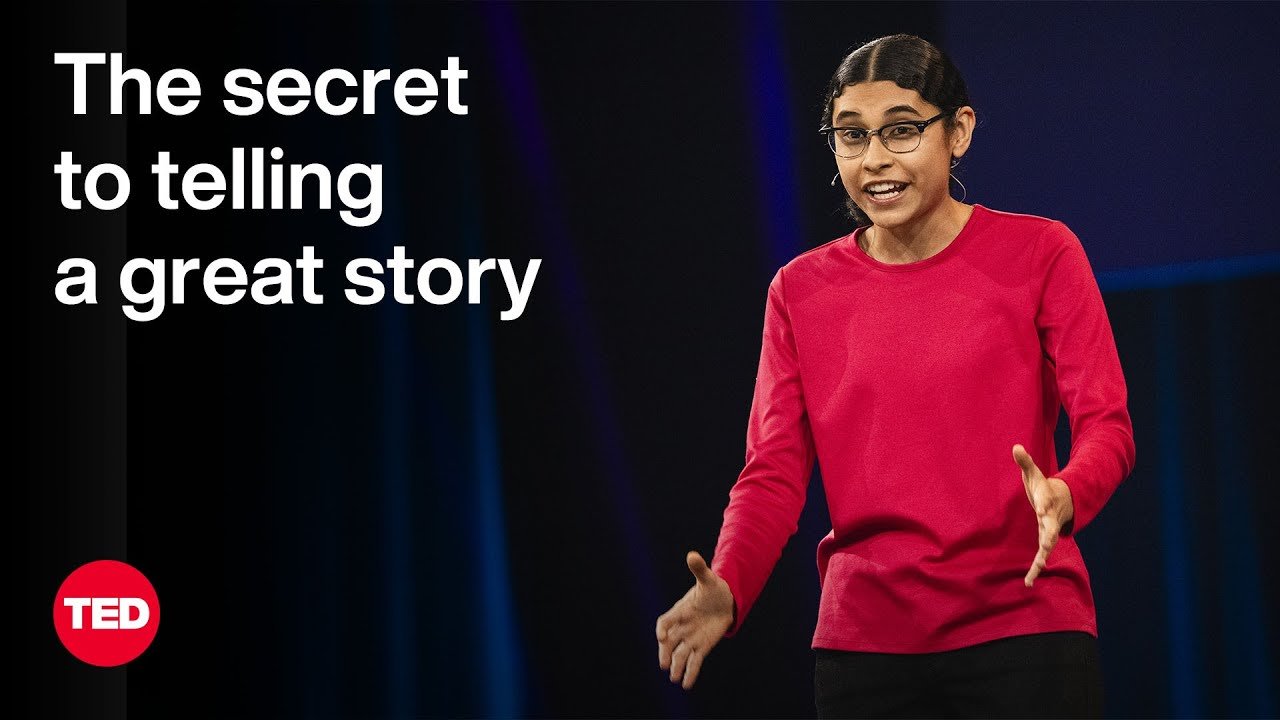
Jenny Hoyos was cutting tomatoes in the passenger seat of her mother’s car, a raw patty sizzling on a portable cooker, while the drive-through line crept forward one car at a time. The stakes were absurd, but 45 million people watched anyway, because the structure underneath the chaos was anything but accidental. What Hoyos had built was a repeatable storytelling engine, and she laid it out in just four minutes on stage, one minute under her own allotted time.
Start with a question nobody asked but everyone wants answered
Hoyos opens every story with a question, not because the question is profound, but because it creates a gap the audience physically cannot leave open. Her fast-food experiment started simply: is fast food actually as fast as it claims? Ridiculous on its surface, irresistible in practice. The opening moment showed her in the drive-through line before she had even started cooking, which meant the audience immediately understood the finish line and wanted to see whether she would reach it.
From there, the story moves in a straight line toward the answer, never looping back or stalling. Hoyos describes this as ‘constant progression,’ the sense that every new second is bringing the audience closer to resolution. In the burger video, each ingredient added to the patty functioned as a visible countdown: tomatoes sliced, cheese ready, lettuce waiting. The viewer always knew exactly how far away the answer was.
Conflict is not drama for its own sake, it is what makes the answer matter
Smooth sailing, as Hoyos put it on stage, makes nobody care. So she introduced her mother as what she called the B plot. While Hoyos focused on the cooking competition, her mother was reacting in real time: warning about smoke inside the car, questioning whether the burger was raw, threatening to move the car before the patty was done. The audience was now tracking two things simultaneously: would the burger beat the drive-through, and would the car survive the experiment.
The tension peaked when the drive-through line began moving before the burger was finished. Her mother’s voice: ‘We’re moving, we’re moving.’ Hoyos: ‘No, my burger is not done yet.’ Then the window. Then the reveal.
As Hoyos acknowledged afterward with characteristic directness: ‘Does it matter that my burger was basically raw? Absolutely not.’ The viewers wanted an answer. She gave them one quickly and concisely.
Jenny Hoyos at the window
A raw burger on a portable cooker, pulled up to the drive-through window just ahead of the restaurant’s own order.
The framework Hoyos described, question, progression, conflict, answer, is the same one she used to build a library of videos about cheap airport snacks and dollar-store ice cream quantities. The burger experiment was never really about the burger. It was proof that if a story takes longer to tell than it does to make the thing at the center of it, something has gone wrong in the kitchen.
 Wake up to Only Happy News!