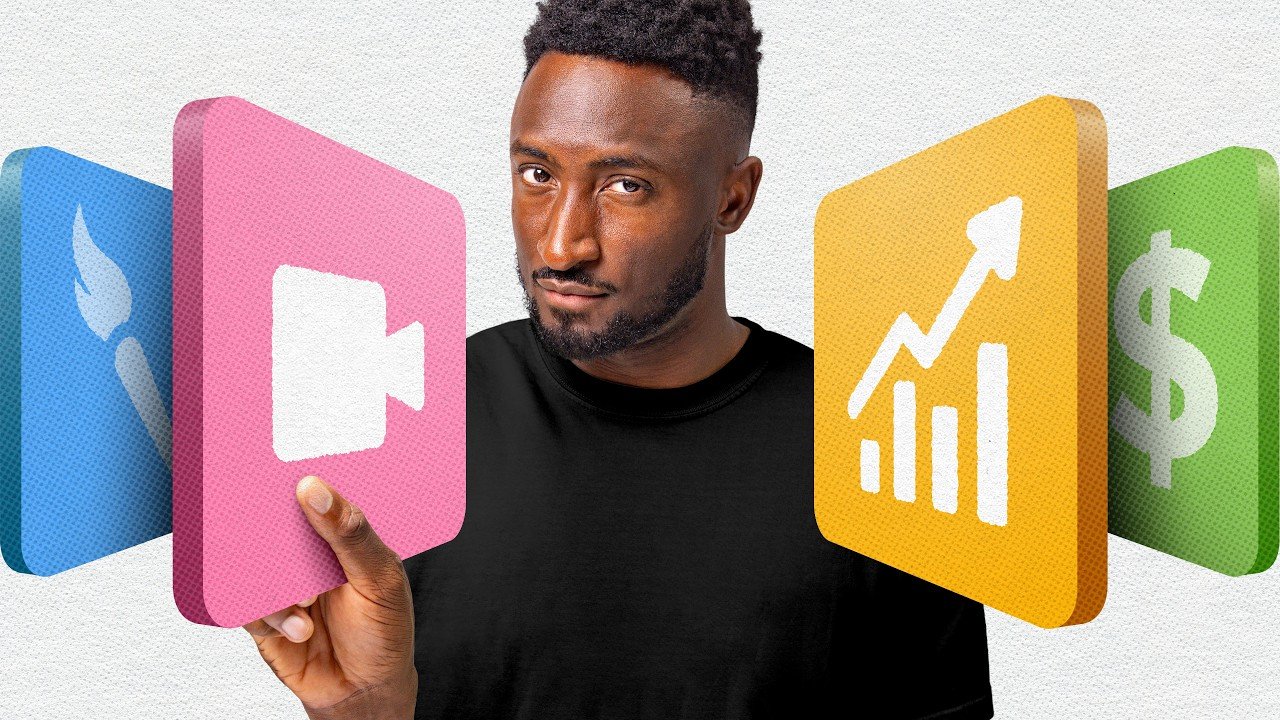
Marquez Brownlee named his YouTube channel after himself on purpose, and it turns out that quiet decision shaped nearly everything that followed. For anyone who has ever wondered whether starting a channel is worth the grind, or how to turn sporadic views into something that actually lasts, the full team behind one of YouTube’s most respected operations just laid out their entire playbook, from the first video to the first brand deal.
Before you open a camera app, answer this first
The team built a flowchart to cut through the noise of the ‘should I start a channel’ question, and it begins with the most honest possible entry point: do you even enjoy making videos? Andrew walked through the branches with Marquez, and the answer for a lot of people is genuinely unknown because they have never tried. The flowchart sends that group somewhere simple: make a few videos and find out. If the process is miserable, the chart dead-ends quickly. If it is fun, the next branch asks whether this needs to become a job. Marquez was candid about how long he circled that loop himself: ‘I was in that loop for longer than I wasn’t in that loop.’ Internet Shaquille and Dr. Mike were cited as real examples of creators who made a large volume of videos long before YouTube became their full-time work.
For those who reach the point where the answer to ‘do I want to make this a job’ is finally yes, the strategy section takes over.
Two growth engines, one sustainable strategy
Eric introduced outlier theory first: scanning YouTube for videos that massively overperformed on small channels, then diagnosing why. Chrome extensions like vidIQ surface outlier scores directly in the feed. The smarter move is not copying a breakout title word for word but understanding what emotional need or curiosity gap it exposed. When a video called ‘Bro, I am begging you to read some fiction’ reached 1.2 million views on a channel where that figure was enormous, the cleverest response was not a clone. One creator inverted it entirely and made ‘I’m begging you to write some non-fiction,’ which worked because it understood the underlying psychology rather than just the packaging.
Trend theory runs parallel: take a broad cultural moment and pull it into a specific niche. Instead of ‘I made AI music,’ one creator narrowed it to ‘I took Charlie Puth’s AI music class.’ Instead of ‘can we tell it’s AI,’ a pair of VFX artists framed it around teaching their mothers to spot it. The narrower the scope, the wider the actual appeal.
The unifying strategic principle across both methods, as the team put it, is to go where your competition isn’t. That might mean combining investigative journalism with science fiction visual aesthetics the way Coffeezilla does, or it might mean simply flying to Beijing to test Chinese EVs on the roads where they actually exist, which is what Miles did when he noticed car creators were discussing the topic without ever going there.
On the money side, Jonno walked Miles through the brand deal landscape with notable candor. Automotive CPMs can run between $30 and $40 per thousand impressions, while finance niche CPMs can reach $80 at the high end. He advised that a car channel taking BMW money immediately muddies the credibility of every future BMW competitor review, and that a dedicated ad manager typically takes 20 to 30 percent, though a strong one might negotiate down to 10 to 15.
The brand and design team, Brandon, Tim, and Michael, closed the creative section by describing how the studio channel identity was built on a whiteboard with dozens of competing ideas, some of which were abandoned deep into development. One direction with theatrical lighting gels and a blur-and-grain aesthetic was genuinely compelling in isolation but could not stretch to thumbnails and photography. It was cut. Tim put the lesson plainly: ‘Having the courage to back away from something that you put a bunch of time into is actually kind of hard sometimes.’
The whiteboard that still had too many ideas on it
One pitch from early in the studio channel brainstorm was a short-form car series hosted by Vin Dang, which the team nicknamed the Vin Number. It never made it past the room.
Marquez closed the session by noting that naming his channel after himself rather than a branded topic was the result of a Google+ policy years ago that forced real names on creators. He called it ‘a blessing in disguise,’ because a name rather than a niche leaves the door open to whatever comes next. That same logic, staying true to what is actually interesting rather than optimizing for what seems safe, turned out to be the thread running through the flowchart, the outlier theory, the brand design process, and the sponsorship decisions alike. The channel name is still just Marquez Brownlee.
 Wake up to Only Happy News!