Jimmy Donaldson stood in Disneyland studying a 1957 hand-drawn diagram Walt Disney made to show how his films connected to his merchandise, his theater sales, his radio empire, and everything in between. The diagram had been sitting in history for nearly seven decades, but for the creator known as MrBeast, it read less like a museum piece and more like a blueprint. What follows is a rare look inside two of the most ambitious creator businesses ever built, mapped out with the same kind of intentionality Disney sketched on that sheet of paper.
Jimmy’s map from YouTube to Beast Land
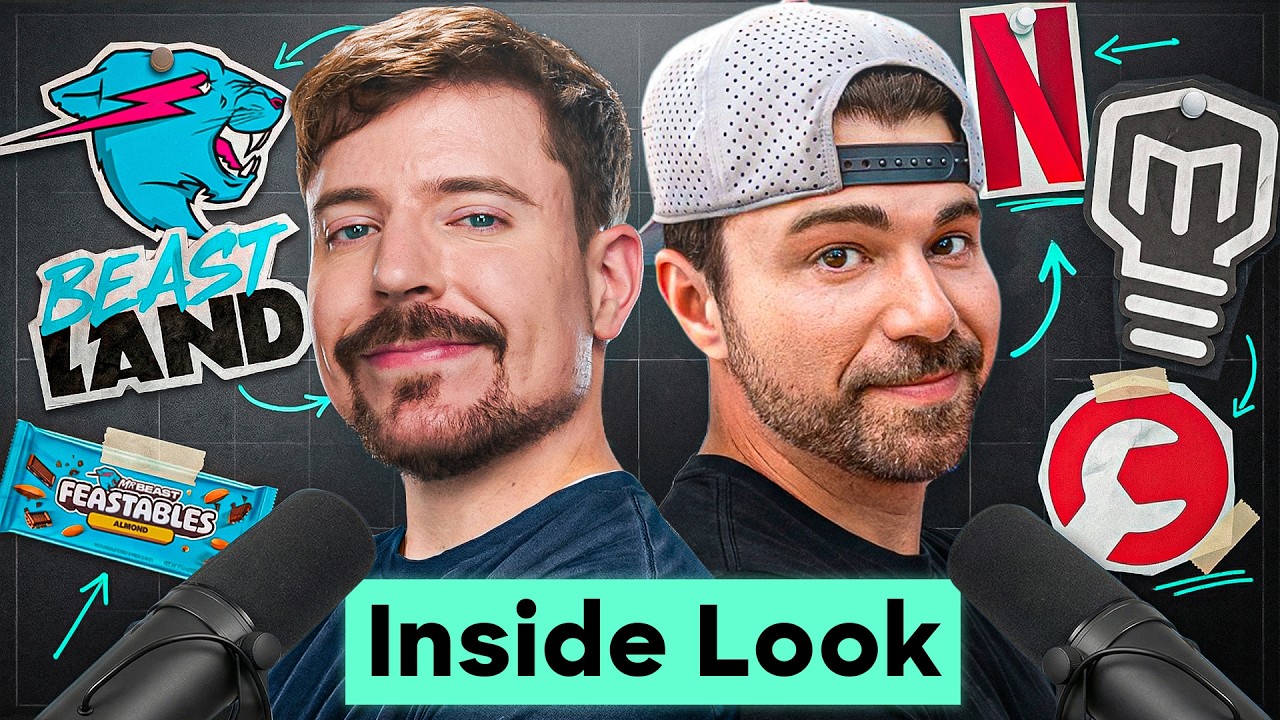
Jon Youshaei, the interviewer who arranged the Disneyland meeting, had prepared a custom version of the Disney map for MrBeast, plotting his empire on a spectrum from digital to physical. Jimmy studied it, called it ‘actually really well put together,’ and then walked through each corner.
The digital core is YouTube: the flagship MrBeast channel, now the most subscribed channel on the platform, alongside Beast Reacts, a gaming channel he describes as one of the largest gaming channels in the world, a philanthropy channel, and Beast Animations, his first animated show. Products radiate outward from there. Feastables, his chocolate brand, is described as the largest ethically sourced chocolate company in the world, one that pays farmers a living income reference price and audits and remediates child labor across its supply chain. Jimmy put the stakes plainly: ‘Most people don’t realize that’s 70% of the labor in West Africa. We’re trying to get those 1.5 million kids out of child labor.’ Without the reach of the YouTube channels and Beast Games, the streaming competition show on Amazon, that message would have no megaphone.
The physical side is Beast Land, a theme park that opened in Saudi Arabia to serve the region’s large Middle Eastern audience. It was built on a concrete parking lot that, within 19 days, became a functional park with roller coasters, a Tower Siege game featuring 10 catapults launching balls at giant tubes, the world’s largest arcade by his own informal count, real mazes, and a pyramid with buttons on its sides where guests race to press every one before sliding down. The target capacity is around 10,000 visitors a day, with a couple thousand on-site at any given moment. Jimmy has openly said he is personally terrified of roller coasters, which is why half of Beast Land is built for competitive, game-oriented visitors who want real-life versions of the challenges they watch online.
His financial content vertical, Mr. Beast Financial, sparked 30 million impressions on a single tweet after a trademark filing. He traced the idea back to a Call of Duty YouTuber named Woody’s Gamertag, who showed a young Jimmy how compounding turned a $10,000 investment into hundreds of thousands. ‘It like blew my brain,’ Jimmy said. He wants to give younger viewers the same moment he had at 13. Virro, a platform connecting brands with video clippers, and View Stats, an analytics tool tracking thumbnail changes and monthly views across any YouTube channel, round out the software layer. Beast Mobile, the furthest out piece, remains under development.
Mark Rober‘s $55 million plan to give science class away for free
Mark Rober arrived at Disneyland with a quieter map and a bigger secret. His main YouTube channel now produces roughly 10 to 12 videos a year, none costing less than a couple hundred thousand dollars to make. His satellite video cost approximately $5 million to produce, with T-Mobile and Google Pixel as sponsors, the satellite itself now orbiting at 25,000 miles per hour.
Crunch Labs, his subscription toy company, grew out of a conversation with Jimmy Kimmel after a 2021 live stream. The CEO of the subscription box company he was sponsoring at the time offered to pay $50 million upfront, pre-launch, before any product existed, to own the concept outright. Rober turned him down on the spot. The first 30,000 boxes sold out in less than a week after the June 2022 launch. Millions of boxes have shipped in four years. The product line now runs from Buildbox for ages 8 to 12, to Hackpack for Arduino-based engineering projects, to the newly launched Creative Kit, developed with professor Adam Green using brain scans to study what creativity actually looks like in practice. The three together are what Rober calls ‘the trilogy.’ Platinum tickets hidden inside boxes grant a trip to Crunch Labs itself. The only three times a platinum ticket has been sold as a standalone item, at charitable auctions, each went for $180,000.
The project he could barely contain was Class Crunch Labs, a full third-through-eighth-grade science curriculum, free for all teachers forever. The price tag to build it properly is $55 million. Rober explained why the number is real: one lesson on electromagnetic fields involves him standing in front of an MRI machine holding a 10-pound hammer while a watermelon sits inside, then turning the machine on to watch the hammer rip out of his hand. ‘I can’t teach you if I don’t have your attention,’ he said. When he presented the plan at the National Science Teachers Association, the room gave three standing ovations. He was crying. The teachers were crying. Funding is being raised, with Rober prepared to contribute his own money. He framed it without hesitation: ‘This is the most important thing I’ll do in my whole life.’
The ticket that almost nobody gets to buy
One object sits at the center of the Crunch Labs physical experience: a platinum ticket, printed and slipped into a random subscription box once a month. It cannot be purchased. It can only be won. The three times it has appeared at a charitable auction, bidders have paid $180,000 to take it home.
At Disneyland, surrounded by rides built from decades of IP and infrastructure, Mark Rober pointed to that number not as a flex but as data. It told him something precise about what a real place, built by real engineers, where impossible things actually exist, is worth to people who have been watching from the other side of a screen.
Jimmy Donaldson had said the same thing about Disneyland itself earlier that afternoon, standing in front of Walt Disney’s 1957 map: the sheer scale of making people feel they personally know the characters walking down the street is what makes all the other pieces click. Both creators are trying to build their own version of that feeling, one chocolate bar, one subscription box, one platinum ticket at a time.