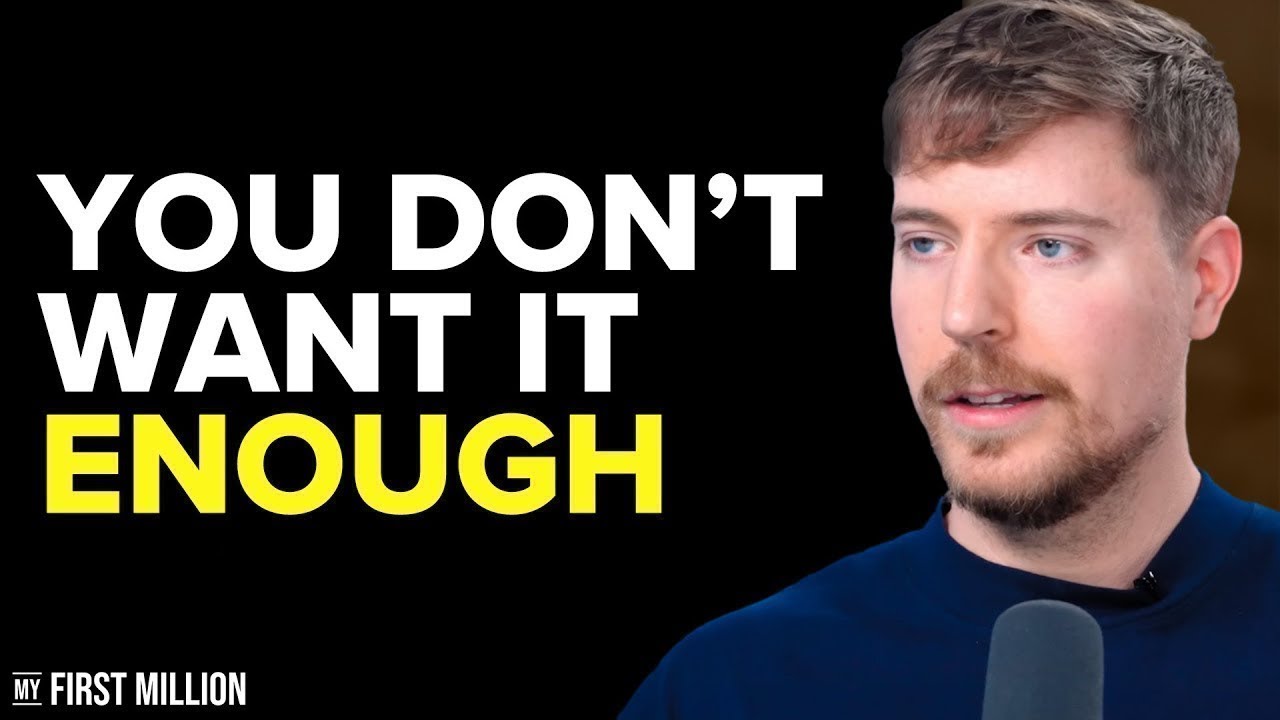
Jimmy Donaldson AKA MrBeast sat across a small table and calmly described the day he stopped attending community college, drove his beat-up Dodge Durango to the parking lot every morning anyway, and edited YouTube videos in the front seat while telling his mother school was going great. That six-month deception was not a teenage prank. It was a countdown. He had calculated he needed enough income to afford a $700-a-month apartment before she found out, and he treated it as a hard deadline: make it or lose the roof over his head. For anyone who has ever weighed security against an obsession they could not explain to the people who love them, that parking-lot gamble is the whole story in miniature.
The conversation, hosted by My First Million, was structured around nine rules that the host had extracted from years of watching Donaldson operate. Together they function less like a motivational framework and more like a field manual written by someone who genuinely cannot conceive of stopping.
Why the rule of 100 is harder than it sounds
The most quoted rule in the conversation is deceptively simple: make 100 videos, improve one thing each time, and only then ask for advice. Donaldson’s 100th video had 730 subscribers, roughly 150 of whom he had recruited by asking strangers on Xbox Live game chat to click subscribe. The rule is not a promise of success at the finish line. It is a filter. As Donaldson put it: ‘The 1% of people who actually do it, they don’t need me after that. They figure it out.’ The host pulled up one of the early thumbnails: a blurry Black Ops 2 gaming clip with text that read like a classified ad. Donaldson looked at it with something close to affection. Being bad at thumbnails, he said, never made him stop making them, which is the actual point.
The companion discipline is what the host called the cloning principle. Donaldson no longer works on any problem alone. Every time he has to personally intervene in some part of the business, he treats that moment as a system failure, and he fixes the failure by keeping someone at his hip until they can make the same call without him. With a team approaching 500 people, the early clones, the ones who effectively lived inside his decision-making process, became the trainers of the next wave. He described the leverage precisely: zero to one takes years, but one to three happens fast because he no longer has to do it.
The phone call habit that most people think is normal until they try it
On long walks, Donaldson scrolls his contacts, stops at a random name, and calls. His only ask: ‘Teach me something.’ He acknowledged it with a straight face: ‘Nobody does this. I don’t understand why.’ The calls run anywhere from one minute to twenty. High-caliber contacts who miss the call tend to ring back within twenty-four hours, and enough of them have caught on to the pattern that some now answer and simply start talking without waiting for the question.
The Feastables conversation brought the same obsessive attention to a harder subject. Donaldson described flying cocoa-sourcing experts to Greenville, North Carolina, and putting them on daily calls until he had absorbed everything they knew about child labor remediation. Forty-six percent of labor on West African cocoa farms involves illegal child labor, and his diagnosis was blunt: the root cause is poverty, so the fix begins with paying farmers a living income. Every Feastables farmer is paid at the living income reference price, all beans are fair-trade certified, and an independent child labor remediation system audits farms and interviews both parents and children on a routine basis. He described a case where a farmer quoted a price and he responded by insisting they take more. His stated ambition is to make Feastables the largest ethically sourced chocolate company in the world, reach a billion dollars a year in sales, and then use that proof to publicly dismantle the ‘it has always been this way’ defense that the major chocolate companies gave him when he first asked about the farms.
On reinvesting everything, he landed on an analogy that apparently surprised even him: ‘I would love to go buy everything in every single store in this entire city and donate it all to charity. That would be $200 million.’ He paused. ‘Actually, it cost $15 million to buy everything in a Walmart.’ The math had already been done. The video had apparently already been considered.
The whiteboard with three or four hundred things on it
Every week, a whiteboard in Donaldson’s studio fills with every bottleneck across every business, ranked by what is blocking the most people from moving forward. A decision that ten people are waiting on does not stay on the board until Friday.
Back in that Dodge Durango, engine off, parked outside a community college he had stopped attending, a teenager with a six-month clock taped his camera to whatever surface was available and went back to editing. The whiteboard is just a larger version of the same calculation.