Craig Federighi, Apple’s global head of software, had been using the iPhone Duo for months before the public ever heard its name. That alone tells you something about how seriously Apple took this one. The Duo is the company’s first folding iPhone, a $2,000 device that closes into a standard smartphone and opens into something uncomfortably close to an iPad mini, and Apple knows the tension that creates because they have spent years carefully avoiding it.
The product Apple was never supposed to make
For as long as Apple has sold both an iPhone and an iPad, the two have lived in a deliberate peace. The iPad has always occupied the middle ground: a bigger screen, more capable as a media machine, better with a stylus, but never powerful enough to cannibalize Mac sales. That positioning held even as the iPad Pro absorbed desktop-class M-series chips and Mac-like interface features, prompting public speculation about a merger of the two operating systems. Federighi famously shut that down on stage with a flat ‘No, of course not.’
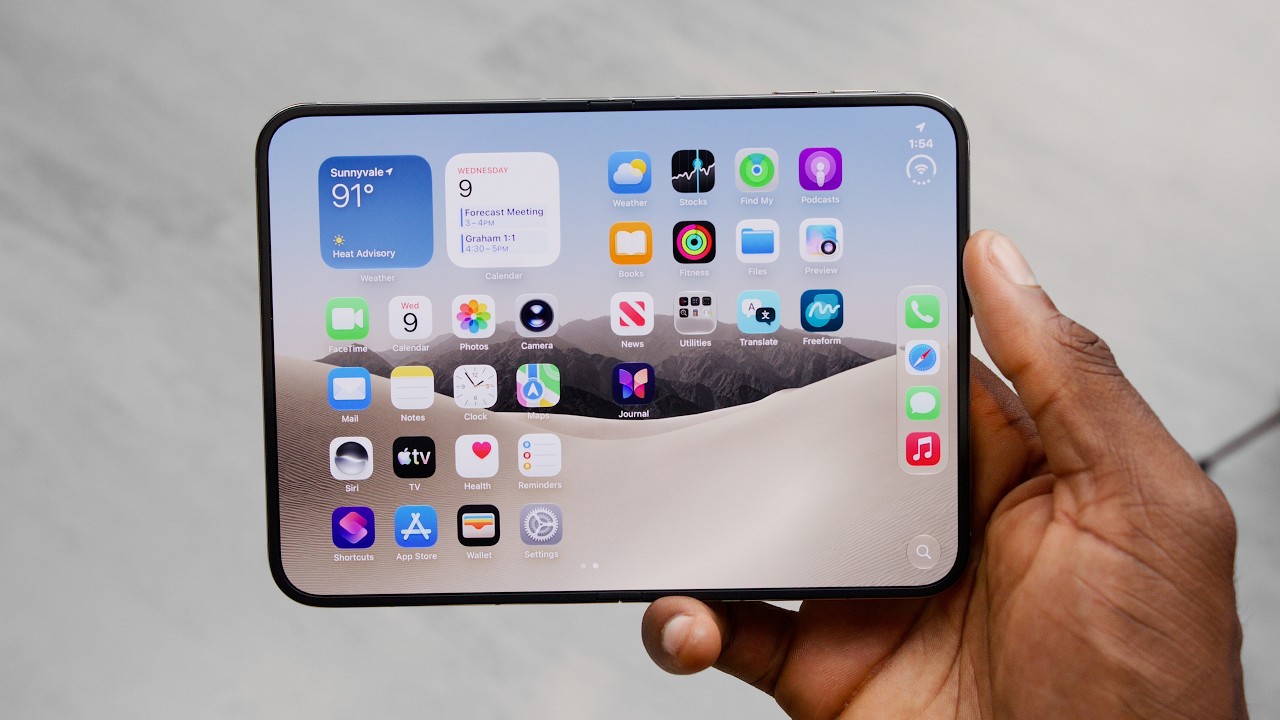
Now the Duo exists. When it is closed, it runs like an iPhone. When it is open, it behaves like a small iPad, sits close to iPad mini dimensions, and is getting full Apple Pencil support later this year. Apple’s own social media account posted a caption calling it ‘the making of,’ referencing how the Duo was made with an iPhone and an iPad mini. The question of whether Apple was finally stepping on its own products was impossible to ignore.
Marques Brownlee put it to Federighi directly, framing the Duo as ‘like an iPhone when it’s closed and like a small iPad when it’s open.’ Federighi did not push back on the description. He acknowledged that for someone who had an iPad mini, ‘this device can often fill that space for them.’
Who this phone is actually for
The Duo is a $2,000 device in a category that makes up roughly 1% of all smartphone sales. Brownlee’s framework for cutting through the noise: if you already own an iPhone and an iPad mini and love them both, this is probably not your phone. If the camera is your priority, the Duo is also likely not the right call, since the best camera hardware lives elsewhere in Apple’s lineup.
But for someone who has been watching foldable phones develop over the past eight years and wanted to try one without leaving the iPhone ecosystem, and who has the disposable income to do it, the Duo is clearly designed with them in mind.
International pricing adds another wrinkle. In Canada the Duo lists at 2,999 Canadian dollars, which works out to roughly 2,160 US dollars. In Taiwan it runs 74,900 new Taiwanese dollars, equivalent to about 2,370 US dollars. In the UK the price is 1,999 pounds, which converts to approximately 2,700 US dollars. That spread is not limited to the Duo. The same pattern appears across Apple’s new Pro models and several continuing higher-priced older phones. Apple announced a financing program a few weeks before the launch, bringing the monthly figure to 35 dollars, which Brownlee noted ‘hits a little different.’
When the apps open, they are not iPad apps
Federighi’s most pointed push-back was on the software side. On other foldable devices, he argued, the approach has been to stretch or cram an existing experience into a new form factor. Apple’s approach with the Duo was to design the software from the silicon up, treating the open-screen layout as its own thing rather than an iPad transplant.
Brownlee went back and checked. The Settings app in the open Duo does look close to its iPad counterpart, with a dual-column layout. The Photos app also reads as familiar. But the home screen preserves a paginated continuity between closed and open that looks distinct. The camera app is ‘very different.’ Every third-party developer will have the chance to build a version of their app that is neither the iPhone layout nor the iPad layout but something new.
The phone that will sit on a table until October
The Duo begins shipping in October, which means hands-on reviews are still weeks away.
Somewhere, Craig Federighi has already been opening and closing it in portrait mode, paging through content he described as ‘extraordinary,’ for the past several months.
The phone’s full potential, and whether that portrait-mode reading experience actually justifies the price gap over two separate devices, is a question that answers itself only once it lands in more hands. The only thing certain right now is that Apple built the product it spent years insisting it would never build, and even the man who said ‘no’ on stage is now carrying one.