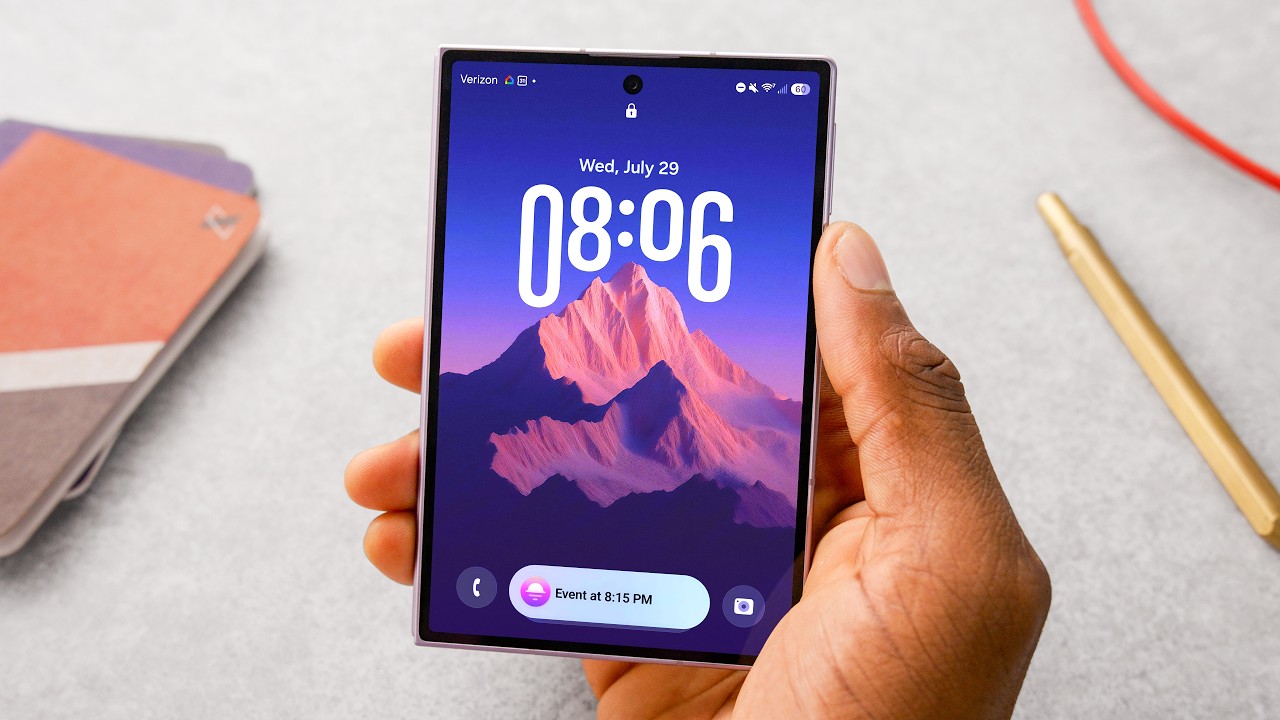
Marques Brownlee pulled the Samsung Galaxy Z Fold 8 out of his pocket on day one and practically fell in love. Then a week passed. He killed the battery a few times, installed all his apps, got into his routines, and started running up against the edges. What he found on the other side of that honeymoon is a phone that is genuinely unlike anything else in his pocket, and also one that comes with a clear list of things it simply cannot do.
What makes the closed screen genuinely better than a regular phone
The outside display is 5.5 inches diagonal, slightly rectangular, and squared off at the corners so it opens and closes like a small notebook. Samsung moved every camera control to the right-hand side so the entire shooting interface is reachable with one thumb, and the power button doubles as a fingerprint reader at exactly the spot where a hand naturally rests. The inside panel opens to a 4×3 aspect ratio, which turns out to play widescreen video at a larger size than the Galaxy Ultra manages, because a 4×3 rectangle is wider than a square. The new anti-reflective coating on the inner screen and Samsung’s titanium flex hinge earn, as Brownlee put it, ‘a B+ job at minimizing the crease.’
Under the hood sits the Snapdragon 8 Elite for Galaxy chip, a 4,800 mAh battery that held up through full days of heavy inner-screen use, and 45-watt wired charging, faster than any previous Samsung fold. Two apps run side by side without the phone feeling awkward, and a single vertical app read sideways makes an unusually comfortable reading surface.
Where the honeymoon ends and the real trade-offs begin
The spring-loaded hinge that makes the phone so satisfying to snap shut also means there is no stable halfway-open position and no flex mode software to take advantage of one. The speakers, which sound perfectly stereo when the phone is closed, both land on the left side when it opens, so full-screen video audio arrives from one direction only. Wireless charging alignment is a recurring frustration because the phone carries no built-in magnets, and the squat shape makes many in-car chargers useless. The phone also rocks noticeably on a flat table without a case.
The camera situation is the most significant compromise. A thinner body meant less room, so the Z Fold 8 ships with a 50-megapixel primary and a 50-megapixel ultrawide and no telephoto at all. Brownlee’s honest verdict: ‘Most photos are just fine. They’re not super sharp. They’re not incredible colors or great low light performance. They’re just fine.’ On a phone priced at $1,900, that lands differently than it would anywhere else.
App compatibility is a real variable. Brownlee could not get the play button to appear in a specific mobile game on either screen, making it, by his account, completely unplayable. Other users may hit more of those walls or fewer, depending on which apps they rely on daily.
The software running on it is 1 UI 9 on Android 17, the first phone Brownlee tested with that combination. A responsive lock-screen clock that repositions itself based on the wallpaper and thicker volume and brightness sliders in quick settings are among the quieter additions that tend to get overlooked next to the form factor itself.
The crossplay button that simply never appeared
On the front screen, the display is too short. On the inner screen, the aspect ratio is wrong. Neither orientation surfaces the one button needed to start the game. It sits there, unavailable, a small and very specific reminder that a genuinely new shape requires the entire app ecosystem to catch up before it is fully comfortable.
Brownlee closed his assessment the way most honest long-term reviews do, not with a verdict but with a feeling. The Galaxy Z Fold 8 is a phone that is unmistakably, physically different from everything else available, light enough to actually want to carry, and limited in ways that matter exactly as much as how someone actually uses a phone every day.