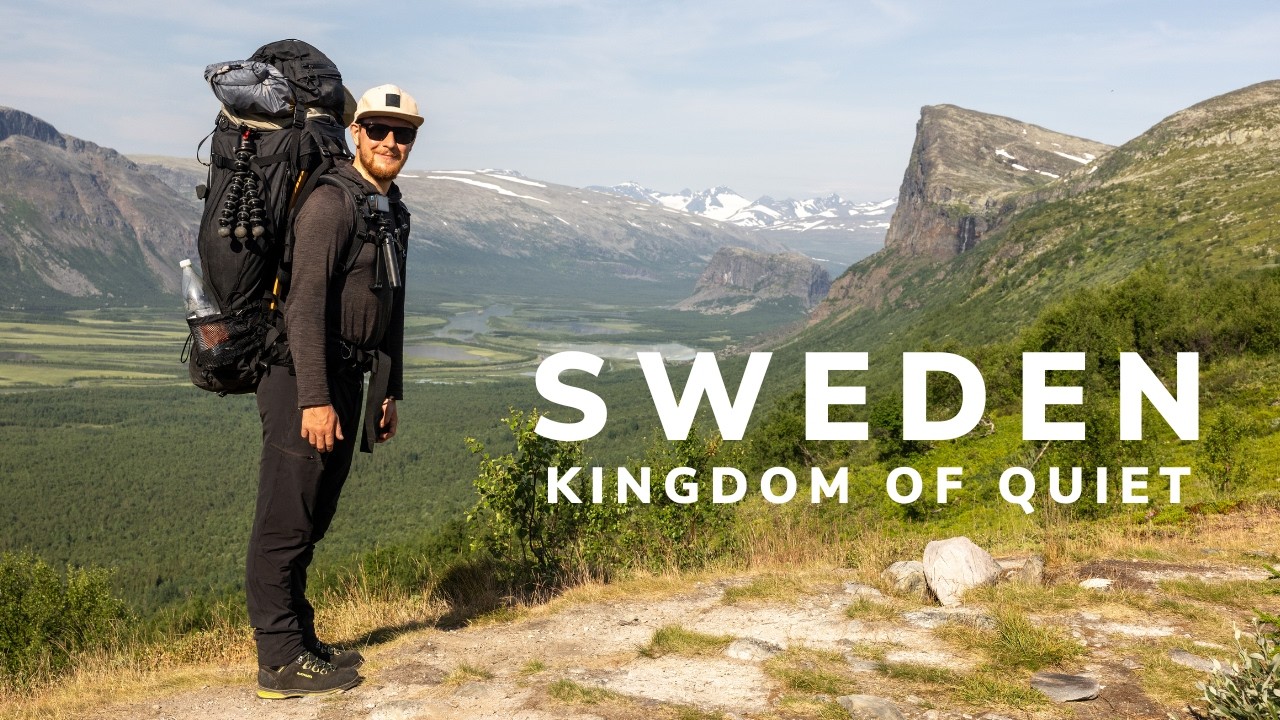
The ferry from Trelleborg had barely docked before Lucas T. Jahn was standing at Smygehuk, reed crosses swaying around him in the Baltic breeze, staring south at the absolute tip of Sweden. Behind him stretched 8,000 km of road, forest, and tundra he had not yet driven. Six weeks to cross an entire kingdom of quiet, from its southernmost headland to the triple-border cairn where Sweden, Finland, and Norway shake hands in the Arctic. What followed was less a road trip than a slow depressurization, a country peeling back its layers one national park, one skinny dip, and one lightning storm at a time.
Where the forest swallows the clock
More than two-thirds of Sweden is covered in trees, making it one of the most forested nations on earth, though the picture is complicated. Since the 1950s, 60 percent of those forests have been converted into spruce and pine timber plantations, a shift that has drawn justified criticism. The old-growth survivors, stands left untouched for at least a century, are now protected inside national parks where nature is slowly clawing its way back.
It was inside one of these protected woodlands that the journey found its first true register. The Swedish concept of skogsbadet, forest bathing, asks nothing of you except presence. No agenda, no destination, just the sounds and smells of the woods closing in. After that came a 23 km hike across fell terrain, the treeless Arctic tundra shaped by glaciers that retreated thousands of years ago, in a park where the weather nearly provided a crash course in Scandinavian meteorology. ‘I find myself in quite a pickle here,’ Jahn said, already moving fast down the exposed plateau as lightning strikes landed around him, ‘because there is no tree cover, which means I am the highest point.’ He outran the worst of it. The rain that followed had, in his words, an almost meditative effect.
The centrepiece of the northern wilderness was a four-day hike through Padjelanta, Sweden’s largest national park at nearly 2,000 square km. The trailhead was reached by helicopter, which Jahn described plainly as ‘undoubtedly one of the coolest ways to get to the start of a hiking trail.’ The park’s rolling tundra, large lakes, and open sightlines delivered ptarmigan chicks hiding in the brush and Sami summer settlements with turf-house churches. A rucksack pushing 33 kg and mosquito-filled cabins were the price of admission. By day four, with phone signal gone and the only tasks reduced to walking, eating, and sleeping, the pace had changed something. ‘I think we haven’t quite felt as much at peace as we do here in a long time,’ he noted on the final morning.
The summit, the berries, and the long way home
The northwest pushed the journey to its physical limits. A 4:30 a.m. start in early August, when the sky was already bright, preceded a 40 km round trip to Kebnekaise, Sweden’s highest peak at just below 2,100 m. The final stretch involved crampons on glacial ice and a summit temperature of around minus five to minus eight degrees with windchill. For almost an hour, Jahn waited as clouds parted and closed over the surrounding peaks, including the northern summit that may or may not stand one metre higher. He waddled back to the car.
Heading south again, the journey softened. The High Coast, reshaped by post-glacial rebound that lifted the shoreline a total of 285 m after the ice retreated, offered maritime views and crevices 40 m deep. A flat tire on a remote track was repaired without drama. Then the woods delivered a different kind of treasure: in the space of one hour, at least a kilogram of blueberries picked from bushes laden with late-summer fruit. Stockholm arrived briefly, its 14 islands connected by 57 bridges, its old town offering a 13th-century church, the Nobel Prize Museum, and some overpriced pastries that did not agree with anyone’s stomach.
The final chapter was a canoe. Six kilometres down a placid river, past fallen trees but no cars and no people, onto a medium-sized lake studded with uninhabited islands. Camp went up on one of the smaller ones. As the tent poles clicked into place, the dying sun reflected gold across the water.
The kilogram of blueberries left in the pot
Somewhere in a forest south of the Arctic Circle, a pot of freshly picked blueberries sat cooling on a camp stove, the bushes around it still heavy with fruit that no one had gotten around to finishing.
After six weeks and more than 8,000 km, Jahn landed on a distinction that the country itself had quietly been making all along: quiet is not the same thing as silence. Silence is the absence of sound. Quiet is the absence of noise. By the time the canoe touched the far shore of that island lake and the journey officially ended, the reed crosses at Smygehuk felt like they belonged to a different season entirely, which they did.