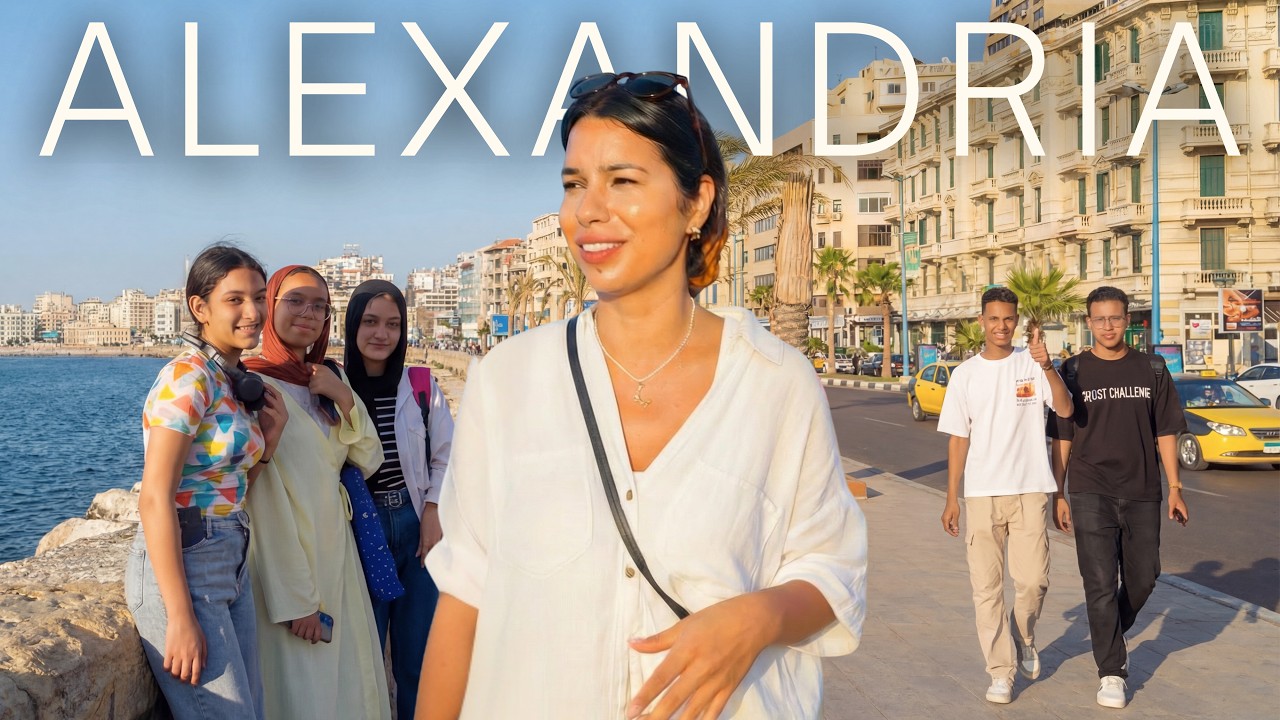
Malini Angelica was standing inside the Roman baths when she looked up and saw modern Alexandria crowding in on every side. The baths, thousands of years old, sat open to the sky in the middle of a fully inhabited neighborhood, excavation work still underway around the edges. For anyone who has only thought of Egypt as a country of pyramids and pharaohs, Alexandria reframes that picture entirely: a Mediterranean city founded by Alexander the Great, shaped by Greek, Roman, and Egyptian cultures in overlapping layers, and today home to a young, outward-looking population that is quietly redefining what Egyptian life can look like.
The city is three hours by road from Cairo, and the contrast hits almost immediately. Art deco buildings line the Corniche, the sea breeze carries in from the Mediterranean, and the pace feels genuinely different from the capital. Alexandria served as Egypt’s seat of power for close to a thousand years, the city from which Cleopatra ruled, before the Arab invasion of the 7th century shifted the center of gravity south.
What the ruins at the center of a neighborhood actually feel like
The Greco-Roman archaeological site sits in a residential area so thoroughly ordinary that it takes a moment to register. Inside the site, the only Greco-Roman amphitheater in Egypt dates to the 3rd century AD, built for musical concerts and possibly public lectures, excavated in the 20th century, and flanked on all sides by apartment blocks and parked cars. Nearby, the remains of the Roman baths and mosaics from Emperor Hadrian’s villa are still being uncovered. Excavation crews were on-site during the visit, turning up new finds at ground level while tourists walked a few meters away.
Below street level, the scale shifts again. A set of catacombs, officially listed among the seven wonders of the Middle Ages, descends far beneath the city and opens into chambers where the carvings blend three traditions into a single wall: gods dressed in Roman imperial clothing with distinctly Egyptian animal faces, Roman columns marking the entrance to burial halls where, at one time, up to 300 mummies were interred. The family that commissioned the catacombs wanted to preserve Egyptian religious imagery, the result is a fusion that looks like no single culture and belongs to all three.
A night out on shrimp kofa, ganduffi, and a sugary street pastry eaten off a car boot
By night, Alexandria belongs to its locals. Malini met up with her friend Muhammad and his Alexandria friends, including Ahmed, who introduced himself to the camera with the practiced ease of someone who should absolutely be running food tours, promising that ‘the Alexandrian kibbeh will make you very delicious and want to try it one day.’
The group moved through several stops: first the kibbeh, made here from buffalo liver and noticeably milder than the Cairo version; then a seafood spread at an outdoor spot in a back alley where the ordering philosophy, as one Egyptian-American diner at a neighboring table explained, was that the place ‘is not the cleanest, but the best taste.’ Shrimp kofa, a deep-fried shrimp version of the beef kofta most visitors already know, arrived alongside ganduffi clams and a shrimp soup that appeared without being ordered. Calamari was dipped in tahini. The final stop was a street pastry with a crisp outer shell, soft interior, and a sugar-and-butter finish eaten directly off the boot of a parked car, because that, Muhammad explained, is simply how it is done here.
A 14-year-old by the Corniche
At sunset on the waterfront, a local teenager stopped to talk. He was 14, still learning English at school, and when asked what he liked about Alexandria, he said: ‘The sea. Very nice. Different to Cairo. Cairo, there’s no sea and a lot of people.’
By the time the evening ended and the Corniche had settled into its nighttime rhythm of friends, dominoes, and shisha, it was clear that the kid had summarized the city better than any itinerary could. Alexandria is Egypt’s second city by population, but on the Mediterranean it feels like something else entirely: a place where layers of history press up through the pavement and the sea is always just at the end of the street.