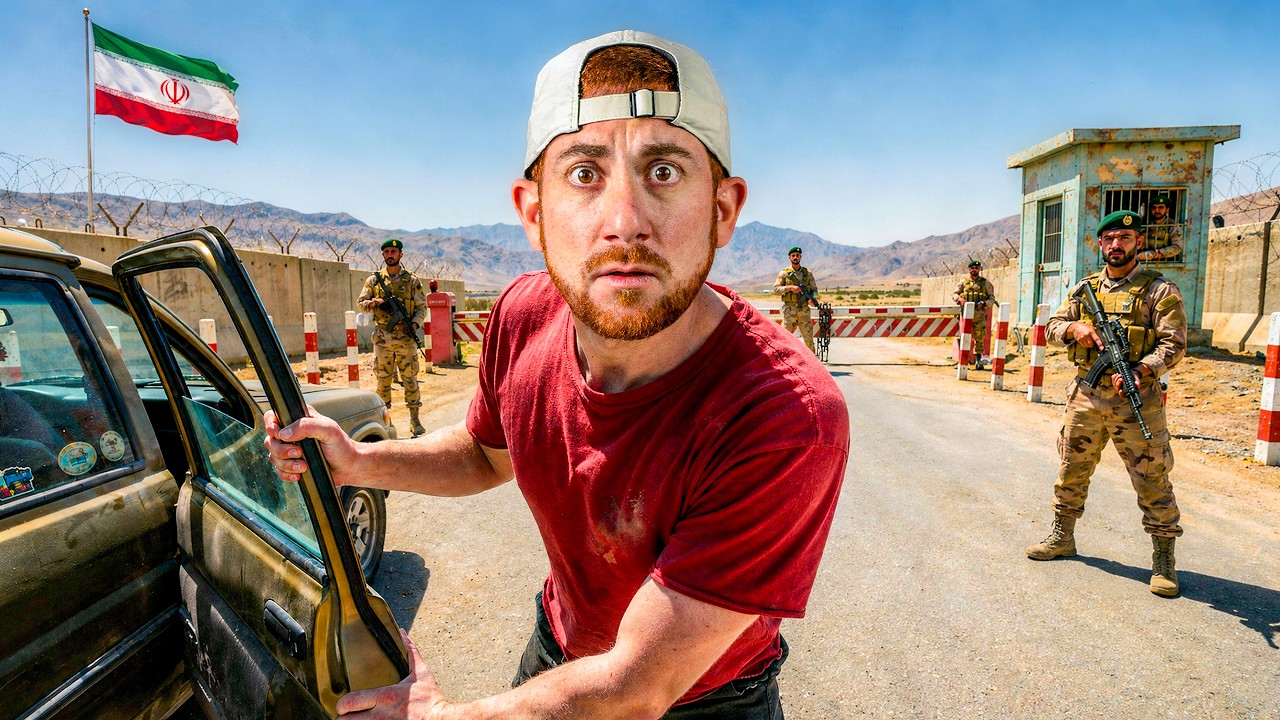
A checkpoint sits a few steps behind Drew Binsky, and just two meters past the concrete and wire, Iran begins. He has visited the country four times and calls it his favorite on the planet, but the visa is out of reach for now, so he has come to the Turkish side of the border instead, determined to drive 100 miles along the frontier through Kurdish villages, shared meals, and a civilization whose roots run 3,000 years deeper than the wall that divides it. What unfolds is not a story about borders so much as a story about what borders cannot actually sever.
Where tea crosses the line and kids carry the load
The journey begins at the crossing point itself, where traders move back and forth with one kilogram of tea per person, the legal limit under Turkish customs rules. The tea carriers are earning roughly five US dollars a day. Some of the most determined traders are children, around twelve years old, working the route with the efficiency of seasoned professionals. When Binsky tries to pay one of them generously, the kid refuses to accept it, insisting the amount is too much. The exchange captures something true about this stretch of road: people here are not poor in the ways outsiders might assume, and pride runs as thick as the hospitality.
The border wall rises along the mountain ridgeline, watchtowers stacked every few hundred meters, an estimated seven or eight visible at any one moment. Military infrastructure sits on the heights like something from a history painting, but the mood on the road below is not hostile. It is curious, and warm.
The city of Van draws the first detour. Over coffee at a street-side cafe, a local man named Seyit Oktay explains the relationship between the two sides plainly: ‘We are living in the same land. Kurdish people and Farsi people and Azeri people were living together, getting married, and it is one of the greatest civilizations in world history.’ He traces the connection back to the Spice and Silk Road, two-way trade that made the communities ‘brothers.’ Van is also the home of a breed of cats with one green eye and one blue eye, and the undisputed center of Turkish breakfast culture, where sitting down at a table produces at least twenty dishes without a single order being placed. Ram cheese with herbs, menemen with tomatoes and eggs, butter, olives, milk cream, and rounds of tea that never stop arriving.
Two weddings, one village, and fifty thousand dollars in gold
On the road north, a passing farmer mentions a wedding somewhere up in the hills. Binsky and his companion Anil arrive unannounced and are waved straight in. ‘You are the guest of God,’ the father of the groom says, ‘so you are welcome.’ Food arrives first, then a halay circle where the whole room dances holding pinkies. Binsky later describes it as his ‘biggest ever halay circle in a family kind of thing.’
The following day produces a second wedding, this one centered on a gifting ceremony held inside a mosque. Every family in the village contributes cash and gold, and the running total is announced publicly at the end: 1,253,000 Turkish liras, roughly 35,000 US dollars in cash, with bank transfers expected to bring the total to around 50,000. In larger clans the total can reach 400,000 or 500,000 US dollars, according to one of the men at the table. The logic is communal and deliberate: whoever receives today repays equal or more when the next family celebrates. For the past 25 consecutive weekends, the village has held three-day weddings on the same schedule.
The road eventually delivers something rarer than any wedding. At a 2,700-year-old fortress built in 764 BC as the ruling center of the Urartu Kingdom, a man named Mehmet has spent 22 years teaching himself a dead language from scratch, reading hieroglyphic inscriptions carved into basalt with a nail-and-line script that uses no curves. He is, by his own account and by every indication around him, the only person on earth who can read or write it. It took him three years to reconstruct the alphabet and another nineteen to achieve fluency. He carves new inscriptions by hand, ten days per stone. He wears a necklace bearing the first two sentences from a temple inscription. Nobody else on the planet can read what it says.
The man who owns a language nobody else speaks
Mehmet pulls a carved basalt stone from behind a wall to show the alphabet. Each letter is a variation of a dash and a line, no circles, no curves, because the tool used was literally a nail pressed into volcanic rock. The stone the Urartu people used is the same basalt that comes from Mount Ararat, the mountain that marks the final destination of the whole drive. Binsky buys one of Mehmet’s hand-carved pieces before leaving.
Earlier, in a village whose name translates as Cold Water after the stream running through it, the water was tested. One degree, possibly colder. No taste at all, and genuinely good.
Across the whole 100-mile run, the pattern repeats: strangers in villages wave travelers over for tea, a family sends out fruit and then insists on a full meal, farmers on tractors hand over phone numbers and ask to be called so the visit can happen properly next time. A man named Umut, met near the call to prayer echo carrying across the mountains, sums up the philosophy in rough but unambiguous English: ‘We are the earth, not war. Peace, peace very good.’
Binsky put it simply after twenty trips to the country: ‘You can stare at the map all day long, but it’s not going to show you what life here is actually like.’
One stone, still cooling from the mountain
Mehmet’s carved basalt tablet sits on a low table, the nail-line alphabet pressed clean into volcanic rock that came down from Mount Ararat centuries before anyone thought to write on it. The inscriptions are as sharp as the day they were made.
The fortress walls above the valley are still standing after 2,750 years, and the oldest known toilet on that hilltop still has two places to squat, side by side, overlooking the plain where Kurdish families have been giving their daughters across an invisible line and receiving brides back in return, long before anyone put a wall there.
 Wake up to Only Happy News!