Big Bertha rolled across the Bosphorus Bridge just as the crew aboard her finished chanting the word Europe in unison, nine people crammed into a retired American school bus that had started its life ferrying kids around Colorado. The moment the wheels crossed into Asia, someone screamed. Someone else laughed. Kara and Nate and their team of seven had just driven a school bus from one continent to another, and there were still weeks of the Mongol Rally left to go. For anyone who has ever looked at a map and wondered what it would actually take to drive from Europe to the edge of Asia, this team found out the hard way, one chaotic border at a time.
The Mongol Rally sends around 100 teams each year on a 5,000-plus mile drive from Europe to Asia in vehicles that were never designed for the journey. Kara and Nate needed something bigger for their nine-person crew, so they bought Big Bertha, a government auction school bus out of Colorado, road-tripped it across the United States, shipped it across the Atlantic to Germany, and drove it to the start line in Prague. By episode five, they had already passed through Slovakia, Hungary, Romania, Moldova, and the self-declared country of Transnistria. Bulgaria and Turkey were next.
The salt lake that smelled like poop but worked anyway
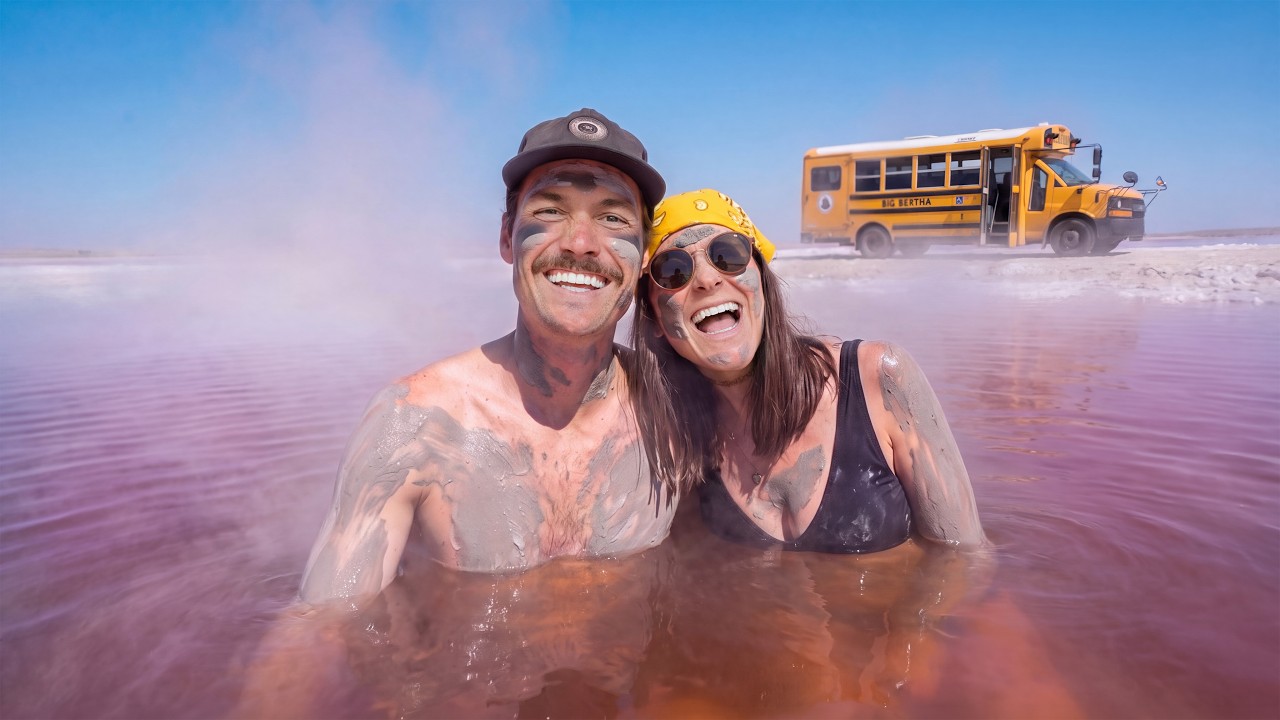
North of the town of Burgas, the crew pulled off toward a coastal salt lake rumored to have healing properties and, if they were lucky, flamingos. The reality did not match the brochure. The water sat gray and still beside an airport, the mud on the bottom smelled strongly of sulfur, and the flamingos were present mostly in the capacity of contributing to the aroma. Charlie, who had already gone for a morning run straight into a military zone along the Black Sea coast, was skeptical from the start.
Then people stepped in. The water was only about three inches deep, but feet sank two feet down into soft mud. The salt content was dense enough that a 200-pound person floated with almost no effort, feet breaking the surface, body refusing to sink. Kara had packed a black bathing suit specifically for this stop. The crew covered themselves in mud they found in a bucket nearby, nobody entirely sure they were using it correctly because there were no instructions in English, and one person ended up with mud on their face while everyone else skipped that step. Charlie, still chafed from his morning run, walked the fifteen minutes back to the bus in a way that told the whole story without a word.
As Nate put it afterward, reading from what he found on his phone while still dripping: the red tint in the water comes from a micro-algae that produces pigment to protect itself from UV light, and that same algae is why flamingos are pink. The science did not make it smell better. ‘I was going to give it a one in my head,’ one of the team admitted after coming out. ‘Said it was all bird poo. Said it looked awful. Now you’re in the water. It’s warm. We’re floating. It’s ridiculous.’
The border crossing nobody expected to survive quickly
The group had read a review posted four months earlier warning that Bulgarian officers at the Turkish border had dismantled an entire vehicle, photographed every item, and held travelers for three hours in what the reviewer called the most aggressive search they had experienced anywhere. The crew arrived at 10 at night smelling like the salt lake, carrying registration documents reprinted on different paper after previous crossings had flagged the originals. Someone suggested fixing their eyebrows before pulling up to the booth.
The Bulgarian side waved them through without searching the bus at all. The Turkish crossing took 36 minutes and 11 seconds, a new record for the trip. Turkish border officers, apparently curious about the disco ball hanging inside, used it as a punching bag. Five or six of them climbed aboard at one point just to look around. Passports were stamped before the vehicle documents were even handed over. Charlie, for his part, said he had not been nervous for a second, except for a brief moment when he thought they might need visas.
The flat white nothing of Tuz Lake at sunset
Eight hours of driving through Turkey’s green mountains and past the capital city brought the crew to Tuz Lake, the second largest lake in the country. The name translates directly to salt in Turkish. During the rainy season the lake fills with one to two feet of water, but in summer it dries completely, leaving a white salt flat that accounts for 70 percent of Turkey’s salt supply. The surface looked, by universal agreement, like Antarctica, or possibly another planet entirely. Someone compared the sunset to the opening of The Lion King. Someone else ate some of the salt directly off the ground. ‘Best I’ve ever had,’ he reported.
One tent still standing in the salt
The tents went up on the flat white surface as the sun dropped orange toward the horizon. A double air mattress self-inflated inside one of them while across the camp, another pair inflated theirs the old-fashioned way, with their mouths, and complained about it with what Kara called ‘a little bitterness.’ The wind picked up. Nobody was sure the tents would survive the night.
Big Bertha sat parked at the edge of the salt flat under an open sky, a Colorado school bus that had crossed an ocean, driven through nine countries, and was now sleeping in the middle of a Turkish salt lake, pointed east toward Kazakhstan and whatever came next.