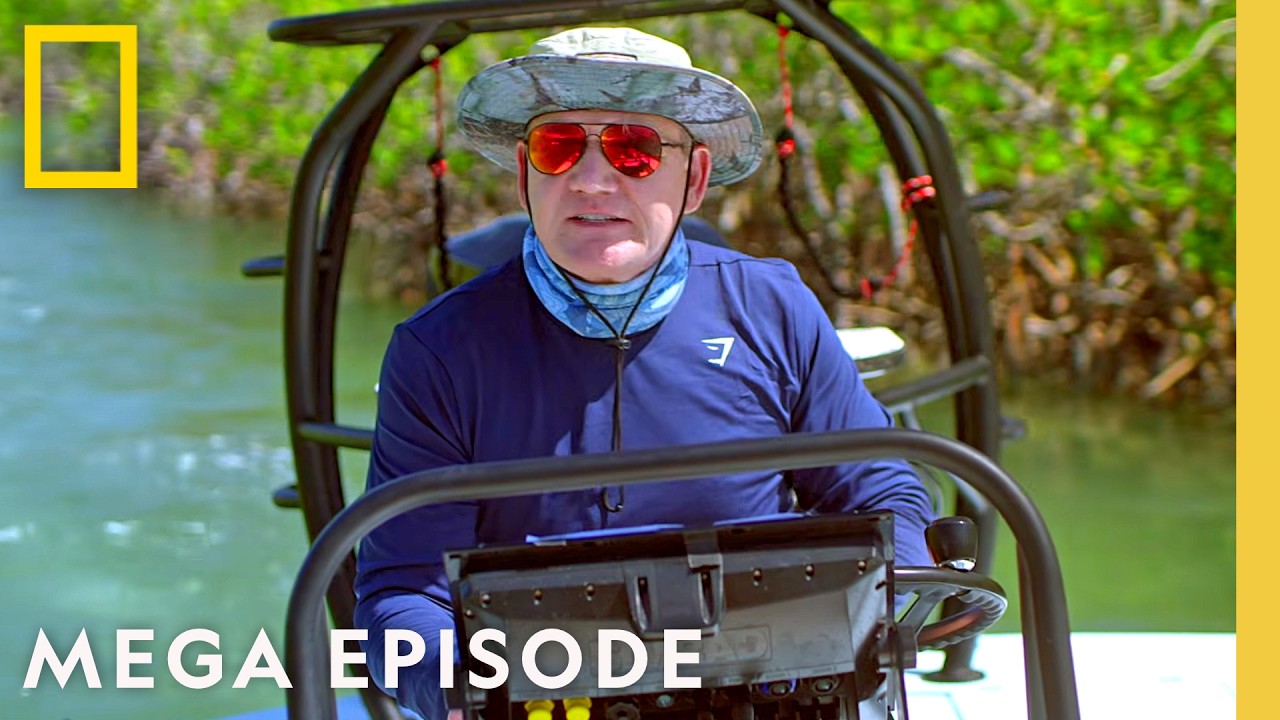
Chef Paul Menta did not arrive by car, or boat, or even a reasonable vessel. He arrived by plane, buzzing low over the middle of the Florida Keys in a stunt entrance that made Gordon Ramsay swear out loud in an empty field. That single moment said everything about what the Conch Republic demands from its people: spectacle, resourcefulness, and a complete disregard for conventional behavior. For Ramsay, three islands and three wildly different culinary worlds lay ahead, each one built not on imported luxury but on whatever the land, the river, and the reef were willing to give up on any given day.
Stone crab, tickle sticks, and the grunt that became a curry
The Florida Keys stretch over 100 miles into the Gulf of Mexico across a chain of 1,700 islands, and Paul Menta has spent 30 years cooking his way through all of them. He co-founded three local eateries, opened a sustainable fish market, and runs a rum distillery where he salt-cures the barrels before filling them, a technique people thought was madness until the distillery was rated one of the top 10 craft distilleries in the United States. His instruction to Ramsay for the week’s cook-off was simple: five-star taste, five-dollar feel.
Twin boat captains Emily and Amanda Gale delivered the first ingredient. Stone crab claws, harvested by rotating the joint in a C-shape and releasing the claw while the crab goes back into the water to grow another, arrived alongside a warning that one crab can crush with 19,000 pounds of force per square inch. The lobsters came next, from a shallow reef where a 14-foot hammerhead shark named Big Mo is treated as a confirmed local resident rather than a legend. Emily tickled a spiny lobster from its coral cave with a literal tickle stick while Ramsay was catching his breath at the surface, and she has not let him forget who put the net behind it.
At Grimal Grove, a two-acre farm started in the 1950s by an inventor who traveled the tropical world collecting rare fruit trees, farmer Patrick introduced Ramsay to caimito and sapodilla, fruits the Keys farmer described as not existing anywhere else in continental United States. The price of entry was operating a mulching machine in exchange for a box of exotic produce. From Sheena, the pastor’s wife of 43 years, Ramsay received a full correction on how to cook grunt fish: whole, never filleted, stuffed with bird peppers that register between 50,000 and 100,000 heat units on the Scoville scale, finished with lime juice squeezed inside the cavity before frying, and served with pigeon pea grits cooked in pork fat. ‘Sheena’s way is the best way,’ she said, and she meant it. When Ramsay suggested spreading the grits ‘like we do in the restaurant,’ she laughed at him.
At the final cook, tide rising around both their feet, Ramsay turned his grunt into a Bahamian-influenced curry built on breadfruit from Grimal Grove. Paul made grunt cakes by rolling the fish with a rum bottle to remove the bones clean, then shaped them into burgers. The seven-person jury, led by the pastor, split one vote each on the grunt and the stone crab before the lobster became the tiebreaker. Paul took it. But the pastor called the room to attention with one more announcement: ‘Chef Gordon Ramsay, welcome to the Bubba system.’ Ramsay said later that felt as good as a Michelin star in the Florida Keys.
A helicopter exit, a rockface rope, and Draco Rosa picking coffee beans
In Puerto Rico, Chef José Enrique, whose restaurant Condado was listed among the top 30 best restaurants in the world by Food and Wine, opened the week by boarding a plane the size of a bread roll to the island of Culebra, squeezing the aircraft between two mountains to land on a strip barely visible from above. Lunch turned out to be ceviche made from mutton snapper fished 100 meters offshore and a citrus mix of grapefruit and orange grown locally. José handed Ramsay a fillet knife and walked to the beach.
The coffee came from a farm in the mountainous center of the island, reached by jumping from a moving helicopter because the pilot had no clearance to land. The farmer turned out to be Draco Rosa, one of the original members of Menudo and the co-writer and producer of ‘Livin’ La Vida Loca’ for Ricky Martin. He assigned Ramsay to pick beans on a slope crawling with fire ants while he watched from above. The beans were then separated from their skins by a hand-cranked pulper and left to dry in the sun before roasting to a finish Rosa described as having a chocolate aftertaste with no bitterness. Ramsay used the coffee as a rub for a pork shoulder at the final cook.
The freshwater shrimp called chagara came from a river reached by rappelling down a wet rock face in the rain, crossing a bridge so old it bounced underfoot, and lifting 60-pound boulders from the riverbed with a net held by spear fisherman Ilias. A queen snapper came from spearfishing a mile offshore in a micro-skiff with local fisherman Anthony. At the cook, Ramsay served ceviche, coffee-rubbed braised pork shoulder, and the queen snapper grilled with handpicked vegetables from an organic farm where Solay and Iyan were back in their fields with oxen five weeks after Hurricane Maria destroyed every crop they had. Tony voted the ceviche better than José’s ceti, a tiny seasonal fish that only runs for six or seven weeks a year. Jorge went to the coconut fish stew. Draco called the queen snapper a knockout punch.
Poi-nacotta, a Hawaiian shepherd’s pie, and a fish that seasons itself
On Maui’s Hana Coast, Chef Sheldon Simeon, whose grandparents came from the Philippines as teenagers, described the food of the island as a layering process: every culture that arrived on the trade winds added one more layer of flavor to what was already there. Free diver and chef Kimi Werner taught Ramsay to spearfish by holding onto the seabed and waiting. The fish he finally landed, an Ana Nui, feeds so heavily on seaweed that Werner described it as pre-seasoned by its own diet. Ramsay ate it raw on the rocks and said it needed nothing.
Taro farmer Wade spent three to four hours a day standing in a mud bath and demonstrated that harvesting taro requires a karate-style side kick to snap the roots without breaking the corm underground. The resulting poi, beaten by hand until it reached the consistency of thick lava, he offered without salt or cheese or any modification. Game hunter Robin Kean provided axis deer, a species introduced to Hawaii as a gift from Hong Kong to island royalty and now hunted to protect the ecosystem, describing the loin as 98 and a half percent lean. Farmer Chuck Boerner drove Ramsay around 70 tropical fruit varieties at speed, stopping for red bananas with orange flesh, cacao seeds, and a small sour fruit called bilimbi originally from the Philippines and used locally as a lime substitute.
At the final cook beside the fire pit, or Imu, Ramsay assembled a venison shepherd’s pie topped with breadfruit mash, seared venison loin glazed with soy and lime, and a poi panna cotta finished with whipped coconut cream and kukui nuts. Sheldon buried a whole breadfruit under the coals, cooked a leather-skinned Opelu Kala fish whole in seaweed and lemon, and grilled spiny lobster in spicy coconut with a sea urchin and fern garnish. Community leader Kaui delivered the table’s verdict: the shepherd’s pie was pretty amazing, the venison soft and well flavored, and the poi-nacotta landed with the group. One note: a little on the salty side. Ramsay agreed immediately.
The tickle stick, still unclaimed
The tickle stick Emily Gale used to flush the spiny lobster from its coral cave still sits somewhere on that reef flat near Culebra, or perhaps back on the boat, its role in the disputed lobster catch officially unresolved.
Ramsay left all three islands with the same conclusion arriving from three different directions: the actual work starts before anything reaches the kitchen, and the people who do that work every day, in mud and current and rain and fire ant colonies, are the ones who understand what the food actually is.