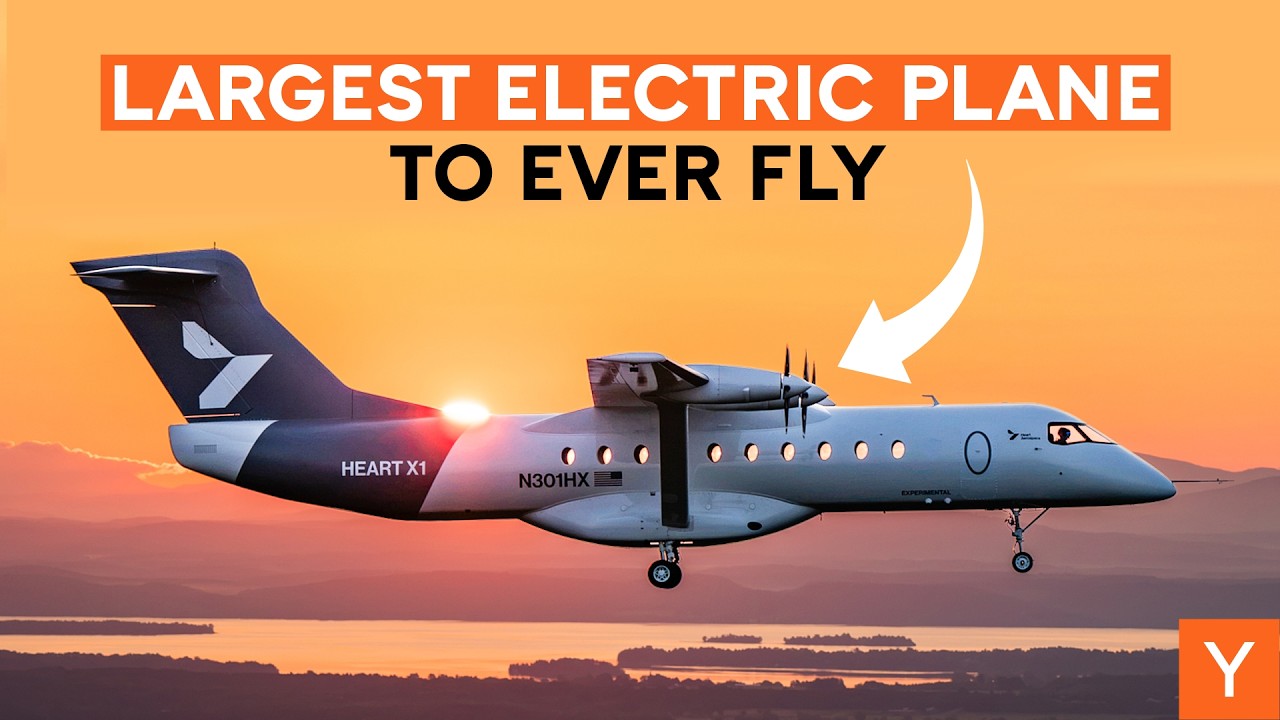
On a runway in Plattsburgh, New York, on Wednesday, August 12th, a 100-foot-wingspan electric airplane accelerated under its own power for the first time, and the electricity that got it airborne cost exactly $5. That number alone stops people cold, because what Heart Aerospace just pulled off is not a drone or a flying taxi prototype. It is the largest electric aircraft ever to fly, by roughly a factor of two over anything that came before it, and the first clean-sheet airliner to take flight in the United States in 18 years. For the roughly half of all flights in the world that are under two hours, this machine represents the most credible alternative to a 40-year-old regional aviation model that nobody has seriously challenged until now.
Seven years before that runway moment, Heart Aerospace CEO Anders Forslund walked into Y Combinator carrying something that fit in the palm of his hand: a 3D-printed model of the plane he intended to build. The journey from that thumbnail-sized model to a 25,000-pound aircraft hurtling down a runway is the through line of one of aviation’s stranger founding stories.
How a spam folder and a soccer field in Sweden got here
Forslund grew up beside a Swedish air force base, watching fighter jets streak over a soccer field, obsessing over paper airplanes, and eventually earning a PhD in jet engines. The inflection point came at MIT, where Elon Musk gave a talk about electric transportation and mentioned batteries reaching 400 watt-hours per kilogram. ‘It kind of felt like a call to arms,’ Forslund recalled. He was working on jet engines by day and tinkering with drones at the kitchen table at night, and the Swedish government was paying him to survey Nordic airlines before he had even formed a company.
When he arrived at YC with co-founder Clara and that 3D-printed model, there was no playbook for hardware at this scale. The team chased letters of intent from SAS and three Nordic carriers, then built a 400-kilowatt electric motor the size of a small jet engine, which attracted pre-orders from United Airlines. That United relationship, it turned out, started in the spam folder. Clara spotted the inbound email while clearing it out, thought it might be real, and the team walked United’s representatives through their lab. ‘They kind of immediately got it,’ Forslund said.
Why the electric motor changes the math for short routes
The core problem Heart is solving is structural. A jet engine costs roughly the same to build whether it powers a 30-seat plane or a 70-seat plane, wears at the same rate whether the flight is 100 miles or 1,000, and burns 10 percent of its fuel just taxiing to the runway on short routes. The entire economics of regional aviation have been bent toward larger planes and longer routes because the technology demands it.
An electric motor has essentially one moving part, no combustion, and virtually zero wear. The current aircraft runs on eight battery packs laid across the floor of the fuselage, carrying the energy equivalent of about four Tesla vehicles. Standing 100 feet away from it under power, the motor is virtually silent.
The successor model, the ES-30, will fly up to 125 miles on battery alone and up to 500 miles using a hybrid system, with a roughly 30-minute recharge window. The hybrid element adds about 20 percent to upfront cost, but it solves the reserve problem that battery-only designs cannot: one in every thousand US flights gets diverted, sometimes requiring 45 minutes of loiter and a 100-mile diversion, and unlike jet fuel, batteries do not get lighter as they drain.
The team is currently testing battery cells from American, Chinese, and Korean manufacturers in their dedicated battery lab, evaluating flight cycle count, safety, cost, and energy density. The highest cell on their test bench at the time of the build was around 370 watt-hours per kilogram, with a manufacturer expected to deliver a 400-watt-hour cell within months, which Forslund said ‘easily meets our targets for the first generation of the aircraft.’
The actuator that used to take a year to source
The entire Heart facility in Los Angeles is wired as a single giant test bench. The cockpit, the cabin, and the tail sections are fed 1.6 megawatts of power simultaneously, allowing the team to run fault-injection tests: programming errors, cut wires, every failure mode the software-defined aircraft might encounter. Forslund’s philosophy, drawn from SpaceX’s approach to risk, is to minimize the impact of getting something wrong rather than trying to minimize the probability of failure entirely, which allows for cheaper, faster iteration.
Many components are machined in-house, including actuator cylinders made from 6061 aerospace aluminum, each containing about 15 parts. In traditional aerospace, sourcing a single actuator from a supplier could take a year. Building it internally compresses that to days.
Forslund put the trajectory plainly: ‘Every time you need more capital, it needs to be something material. Ideally, something physical you can touch that you can show that you made.’
One countdown timer, seven years in the making
A countdown timer visible in the Heart workspace was built on a Chrome extension originally inspired by YC Demo Day. On the day of filming, it showed 23 days.
‘It’s surreal,’ Forslund said, recalling what it felt like to watch the plane taxi down the runway after seven years. ‘I came to YC with that 3D printed plane that was like this size, and now it’s a 100-foot wingspan hurtling down the runway.’
The aircraft’s operating economics improved from 33 percent better than existing regional planes to 48 percent better in a single year, largely because of rising oil prices making the comparison more favorable without Heart changing a thing.
Forslund’s longer horizon includes 36-seat configurations where every passenger gets six inches of extra legroom, eventual expansion to narrow-body aircraft competing in the 737 and A320 market, and a gradual path toward reduced cockpit crew as autonomy proves itself first in cargo. The goal, as he frames it, is the neighborhood airport as a genuine option again, the way it was in an earlier era of American aviation.
The 3D-printed model that started all of this sits somewhere in the Heart headquarters in Los Angeles, a city Forslund describes as ground zero for both historic aviation and the new aerospace ecosystem growing out of the space industry. It is, by any measure, a long way from a kitchen table in Sweden.
 Wake up to Only Happy News!