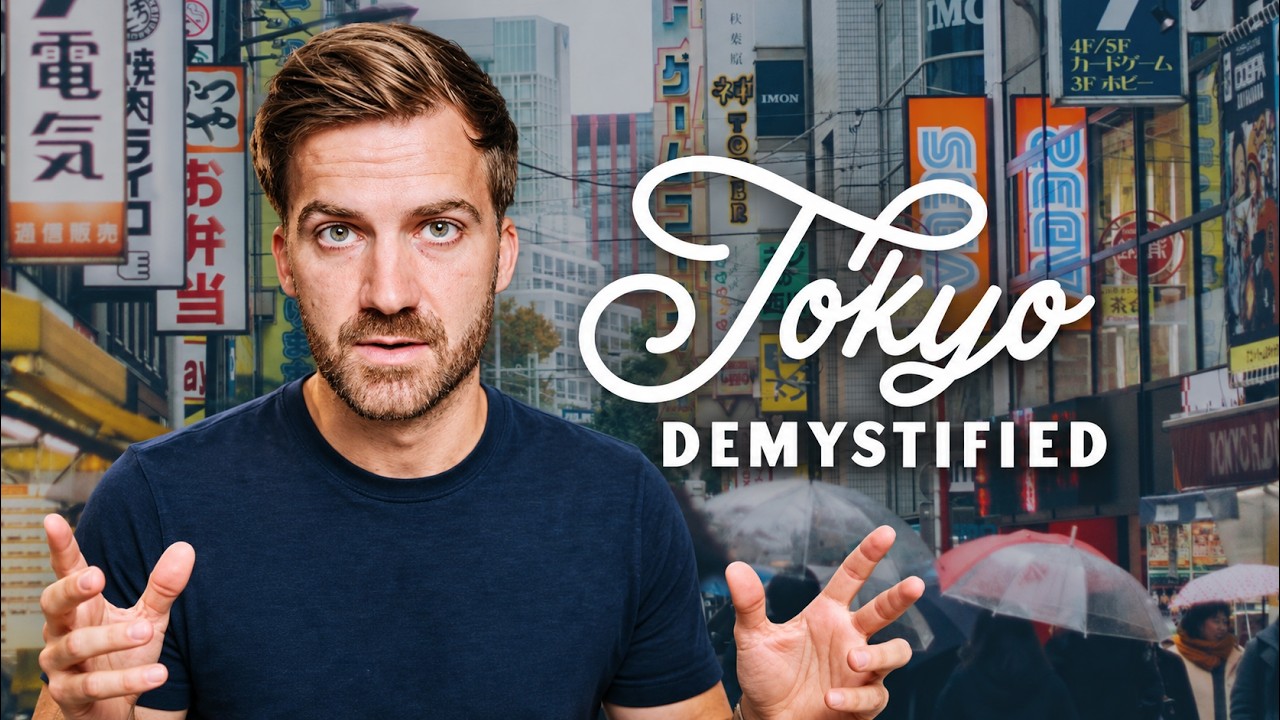
Johnny Harris and Bright Trip – Tokyo Demystified: Shinjuku Station, the busiest train station on the planet, sits at the heart of a city that is home to more people than any other on Earth, yet most first-time visitors arrive convinced that navigating it will be their undoing. That anxiety is understandable: 38 million people spread across a megalopolis that stretches as far as the eye can see, served by a train map that looks, on first glance, like a plate of tangled noodles. But Tokyo is a city built to be understood, and once a few key anchors click into place, the whole thing becomes manageable.
Tokyo’s story starts long before the skyscrapers. The city began as a fishing village called Edo, a sleepy coastal settlement that changed course in the 1600s when military commanders shifted Japan’s center of power from the historic capital of Kyoto to its shores. Edo grew in population and political weight until the late 1800s, when the emperor reclaimed authority and relocated from Kyoto, renaming the city Tokyo, meaning Eastern Capital. That transformation from fishing village to imperial seat to devastated postwar city to one of the highest qualities of life of any nation on Earth happened within living memory, which is why the collective awareness of it sits so close to the surface.
Finding your footing across six distinct districts
The city organizes itself more intuitively than its size suggests. The dead center is the Imperial Palace, a large forested green space with a moat, sitting alongside Tokyo’s central train station in the middle of the financial district. Lockers at the station let arriving travelers stow luggage before checking in, and the station itself holds food and shopping worth exploring on its own.
Moving south, Ginza and Tsukiji form the shopping and street food corridor. Ginza carries the same register as Fifth Avenue, but it also holds a 12-story clothing store and a 12-story stationery store side by side. The basement of the Ginza Six mall is worth going down for the food alone, and an elevator marked R takes visitors straight to a rooftop garden above the busy street. Tsukiji’s inner fish market has relocated to a nearby site, but the outer street food area persists, still selling Japanese steel knives considered among the best in the world.
To the west, Shibuya and Harajuku define what youth culture looks like at full volume. The Shibuya crossing handles up to 3,000 people at a single light change. One street over in Harajuku, Takeshita Street is the origin point of Japan’s kawaii aesthetic, the culture of cuteness that eventually gave the world Hello Kitty and Pikachu, though the guide notes plainly that the street has become ‘pretty saturated with visitors’ and the kitschy souvenir shops no longer represent the original culture well. Yoyogi Park, a forest of over 100,000 trees, sits immediately alongside both neighborhoods and holds Tokyo’s largest Shinto shrine, offering a full reset between the park’s calm and the neon of the evening.
Shinjuku earns its own category: the everything district. Walk out of the station and within a few blocks you can pass through a multi-story department store, turn into a narrow alley packed with food stalls, emerge onto an entertainment street blazing with neon signs, and end up at a hotel terrace looking at a giant replica of Godzilla. The density is the point.
To the north, Ueno Park holds the highest concentration of museums in the city, including the National Museum, which carries the world’s largest collection of Japanese art and is relatively quiet in the mornings. The city’s oldest Buddhist temple and an amusement park at Tokyo Dome City are both within reach of the same neighborhood.
The train system is simpler than the map looks
Of the 50 busiest train stations in the world, 46 are in Japan and 27 are in Tokyo. The system runs on lines identified by color and letter, and each station along a line carries a number that climbs or falls depending on direction. The Ginza line, orange and marked G, starts at station one in Shibuya and ends at station 19 in Asakusa. The guide’s core advice is to stop trying to memorize Japanese station names and just track the color and the number: ‘Instead of remembering that you have to get off at the Shidokana Dai Takanawa station, you can just remember that you have to get off at stop three when you’re on the blue line.’
The IC card, either the Suica with its penguin logo or the Pasmo in pink and gray, functions as the single payment tool for trains, buses, most convenience stores, and taxis. A 500-yen deposit gets the card started and can be refunded at a ticket office when leaving. Rush hour, roughly 10 a.m. and 5 p.m., is worth avoiding when possible, and backpacks come off and go to your feet once you board.
Arriving at Narita, the main international airport, the Narita Express runs directly to Tokyo Station, while the Skyliner suits travelers heading to the northern wards. The bus costs about a third of the train fare but is slower and subject to traffic.
A card with a penguin
At a kiosk inside a Tokyo train station, a Suica card with a small penguin printed on it sits in a traveler’s hand, 2,000 yen loaded onto it, ready to work on trains, buses, and the convenience store around the corner.
The train map that looked impossible at the airport will, after two or three journeys, start to feel like a grid that bends to your purpose rather than a tangle working against you. Tokyo is the most populous city on Earth, and it built its transportation system accordingly.
 Wake up to Only Happy News!