At 5:30 a.m. somewhere above the Dolomites, Ryan Shirley and his friend George were scrambling up a dark mountain trail toward the Tre Cime di Lavaredo, three rock pillars that tower over one of Europe‘s most surreal landscapes. When the sun broke over the peaks, Shirley was still catching his breath from the climb. That breathless moment, earned rather than observed from a bus window, is the entire thesis of a decade of European travel compressed into 100 destinations. The question every traveler quietly carries, which places are actually worth the effort, is the one Shirley spent ten years answering in person. He started in Slovenia and ended on a tidal island off the coast of Normandy, and what follows is every stop in between.
From Slovenia’s hilltop churches to Norway’s midnight sun
The journey opens in Slovenia, a country Shirley calls the most compact in Europe for sheer landscape variety. From Ljubljana, a one-hour drive puts you either in the Alps or down at the Adriatic. Lake Bled, with its island church, draws the most cameras, but Shirley’s personal favorite was the River Soca, a channel of Turkish-colored water he floated down on the current. The Postojna Cave requires a four-kilometer train ride underground before you can walk its enormous chambers. Hilltop churches dot the countryside throughout, and the Church of St. Thomas, perched above the Alps, is among the most photogenic.
From Slovenia the route swings to the Greek island of Milos, part of the Cyclades, where Sarakiniko Beach offers white volcanic rock and natural cliff jump ledges. The sea cave at Kleftiko, a collapsed ceiling open to the ocean, allows visitors to arrive by dinghy directly onto an interior sand floor. The water clarity, Shirley said, is ‘truly on another level.’
The Faroe Islands arrive next and land hard. The Drangarnir sea stack is reachable by a guided six-hour hike or a shorter boat ride. The Mulafossur Waterfall cascades straight into the Atlantic, and the island of Kalsoy ends at a lighthouse perched on sea cliffs that Shirley ranked among the most epic places he has ever stood.
Iceland follows, with southern Iceland’s Skogafoss waterfall dropping 60 meters and Reynisfjara Black Sand Beach defined by jagged basalt sea stacks taking constant wave punishment. The interior highlands hold the rainbow-colored mountains of Landmannalaugar, where thermal vents steam out of the ground.
Austria delivers Hallstatt by ferry, which is the correct way to arrive at the fairy-tale lakeside village. The Schafberg peak is reached by Austria’s steepest train. Near Gosau, the Sky Ladder via ferrata takes about two hours of climbing and keeps you clipped into an iron wire the entire way, which Shirley describes as ‘basically impossible to fall’ once you accept the initial wobble.
Croatia brings Dubrovnik’s walkable city walls, Plitvice Lakes National Park’s terraced turquoise water, and the island of Dugi Otok, home to the tallest lighthouse on the Adriatic and the Telascica Nature Park’s sea cliffs.
The Mediterranean islands, the Alps, and cities built on impossible cliffs
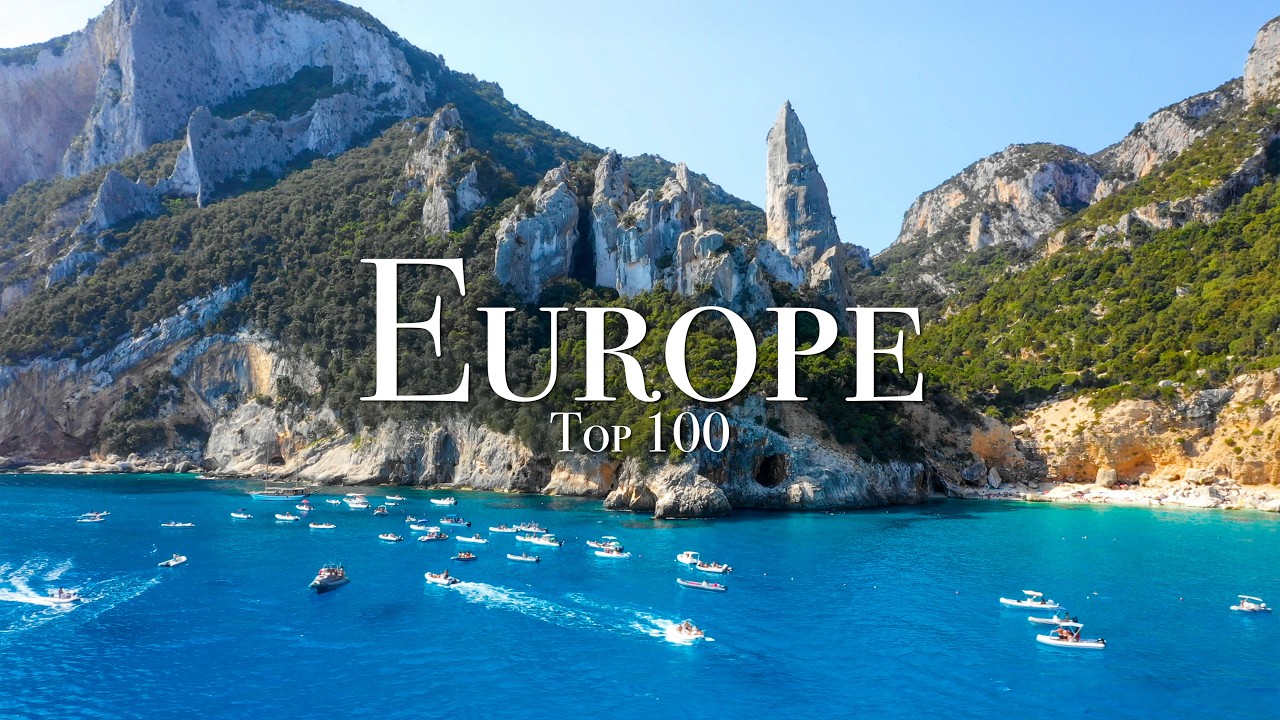
Corsica’s Bonifacio sits on sea cliffs and looks, as Shirley puts it, like it is about to fall into the ocean. A half-hour hike from Bonifacio reaches a beach with a rock tunnel connecting both sides of a formation. The Torre di Capo Pertusato took an hour to climb and returned 360-degree coastal views. Sardinia’s Bue Marino coast runs 40 kilometers of limestone cliffs and hidden beaches. Its star, a beach Shirley calls one of the most beautiful in all of Italy, is reached either by a moderate hike or a 45-minute boat ride to anchor offshore and swim in visibility he describes as among the best he has ever experienced. A sea arch at the site doubles as a cliff jump platform.
The Amalfi Coast town of Positano looks best from a boat. Fiordo di Furore, a fjord beach tucked under an arch bridge, is where Shirley sent flips into the sea. Capri’s Faraglioni sea stack is the island’s visual signature; renting a boat remains the best way to find its hidden grottos. The Lofoten Islands in northern Norway feel tropical despite sitting inside the Arctic Circle. The fishing village of Henningsvar is built across several small islands and overlooks one of the world’s most scenic football pitches. The Ryten hike demands nearly 2,000 stone steps and returns a panoramic fjord view. During June and July it is an extraordinary place to watch the midnight sun.
Norway’s Geirangerfjord, reachable by roughly five to six hours’ drive from Oslo, features the Seven Sisters waterfall cascading 410 meters to the water below and the historic mountain farm of Skagefla, grass-roofed and ferry-accessed, perched on a cliff that looks like it belongs in a different century.
Portugal’s Madeira earns its ‘Hawaii of Europe’ reputation. Pico do Arieiro sits high enough to place you in or above the clouds, and the trails are well-maintained enough that serious views arrive before serious distance. The beach at Praia da Ursa on the Sintra coast requires a hike down, rewards at sunset with an orange glow on enormous rock formations, and was cold enough to remind visitors it is the Atlantic. The Pena Palace in Sintra, completed in 1854 and one of the seven wonders of Portugal, glows red and yellow above the town and gets crowded enough that early arrival or avoiding August is genuinely worth planning around.
Switzerland claims Shirley’s title of all-time favorite country. Lauterbrunnen, with the Staubbach Falls dropping nearly 300 meters into the valley, is described as the inspiration for Rivendell. The Murren via ferrata takes roughly two hours from a starting tunnel through cliff faces, a wire traverse above a waterfall, and a shaky suspension bridge over a canyon, finishing in Gimmelwald. The Valle Verzasca river in the Italian-speaking canton holds a medieval bridge over water so clear that post-swim snorkeling is irresistible. The Matterhorn at 4,478 meters straddles Switzerland and Italy; Zermatt sits at its base and the Gornergrat railway delivers the best views. Grindelwald, surrounded by the Eiger, is where Shirley once hiked a random unnamed peak rather than pay for a lift, reached the summit alone, and considers it among his finest travel memories.
Albania’s Albanian Alps center on the village of Theth. The Blue Eye spring nearby is a roughly 40-minute hike to water so cold and clear that jumping in teeters between pain and exhilaration, with fish visible through the current. The Shala River winds from Theth to a canyon of turquoise water that takes about an hour by boat from Lake Komani, with bar and restaurant access and the option to sleep overnight. The Albanian Riviera’s sea cave, accessed by wading through a small entrance that opens into a dome-shaped room, is the best sea cave Shirley has entered in Europe by his own reckoning.
Hungary’s Budapest offers the Chain Bridge over the Danube, the Hungarian Parliament Building visible from its span, and the Szechenyi thermal bath, built in 1913, the largest medicinal bath in Europe with three outdoor pools and 15 indoor baths. Lake Balaton, about two hours from Budapest, is central Europe’s largest lake and home to the Tihany peninsula and its abbey, first built in the 11th century and rebuilt in 1754.
Romania’s Transylvania holds Bran Castle, built around the 14th century as a fortification against the Ottoman Empire and now known as Dracula’s Castle, and Corvin Castle in the town of Hunedoara, one of Europe’s largest, constructed in the 15th century. The Transfagarasan Road climbs to 2,042 meters through hairpin turns and typically opens from July to October.
Prague, founded around the 9th century and shaped by the Renaissance and Baroque eras, is anchored by the Charles Bridge, whose construction began in 1357 and finished in the early 15th century, decorated with 30 statues. Two hours south, Cesky Krumlov is a 13th-century medieval town that reads as a fairy-tale set piece. Krakow in southern Poland was founded in the 7th century; its Wawel Royal Castle dates to the 14th century, and its main square is the largest medieval town square in Europe. Morskie Oko lake in the High Tatra Mountains is a 16-kilometer round-trip trek from the trailhead, but the mountain backdrop at the end justifies every step.
Tallinn, Estonia, received city rights in 1248 and its old square remains one of Europe’s most intact medieval city centers. Riga, Latvia, founded in 1201 and the largest city in the Baltics, is anchored by the 14th-century House of the Blackheads and the skyline-dominating St. Peter’s Church. Finland’s Lapland in winter offers the Aurora Borealis on cold nights with temperatures that can reach -50 degrees Celsius, and snow-covered trees that Shirley compares to a Dr. Seuss illustration.
Malta’s capital Valletta covers just 61 square kilometers, the smallest EU capital city, with city walls so massive that imagining their medieval construction is genuinely disorienting. Comino’s Blue Lagoon and its cliff jump spots were the primary draw for Shirley’s visit.
The Netherlands produced the Kinderdijk village of 19 windmills nearly 300 years old, some still lived in as full homes, and the tulip fields of North Holland, which bloom anywhere from early April to mid-May depending on the year and the farmer’s planting choices. The historic district of Zaanse Schans near Amsterdam holds 13 windmills in what was once the oldest industrial area of Western Europe, at its peak running over 600 windmills for purposes including sawing wood, making paper, and grinding spices.
London gets the standard icons, Big Ben, the Palace of Westminster, Tower Bridge, Buckingham Palace, the London Eye, and Piccadilly Circus, but Shirley’s real recommendation is simply to walk. The Cotswolds village of Castle Combe has had no new houses built since 1600. The Jurassic Coast delivers Durdle Door’s limestone arch and the white-cliffed peninsula of Old Harry Rocks, about two and a half hours from London. The Lake District is home to Buttermere, a glacier lake whose name translates to ‘the lake by dairy pastures,’ and to Scafell Pike, England‘s highest point at 3,209 feet.
Wales offers Snowdonia’s Mount Snowdon at 3,560 feet; the steam train up costs around 48 pounds per person, takes about an hour, and requires stopping to let descending trains pass. At the base of the route, Llyn Padarn stretches two kilometers and its famous solitary silver birch tree grows on a small island just off shore.
Edinburgh is among Shirley’s all-time favorite European cities. Calton Hill gives a 360-degree panorama of the city. Arthur’s Seat, an extinct volcano in Holyrood Park at 823 feet, is a short walk from the city center and a reasonable hike to the top. The Canso Stacks in the far north of mainland Scotland, about five and a half hours from Edinburgh, are best viewed near sunset when jagged rock catches the low orange light. Glencoe’s Three Sisters mountain cluster and the pyramid-shaped peak visible from the Buachaille Etive Mor viewpoint line the drive east through the valley. The Glenfinnan Viaduct, completed around 1898 and featured in the Harry Potter films, sees a steam train cross four times per day at fixed times. Shirley missed one by minutes and waited three hours for the next. The Isle of Skye’s Old Man of Storr, a dramatic rock formation that takes about a three-and-a-half-mile round trip from the trailhead near Portree, was hiked in cloud cover on his most recent visit, creating a dramatic setting that was its own kind of reward.
Northern Ireland’s Giant’s Causeway is defined by 40,000 hexagonal basalt columns along the coast. Legend holds the causeway was built by an Irish giant to cross the sea for a fight with a Scottish giant. The Skellig Islands off southern Ireland require a boat from the town of Portmagee and a rough open-sea ride of about an hour. Once ashore, 618 stone stairs climb past puffins burrowed into the slope to a sixth-century monastic settlement where roughly 12 monks at a time lived in precisely constructed dry-stone beehive huts designed to shed water. The monks left in the 13th century.
Cyprus’s area around Ayia Napa holds the Bridge of Love sea arch and the coastal rock formations of Aphrodite Beach to the west.
Crete’s city of Chania was shaped by Venetian fortifications built during their 13th-century rule. The beach in a fjord-like cove about 30 minutes from Chania is an easy hike down with cliff jump access. Balos Beach is remote, reachable by boat or a downhill walk, and shallow enough to swim in water of near-impossible clarity. Corfu, crossing from Albania by ferry, offers rocky outcrops near Paleokastritsa, a hilltop fortress, and the wind-shaped sea cliffs of Cape Drastis at sunset.
Zakynthos, which Shirley has visited four times, earns his title of favorite Greek island. Shipwreck Beach, where a Turkish cargo ship carrying illegal contraband ran aground in the 1980s after a chase by the Greek Navy, is viewable from a clifftop lookout about an hour’s drive from the main island or by boat from the northern harbor at Porto Vromi. The boat ride hugs the base of cliffs approaching 1,000 feet. As of recent years the beach itself is closed due to rockfall, leaving the ship visible from the water with no crowds on shore. The Keri Caves on the southwestern side are the best spot for open-water swimming on the island. Shirley’s group passed the twin rock formation called Marathonisi on the way, found a sea arch to drive the boat through, then Shirley scaled a large boulder in the sea to send gainers into the water below.
Lake Ohrid on the Albania-North Macedonia border reaches over 288 meters deep and is one of Europe’s oldest lakes. The medieval city of Ohrid on the North Macedonian side is anchored by Samuel’s Fortress on the city’s highest point.
Montenegro’s Kotor, situated in what some describe as Europe’s southernmost fjord, was part of the Venetian Republic from the early 1400s through the end of the 18th century. Its fortress dates to the sixth century. The nearby village of Perast, about 20 minutes away, features two offshore islands. Our Lady of the Rocks is an artificial island built over centuries as local fishermen added a stone after each safe return. St. George Island holds a monastery dating to the 12th century. At sunset, Perast’s Church of St. Nicholas tower glows orange against the Boka Mountains.
Bosnia and Herzegovina’s Mostar is defined by its Ottoman bridge from the 16th century, destroyed in 1993 and rebuilt in 2004. The Kravice waterfalls, 40 minutes from Mostar, form a natural amphitheater of cascading water.
The Canary Islands’ Tenerife holds Mount Teide, Spain’s highest peak at 3,718 meters, and the Acantilados de los Gigantes cliffs rising over 800 meters from the ocean. Gran Canaria offers the Sahara-like dunes of Maspalomas and the Roque Nublo rock formation rising from the landscape like a large thumb.
Majorca holds a permanent place for Shirley as the first destination he visited when he started solo traveling. At a beach he names Cala Figuera, he jumped off a 20-meter arch, one of the biggest cliff jumps he has ever made, and later found an underwater cave with his brother that they swam through together.
Toledo, about an hour from Madrid, is a city of three cultures, with Christian, Muslim, and Jewish influences layered across its hilltop architecture. The Alcazar de Toledo began as a Roman palace and was restored in the 16th century. Nearby, 12 windmills from the 16th century at Consuegra were made famous by Don Quixote. Ronda in southern Spain holds the Puente Nuevo bridge, built in the 18th century, spanning more than 120 meters above the El Tajo Gorge.
The Pyrenees straddle France and Spain, with Monte Perdido on the Spanish side and the Cirque de Gavarnie on the French side, a glacial bowl with waterfalls dropping down its cliff walls. Carcassonne in southern France, a Roman fortification expanded by the Visigoths in the fifth century, still stands with 53 towers and two outer walls. The Alsace region’s town of Colmar has a timber-framed medieval old town threaded with canals.
Bavaria’s Neuschwanstein Castle, the inspiration for the Sleeping Beauty Castle, is best viewed from a vantage point Shirley found in the trees nearby. The Zugspitze at 2,962 meters is reached by a cable car holding the world record for longest free span at more than 3,000 meters. From the mountain station, a ladder and iron wire lead to the summit cross. Below, the Eibsee lake is the ‘Mount Eaves of the Alps,’ clear-watered with tree-dotted islands. The alpine meadow of Vorderriss in Bavaria holds farm sheds dotting a hillside above a lake.
The Dolomites stand as one of Shirley’s most treasured regions, rated among the greatest weeks of his life. The peak Seceda is so unusually shaped it barely looks real and is frequently cloud-covered. The Alpe di Siusi, the largest alpine meadow in Europe, is reached by driving to Compaccio and walking to the famous viewpoint over the Sassolungo mountain. The Tre Cime di Lavaredo, three vertical rock pillars, produced that 5:30 a.m. alarm and the sunrise Shirley describes as one of the most incredible of his life.
Lake Como is anchored at the base of the Alps and ringed with luxury villas. The fishing village of Varenna, founded in 1769, was where Shirley based his stay, favoring the northern shore’s stone beach and the sunsets watched from its docks.
Rome’s Colosseum, completed in 80 AD and capable of holding 50,000 to 80,000 spectators, and the Baroque Trevi Fountain, built in 1762, are the required stops.
Puglia’s Polignano a Mare is a seaside town built directly onto sea cliffs. Alberobello is known for its trulli, the beehive-shaped stone houses. Taranto is a heavily fortified medieval city on the Adriatic. The mountain town of Pietrapertosa in Basilicata integrates so completely into the rockface that it barely looks built. Calabria’s Arco di Magno is a secluded arch beach that Shirley had entirely to himself. Tropea is the region’s signature cliffside town; its sea cave is reachable by wading through a narrow entrance that opens into a sand-floored room. The Costa degli Dei around Tropea includes the white granite cliffs of Capo Vaticano.
Sicily’s Cefalu was first mentioned in 396 BC and glows orange at sunset above a pleasant beach. The Aeolian Islands, seven inhabited volcanic islands off Sicily’s northern coast, home to two of Italy’s four active volcanoes, are best navigated by ferry from Milazzo or by sailboat. Stromboli, nicknamed the lighthouse of the Mediterranean, is visible at night with lava shooting from its summit. Panarea, the smallest of the seven, has whitewashed houses, massive sea cliffs, and a nearby islet with volcanic underwater bubbles warm enough for snorkeling.
Tuscany’s San Gimignano, an hour from Florence, has 14 medieval watchtowers still standing from a peak of 72, the tallest of which once exceeded 230 feet. The towers were built by competing families in a medieval height race Shirley compares to Manhattan. Florence, birthplace of the Renaissance, anchors the region.
The French Riviera town of Eze, founded around the 14th century, has an exotic garden at its hilltop with full Riviera views. Saint-Tropez is best experienced on foot. The Calanques near Cassis, particularly Calanque de l’Eissadon, reached only by hike or kayak, present white cliffs, pine green, and water blue in a single steep frame. Shirley found a rock about 7 meters high near the beach and jumped from it.
The French Alps hold Mont Blanc, the highest peak in the Alps at 4,807 meters, with the town of Chamonix at its base. The Aiguille du Midi cable car holds the world record for highest vertical ascent by a cable car, gaining over 2,807 meters, reaching an elevation of 3,843 meters. A round-trip ticket costs around 69 euros. At the top, tunnels carved from granite lead to platforms above the glacier, with an exit point where mountaineers head out to attempt Mont Blanc or explore the ice below.
Etretat in Normandy, about three hours from Paris, has chalk sea cliffs larger than Shirley expected, three sea arches, and a pointed sea stack. Sea fog rolled in during his visit and changed the mood entirely. Staying for sunset, when orange light hits the white chalk, is the move.
The sheep that ended the journey
On the last morning at Mont St. Michel, a herd of sheep came storming through the streets on their way to morning grass.
Mont St. Michel, the tidal island off Normandy that closes out the list, requires parking on the mainland and either taking a shuttle or walking four kilometers across the causeway. The abbey’s construction began in the 10th century and the tour costs around 11 euros per person. The stone arches inside are grand enough that Shirley compared walking through them to walking through Hogwarts. Around sunset on the evening before, the tide came in faster than expected, and the speed of the rising water made immediately clear why medieval pilgrims found the crossing dangerous. The next morning, the sheep arrived, and that was the end.