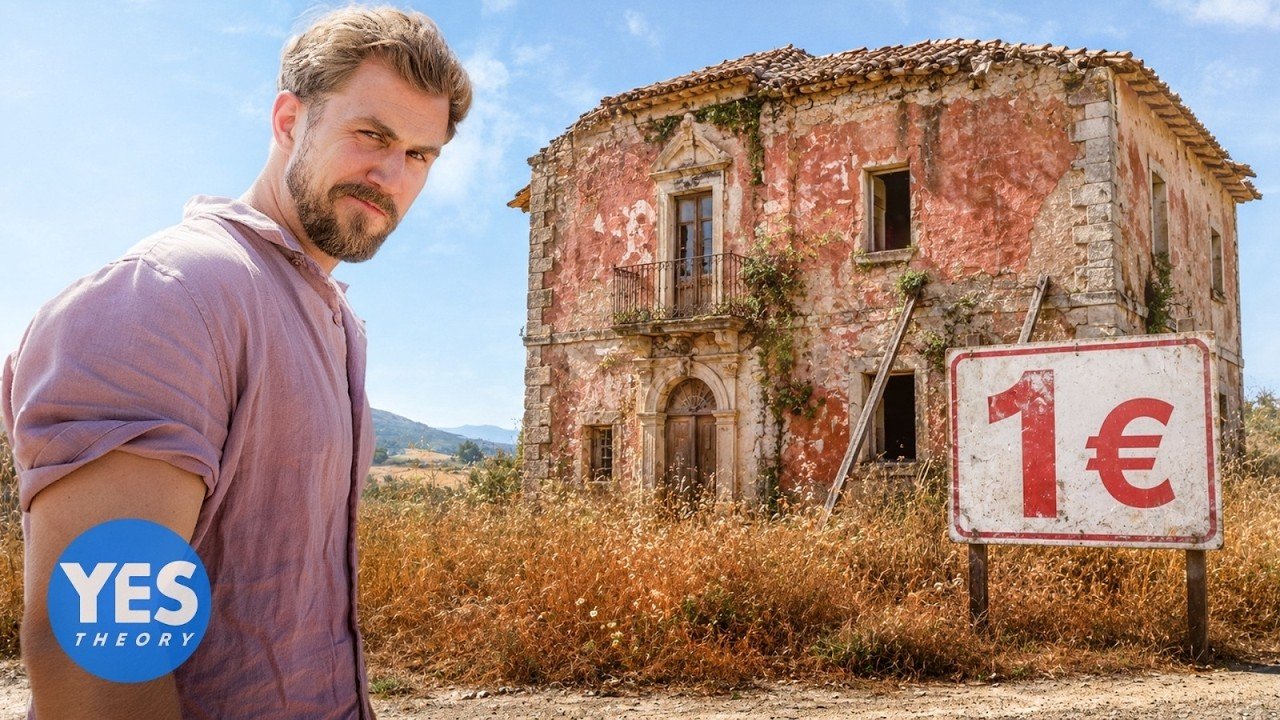
Summer found his home in Musameli by accident. He was passing through during a train strike, got talking to a painter renovating a derelict building, and left four years later the owner of four combined houses totaling around €8,000 and a church-valley view that runs all the way down to a tree he now also owns. His story is the one most people picture when they hear about Italy’s one-euro housing schemes, and it is almost the only one that looks anything like the fantasy. What Yes Theory set out to discover in rural Sicily was whether that fantasy was real, and whether it was the kind of place worth building a life, or at least a digital detox retreat, around.
To keep the investigation honest, the group deliberately recruited a skeptic rather than a convert. After scanning hundreds of Instagram comments under viral one-euro house posts, they found Stefan, a Finnish chef who owns nine steakhouses in Finland, competed on Top Chef, and left a blunt comment calling the whole thing a potential nightmare. He flew into Palermo with 400 euros in cash on the stated chance he might buy a whole town. Finnish directness intact, he opened his meter at a two-and-a-half out of ten and mostly stayed there.
What a euro actually buys you in Sambuca de Sicilia
The first town on the route was Sambuca de Sicilia, a hillside village in western Sicily that looks almost frozen in time from a distance. Up close, the story is more complicated. The one-euro housing scheme began in Italy around 2008 as local municipalities started offering neglected properties to buyers willing to restore them, and Sambuca was one of the early adopters. Decades of rural depopulation, the mechanization of agriculture, and a devastating 1968 earthquake had hollowed out much of the town, leaving whole sections empty.
The group met Gary, an American who had traveled to Sambuca with his girlfriend two years earlier and bought three houses together for under €30,000. Gary was clear that the official one-euro price tag was real in name but misleading in practice. The actual cost of renovation ran between €175,000 and €200,000 for what were often little more than piles of rubble. A cleaner move-in across the street had sold for €25,000. His own project came in at €35,000 before finishing work. He said the town had gone from having a Main Street that was at least half empty for sale or for rent to something visibly alive, with repaved sidewalks and houses under renovation everywhere. ‘It’s no longer a dying village,’ he said flatly.
Stefan’s blood pressure had other ideas. Mid-tour of Gary’s renovated space, readings came back high enough that the group spent the next seven hours waiting at the local medical center before doctors confirmed he was fine. He rejoined them the following morning, restored to a two-and-a-half on his internal meter.
The man who actually paid one euro
Musameli, the second town, produced the clearest answer to the central question. Summer, an Australian whose father is from Sicily, confirmed he had bought two of his four combined properties for the official price of one euro each, paying a notary fee of around €2,500 on each and handling much of the renovation himself. The other two cost a few thousand euros. Total outlay across all four houses came to around €8,000. The house nearest the street was partly built in 1580 and had been in one family, the Favata family, for its entire recorded life. When Summer cleared the basement, he found photographs from a hundred years ago with names and dates inscribed on them. He tracked down the family and returned them.
The town square had recently received a €2 million investment and now carries what Summer described as the fastest internet he had ever used, running to 2GB download per second. He estimated around 2,000 foreign residents now live in Musameli, roughly 25 percent of the total population. A volunteer kitchen run partly by a woman who spent 17 years working on Jamie Oliver’s community food programs in London was cooking a full lunch from rescued produce the afternoon the group arrived.
Still, the real one-euro houses were hard to love. The real estate agent’s tour produced rooms with no floors, probable mold, and what felt like decades of sealed-in stillness. Stefan’s verdict after stepping back outside was characteristically precise: ‘I want history. I want to breathe and smell and lift the history of this town. Otherwise I go move to Stockholm.’
The train-strike house
Summer’s combined four-house property, all the way down to the tree.
The view from his dining area opens over a church and a valley. The bottom floor of the building dates to 1580. Fifty-seven years had passed since anyone had lived there. Dead rats, a dead cat, dead pigeons. He did the renovation himself, enough to make it habitable. He plans to build community gardens in the open land below.
 Wake up to Only Happy News!