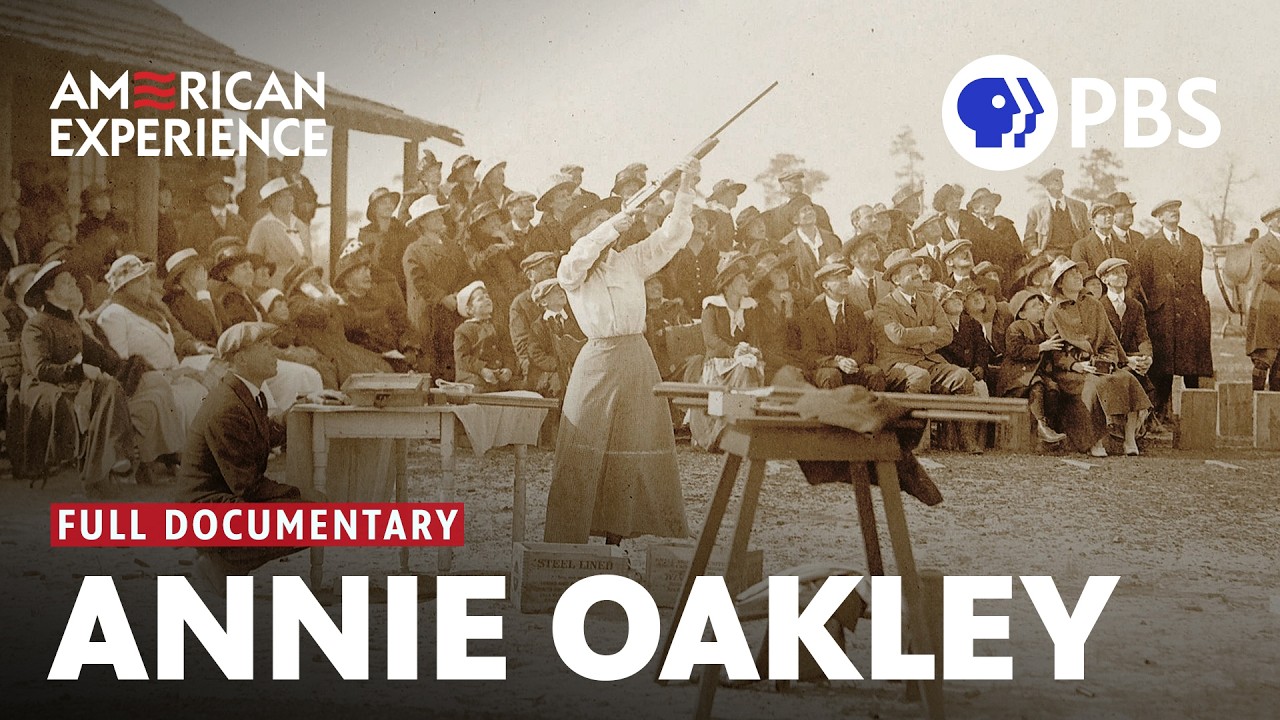
On a summer afternoon in 1922, a small woman with white hair skipped into a packed arena on Long Island, adjusted her spectacles, and signaled her husband to begin. Annie Oakley was 62 years old, reportedly a little out of practice, and still did not miss. What old-timers watching that day understood, and what most of her adoring public never knew, was that the composed, smiling woman behind the gun had clawed her way out of a childhood so brutal it shaped every calculation she made for the rest of her life.
She was born Phoebe Ann Moses, the fifth surviving child in a Quaker farming family in western Ohio. In late 1865, her father Jacob returned from a 14-mile journey to the mill in a fierce blizzard, his hands frozen solid, his speech gone. He never recovered, dying the following March when Annie was not yet six. The family lost the farm. To ease the burden, her mother sent her first to the county poor farm, then to work as a live-in helper for a family in a neighboring county. Annie never named them publicly. She called them only the wolves. They locked her in closets, worked her without mercy, and threw her into the deep snow without shoes when she fell asleep over her darning. ‘I got down on my knees, looked toward God’s clear sky, and tried to pray,’ she later wrote, ‘but my lips were frozen stiff, and there was no sound.’ She endured two years before escaping at age 12, slipping onto a crowded railroad car back to Greenville.
How a teenage hunter became the family breadwinner
Back home, Annie taught herself to shoot using her father’s old cap and ball rifle, heading into the woods and selling hampers of quail to Katzenberger’s General Store in Greenville. By the time she was a teenager, she had saved enough to pay off the $200 mortgage on the family farm. Her skill with a shotgun was becoming known well beyond her county.
In the fall of that period, an Irish immigrant sharpshooter named Frank Butler arrived in southern Ohio boasting he could outshoot anyone. Local farmers bet him $100 against a person in their county. Butler showed up to find a 15-year-old girl, five feet tall and 100 pounds. Both shot 24 birds in a row. Then Butler missed. ‘I stopped for an instant,’ Annie remembered. ‘I knew I would win.’ The loser was instantly smitten. Frank Butler eventually became not just her husband but, in a sharp reversal of 19th-century convention, her assistant and press agent. He understood, as one observer noted, that ‘she was pretty, she was lady-like, she was petite,’ and he did not want to get in her way.
The libel war that nearly cost her everything she had built
Annie joined Buffalo Bill Cody’s Wild West show in April 1885, rising quickly from low billing to become, by some accounts, as famous as Cody himself. She toured America and Europe, shot a cigarette from the lips of Prince Wilhelm of Prussia at 30 paces, and was adopted by Chief Sitting Bull, who named her Watanya Cecilia, Little Sure Shot. Her carefully constructed image, the calf-length skirt, long sleeves, leggings she sewed herself, the girlish skip into the arena, was deliberate armor against the Victorian suspicion that any woman performing on a stage must be disreputable.
That armor was tested in August 1903 when William Randolph Hearst’s Chicago newspapers reported that Oakley had stolen a pair of men’s pants to pay for cocaine, that she was a drug addict serving time in jail. The woman arrested was a burlesque dancer who had given Annie’s name. The Associated Press carried the story nationwide. ‘That terrible piece nearly killed me,’ Oakley wrote. ‘The only thing that kept me alive was the desire to purge my character.’ Over six years she crisscrossed the country suing 55 newspapers in what became the largest libel action the country had ever seen. She won 54 of the 55 cases. Hearst paid her $27,000. After legal expenses, she had spent more than she recovered. She did not care. ‘It’s not about money,’ one account of her thinking captured it plainly. She was spending money to prosecute an injustice.
The woman who never agreed to be forgotten
Oakley spent her later years teaching thousands of women to shoot, advocating for women carrying firearms for self-protection, and appearing in a Cincinnati newspaper demonstrating how to conceal a gun under an umbrella. She did not support women’s suffrage. She was, as one scholar of her life put it, ‘living a lot of the values that her feminist sisters were arguing for’ while refusing to claim the label.
A car accident in 1922 shattered her ankles and fractured her hip. She had her shooting medals melted down and donated the money to charity. On November 3rd, 1926, Annie Oakley died at home in her sleep. Frank, who had fallen ill while traveling in Michigan, died 18 days later. They were buried beside each other in Greenville, Ohio, not far from her childhood home.
The medals, already gone
Somewhere in the last years of her life, Annie Oakley gathered the medals from a career that had run across two continents and handed them over to be melted. No inventory survives of which competitions they marked or which crowned heads had presented them.
On a summer afternoon in 1922, the New York Herald reported that during the 16 years she performed with Buffalo Bill’s Wild West, she had never given a more entertaining exhibition than the one she put on that day on Long Island, adjusted spectacles and all, for a crowd that had no idea it was watching her last.
 Wake up to Only Happy News!