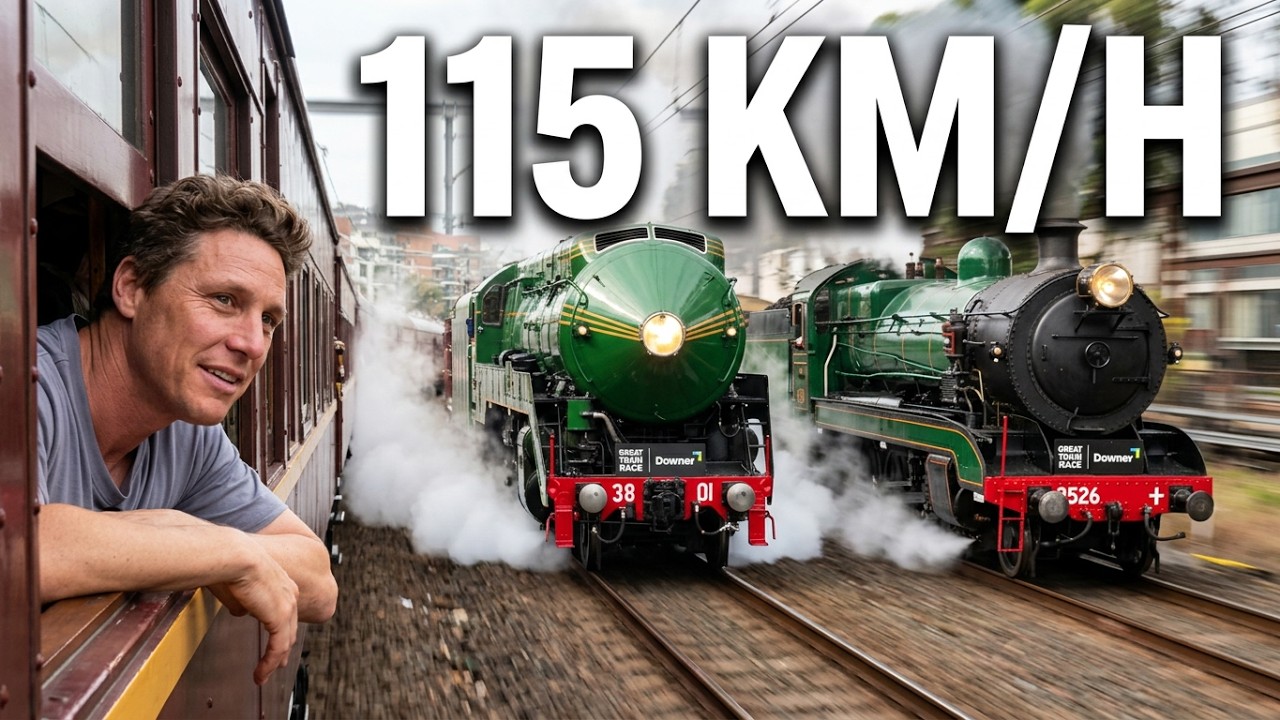
Sydney Central Station was running on coal smoke and boiler pressure the morning Mike stood in a train corridor, squatting against the hallway wall because the other locomotive was right there, out the window, close enough to feel the heat. The question he had arrived with was deceptively simple: between two steam trains built decades apart, which one was still the fastest? The answer turned out to be more complicated, and far more fun, than anyone on board expected.
A race more than a century in the making
The two contenders had been warming their boilers at Sydney Central Station as the Transport Heritage Expo got underway. Locomotive 3801, a streamlined steam engine built in 1943, already holds a steam speed record. Its rival, 3526, is older by 26 years, built in 1917, and was designed from the start to be bigger and stronger than traditional locomotives of that era. It is also, as it turns out, lighter than 3801. The expo was not a museum of static displays. Almost everything on site was running, and visitors could ride it. That philosophy extended all the way to the main line.
Before the race began, the day built momentum through layers of living history. A free bus ride from Sydney Central to the waterfront put riders aboard a fleet of working double-decker and single-level buses, some fitted with hand cranks, with noticeably more diesel exhaust than their modern counterparts. At the waterfront, the James Craig, a tall ship built in 1874, was taking passengers under the Sydney Harbour Bridge. At high tide the gap between the top of the mast and the bridge deck was approximately 14 metres, and Mike had predicted it correctly beforehand. A vintage rail motor, a passenger car with its own small engine built just over a century ago, was running tours along the main line and reportedly only gets out of the museum once a month under normal circumstances.
When two steam engines hit track speed side by side
The race itself unfolded with a particular honesty. The two locomotives eased past the maintenance yard, slipped by a handful of commuter trains, and found their parallel tracks out on the main line. Both had already been given a green signal. When they drew alongside each other and stopped, the race began.
3801 moved. Fast. It pulled away almost immediately, its power obvious from the moment the wheels bit. 3526 built speed more slowly, then started reeling the leader back in through the intermediate stations. Then 3801 made a comeback. Then ash began falling on the passengers inside 3526’s carriages, the real consequence of a coal-burning engine working hard at speed.
Mike was direct about what happened next: active railroad tracks carry a maximum permitted speed, in this case 115 kilometres per hour. With neither locomotive able to go flat out, the engineers turned the run into something arguably better, pulling back and forth past each other so every paying passenger on both trains got a clear view of the other engine working at full track speed. Commuters on station platforms watched two steam trains roll through together and had no idea what was happening.
His favourite detail was not the speed. ‘My favourite part of this experience is not just being next to them,’ he said, ‘but being able to look and listen to the engine chugging along with a full load of passenger cars behind it.’
A still moment on the platform
At the finish station, 3801 had arrived first. 3526, the older and lighter contender, was already there waiting.
By the time the two locomotives stood side by side at the end point, the coal smoke had settled and the boiler pressure had done its work. 3801 got there first. The gap was close enough that Mike said he might have to come back next year and try again.
 Wake up to Only Happy News!