Simone Giertz once built a chair specifically designed to hold half-dirty clothes. She solved the coat hanger problem in her bedroom by confronting it directly with power tools. But the t-shirt drawer, that churning, chaotic pit she started calling ‘t-shirt soup,’ was the one that almost broke her. The stakes of a messy drawer might sound small, but anyone who has ever yanked one shirt out of a packed pile and watched three others unfurl behind it knows exactly what she means. The solution she landed on took a street-salvaged cabinet, a custom-welded hanging system, hand-installed wallpaper, and the kind of stubborn creative energy that refuses to just try folding better.
Three problems, one drawer, and a refusal to try harder
Giertz diagnosed the chaos methodically. Problem one was herself, specifically her own inconsistency, which she immediately ruled out as something she had ‘no interest in trying to solve.’ Problem two was the shirts: wildly inconsistent in size, fabric, and cut, impossible to fold neatly even with effort. Problem three was visibility. Because she could not see what was in the drawer, she had to dig, and every dig rippled outward, destabilizing every shirt around it until the whole drawer curdled.
The cabinet arrived as found treasure: a piece of furniture someone left on the street, pretty enough that Giertz described it as almost unbelievable that anyone threw it away. She reglued the detached top panel, skipped paint entirely because the wood grain was too good to cover, and finished it instead with Danish oil. ‘You think I’m trying to get canceled?’ she said, mock-serious, at the suggestion of painting over it.
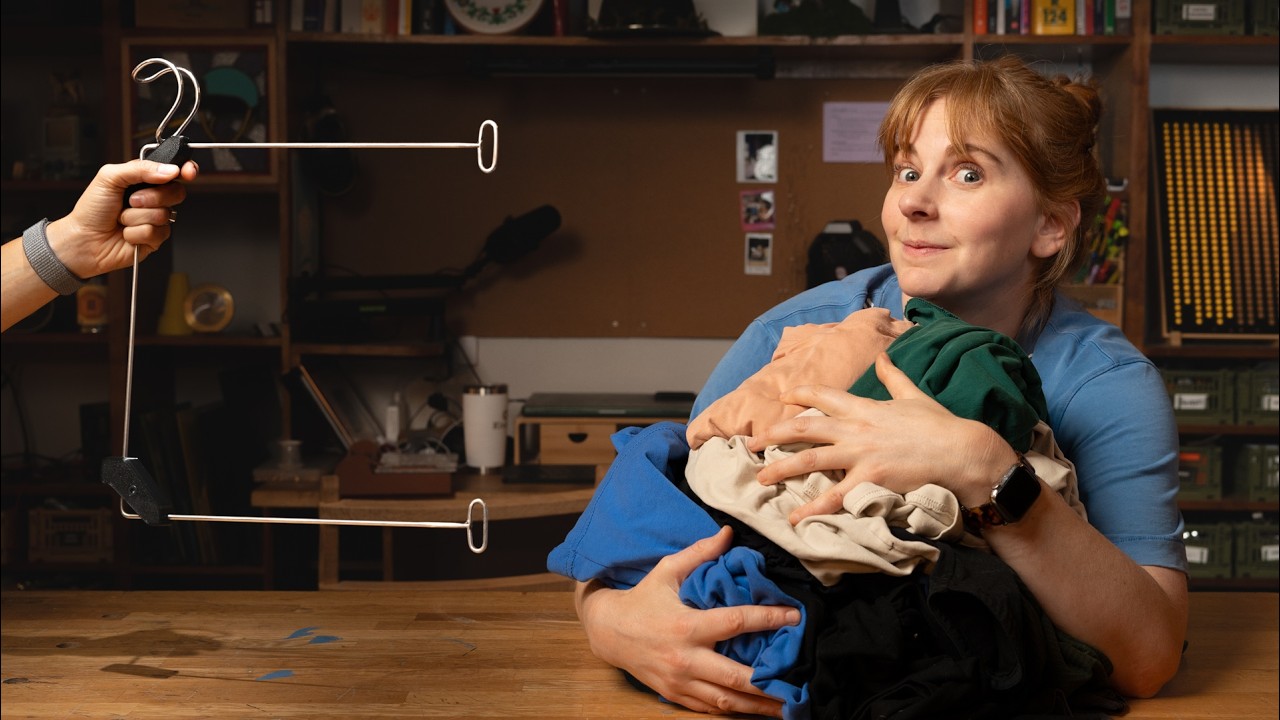
The real engineering began inside. She rejected coat hangers because they stretch shirt necks and require more effort than the shirts deserve. She also rejected folding entirely. What she landed on was a hanging rod system: U-shaped rods, each one holding two shirts draped over them side by side, mounted on supports she called the ‘double-necked gooseneck,’ a component her team was already developing for a future product. She welded roughly 25 of the U-shaped rods herself, building a jig first to keep them consistent across a full manufacturing line set up in her workspace: a cutting station, a bending station, and a welding station running in sequence.
When pulling one shirt no longer disturbs the rest
A key early prototype problem was rod stability. The grooved rods she initially tried prevented the shirts from sliding apart to create a gap for clean removal. A smooth rod solved the sliding issue but flopped sideways. She also printed 3D bracket reinforcers to stabilize the joints and correct a size mismatch between the rods and the mount hardware. Each small fix built toward a system where any single shirt could be lifted out without touching the ones beside it.
She lined the inside of the cabinet with wallpaper that arrived just before the final assembly, installing it without looking up instructions. ‘The stakes are so low,’ she said. ‘We’re just going to wing it.’ The finished interior paired the patterned wallpaper against the oiled wood in a way she liked enough to abandon her original plan for custom metal drawer pulls.
Loaded with shirts, the cabinet looked clean and orderly in a way she admitted felt almost suspicious. Putting shirts back in was still fiddlier than she wanted, a detail she logged immediately as a problem for a future version.
The shirt she pulled out without a single ripple
One rod, holding two shirts, hanging perfectly still while the shirts on either side stay completely undisturbed.
Giertz filled the cabinet, stepped back, and noted that the whole system was still faster than folding and produced significantly fewer wrinkles than t-shirt soup. ‘I am sold on the thing that I myself am selling myself,’ she said. The putting-back problem, and whatever comes after it, is already queued up as V2.