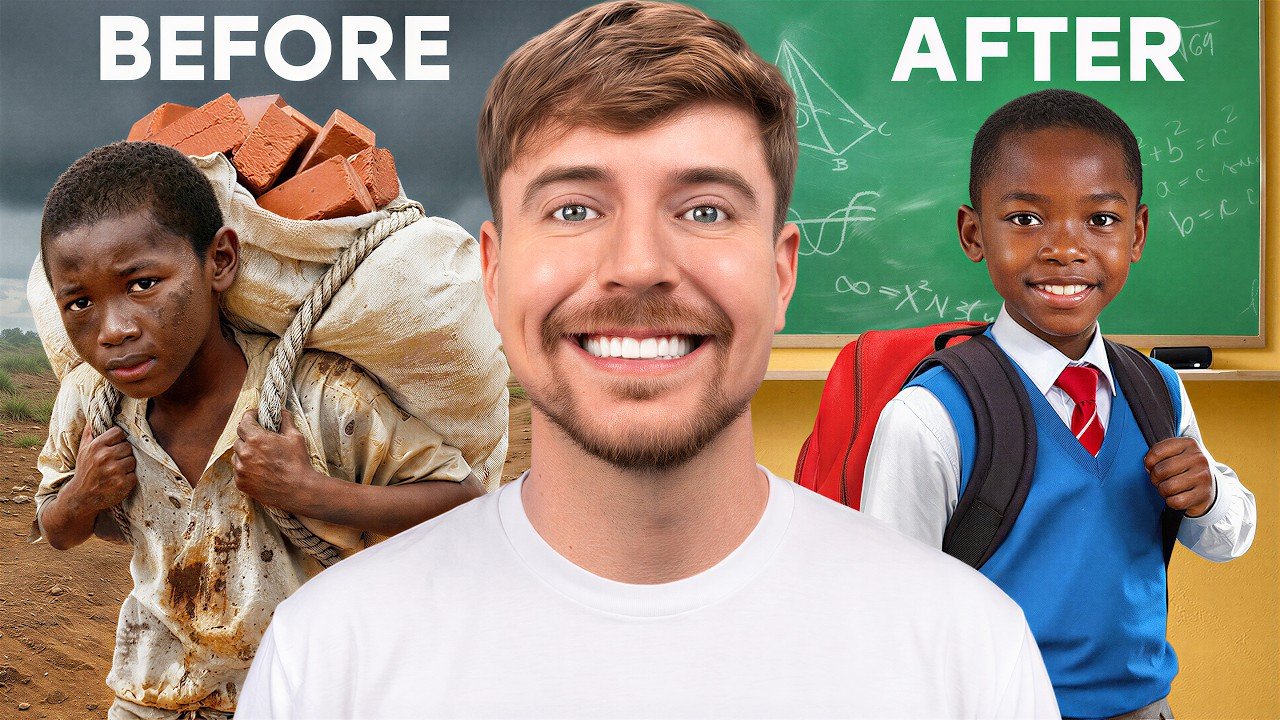
In Ghana, children abandoned by their parents are regularly captured and forced into the fishing industry as slaves – and when they finally escape, the medical system waiting for them is a 30-minute drive to a hospital with lines of over 600 people, where many are turned away without treatment. Beast Philanthropy traveled to the GMAD compound to document what came next: months of construction, a surgical center built from the ground up, and a young girl named Mary walking steadily on legs that had barely carried her before.
Here is how that facility came to exist – who built it, who volunteered for it, and which survivors it was designed to serve first.
Ernest, Richmond, and the Reality of Escape
Two brothers, Ernest and Richmond, were sold into the fishing industry after being abandoned by their parents. They were not rescued until age 16. During those years, they worked separately on the water, with no knowledge of whether the other was still alive. Richmond described how slave masters would threaten children who refused orders: ‘Sometimes they will try to push you inside the water. If you don’t know how to swim, then you are going to die.’ Twenty of his friends, he said, did not survive.
The Ghana Make a Difference Foundation – GMAD – pulled them out. Founded 12 years ago by Cory and Stacy Hoffman, GMAD runs a compound that houses abused and orphaned children, offering rehabilitation, education, and a structured path toward independent adult life. Ernest and Richmond were fortunate – they required no immediate medical attention after rescue. Many of their peers were not in the same condition.
Austin, GMAD’s executive director, laid out the gap plainly: volunteer surgeons arrive willing to perform over 200 major operations in four and a half days, but the infrastructure to support that volume had never existed. ‘The bottleneck’s always been O space,’ Austin said. ‘We’ve never had enough O space.’
600 People in Line, Then a Surgical Center
When Beast Philanthropy‘s crew arrived alongside the volunteer medical team, roughly 600 people showed up the first day seeking care. Some waited the entire day and were still turned away. That single day’s reality accelerated the decision: construction on a new surgical center inside the GMAD compound began immediately.
The 60 volunteer surgeons and medical staff fund their own travel to Ghana. They return repeatedly – not because it is easy, but because, as one surgeon put it, watching patients deal with severe conditions and still push forward is ‘infectious.’ Several of the volunteer doctors reported encountering medical cases in Ghana that they had never encountered in their entire careers elsewhere.
After months of construction, the Beast Philanthropy Surgical Center was completed and opened with a formal ceremony on the GMAD grounds. The night after the opening, surgeons used the new facility to operate on Mary, a young girl whose legs were so severely deformed she could barely walk. The procedure went forward – and Mary became one of the first patients treated in the new building.
The Bigger Picture
Child labor in West African fishing communities is a documented, persistent problem – and the medical fallout for survivors rarely attracts the same attention as the rescues themselves. What GMAD and Beast Philanthropy have identified is that the rescue pipeline and the recovery pipeline are two entirely different systems, and only one of them had been funded. Building surgical capacity directly inside a rehabilitation compound removes the 30-minute hospital commute, the six-hundred-person queue, and the systemic denial of care that was turning rescued children away from treatment they had already waited years to access.
Mary’s surgery happened the night after the ribbon was cut. Ernest and Richmond, now older and living within the GMAD system, represent what the compound was designed to produce – young adults who survived, stayed, and rebuilt. The surgical center means the next generation of survivors arriving at that compound with physical injuries will no longer have to add a broken medical system to the list of things they are recovering from.