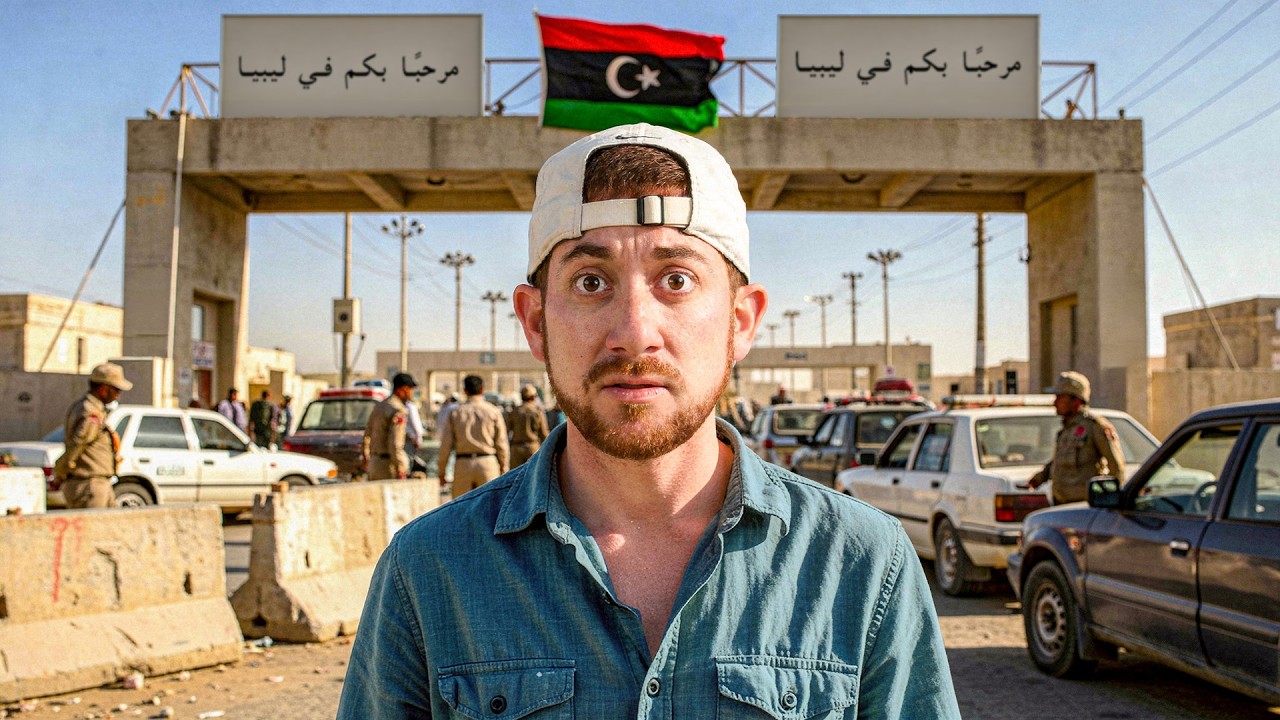
Deanna had one question before the car even cleared the border crossing into Libya: ‘Babe, do you feel dangerous?’ Her answer, delivered after just a few hours inside Africa’s most closed-off country, was ‘101 percent safe.’ That gap between expectation and reality is the whole story of Libya right now, and travel creator Drew Binsky spent two weeks there chasing it, alongside his wife on her first visit, with two undercover police officers riding with them every mile of the way.
What Tripoli looks like when you actually show up
Tripoli hits differently when you arrive at a land border that no tourist has crossed since the civil war started. Binsky and Deanna had their passports taken and stood in no-man’s land between Tunisia and Libya in 110-degree heat while officials processed the paperwork, a crossing that required special government permission to attempt at all. Once through, the first stop was a petrol station, where they filled an entire minivan with 40 liters of fuel for one dollar and fifty cents.
Martyr’s Square in central Tripoli is ringed by construction cranes that have not moved in 15 years. The buildings they were raising in 2011 are still mid-frame, frozen at the moment the revolution started. But at street level the city is alive: kids on go-karts, men exchanging dollars and euros from wheelbarrows in the old city lanes, and a stranger who flagged Binsky and Deanna down, bought them both espressos served in the bottom sixth of oversized cups, Italian-style, and refused payment so firmly that Binsky later said, ‘if I tried to pay, he would slap me in the face.’
The old city holds a 2,000-year-old Roman arch whose marble was shipped in from Rome because Libya had only sandstone. The call to prayer from surrounding mosques filled the air while Binsky stood beside it. He noted that the arch predates the arrival of Islam in Libya by roughly 700 years, which gave the moment an extra weight that no guidebook phrase could carry. A French-Libyan man who introduced himself as Nizar Salah Seren Gaddafi shook hands with the pair in the lane outside and told them to say hello to Trump.
At the city’s Red Fort, Binsky stood on the exact spot where Muammar Gaddafi gave his final speech in 2011 before he was killed, looking out over the same square Gaddafi had addressed.
Leptis Magna and the eight-hour drive to Ghadames
Leptis Magna, a Roman port city on Libya’s Mediterranean coast, was the clearest argument for the country’s tourism potential and the clearest evidence of why that potential sits largely unclaimed. An amphitheater that once held 16,000 people stands almost perfectly intact, sand having preserved it for centuries after the Roman Empire pulled back. On the day Binsky visited, not a single other tourist was there. As Binsky put it: ‘I’ve traveled to every country in the world. I’ve seen so many amazing UNESCO World Heritage sites and Roman ruins. But this place, Leptis Magna, is probably the most magnificent.’
From the coast the group drove eight hours into the Sahara to reach Ghadames, a 12,000-year-old oasis town near the Algerian and Tunisian borders. Their guide there was a man named Muhammad Ali, who clarified immediately: ‘Only the name.’ He walked them through streets that his family has lived in for generations, pointing out a double-lock door mechanism cut into stone, a wall still scarred from a French-American air raid in 1943, and the central square where wedding ceremonies for men were traditionally held while women celebrated separately in the houses above.
Two elderly residents, neighbors who grew up together in the old city and were separated in age by only four years, told Binsky that the families moved to a new settlement just 100 yards across the road in 1982. They still return to the old town regularly. One of them, 74 years old, called those early years ‘like memories.’
A Berber granary on the route to Ghadames had 600 individual chambers carved into stone, built between the 6th and 7th century AD to keep food cool in the Sahara heat. A local guide called it the country’s biggest and oldest surviving granary. The moment Binsky stepped inside one of the cave chambers, the temperature dropped immediately despite the scorching air outside.
The woman whose question landed hardest
An artist running a gallery of Libyan traditional handmade goods in Tripoli’s old city had met Binsky six years earlier on his first visit. She was still there. When asked what she would tell female travelers nervous about coming to Libya, she said foreign women she knew had told her Libya was ‘the easiest place to be,’ adding that local men ‘are not nasty at all’ and that as a foreigner ‘you’re free to do whatever you want.’ The country, she said plainly, ‘is not stable yet.’ She hoped things would be better in another six years.
The trip ended with dune bashing in the Sahara, sand pelting every window of the SUV as it crested the edges of massive dunes. Deanna, who had boarded the flight with serious reservations, summed it up from the passenger seat: ‘It’s so different than what I expected. People are very genuine.’
The granary at Nalut still stands at the edge of a Saharan hillside, its 600 chambers quiet in the afternoon heat, each one owned by a different family in the town below.