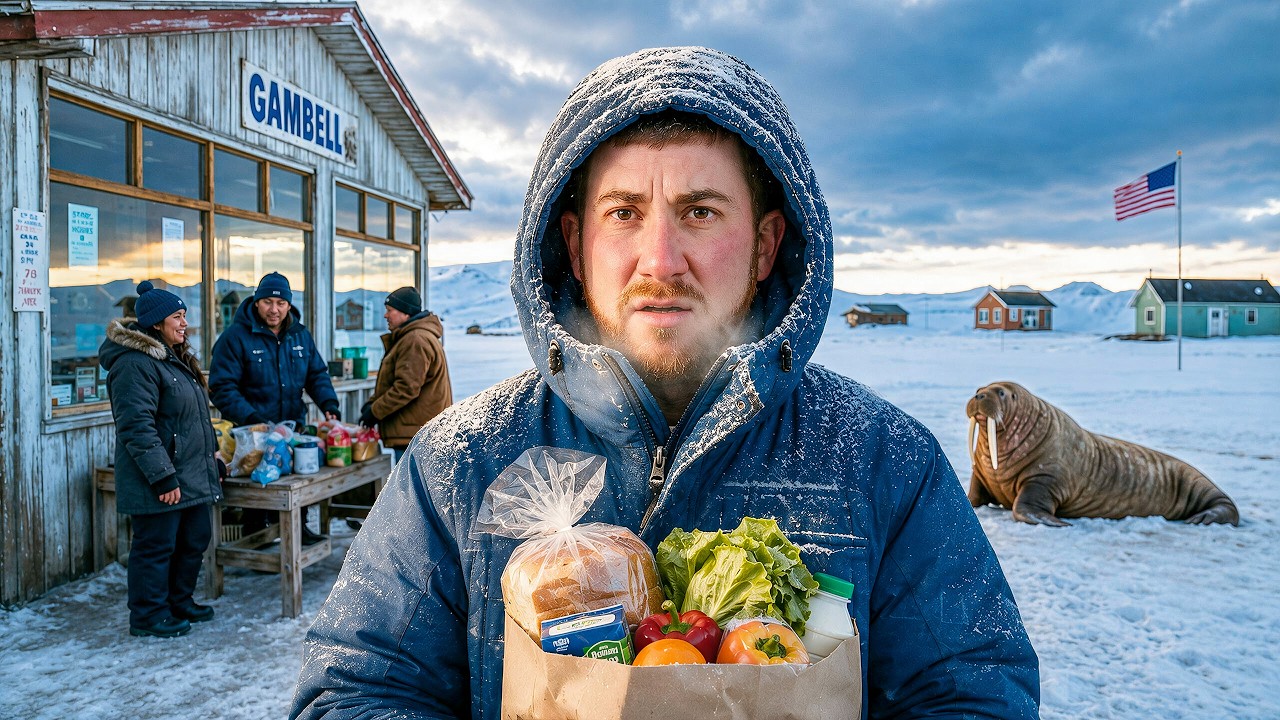
Gambell sits on the northwestern tip of St. Lawrence Island in the Bering Sea, close enough to Russia that on a clear day you can see the coastline 30 miles out. That proximity is not a quirk of geography. It is the entire story of this place, a Yupik community of roughly 700 people who have outlasted empires, famines, and the Cold War by staying exactly where they are and eating exactly what the sea provides. For Drew Binsky, a travel journalist who has spent a decade chasing the world’s most overlooked corners, walking off a small plane onto the gravel of Gambell produced what he described as ‘that tingly feeling inside’ that tells you something is going to be genuinely good.
His local guide was Wallace, a Gambell native who played Division 2 basketball in the Lower 48 and came home. Wallace’s family became the gravitational center of the visit: his father, a whaling captain whose 2021 catch fed the whole community, his mother, who cooked non-stop and organized the household’s two chest freezers packed with aged whale muktuk, walrus skin and blubber, dried bearded seal meat, and a block of polar bear rump caught just six weeks earlier on the edge of town.
Where the meat rack tells you everything
Every family in Gambell keeps a meat rack outside. Wallace’s neighbor had a polar bear hide stretched across his, taken two months prior after the animal wandered into town and was found eating the family’s whale head. The hunter described the encounter plainly: he was heading to the dump, saw two black eyes and a nose, and hauled away to get a gun. The hide is roughly three inches thick.
Nearby sits the family’s whale bone yard, jawbones from bowhead whales caught over decades. One skull is 12 feet long and 6 feet wide and has been weathering in the yard for 20 to 30 years. A more recent catch, from 2021, still carried some flesh. Wallace explained the community logic without sentimentality: one bowhead whale, taken with a whale bomb, feeds all 700 people in Gambell for an entire year. Whenever a walrus or seal is brought in from a boat, the meat is divided and hand-delivered to 10 to 15 households, prioritizing families without able-bodied hunters. No money changes hands. ‘Food is for family,’ Wallace said.
That ethic runs against the economics of everything else on the island. The one grocery store, opened about five years ago, charges $10 for a loaf of bread, $8.49 for a half gallon of milk, $22 for a frozen pizza, and $15 for ketchup. A chocolate birthday cake runs $38.99. Binsky estimated prices at roughly two and a half to three times what he pays in Arizona. Heating fuel, a diesel blend the locals call stove oil, gets shipped in on a single barge once a year. In winter, 15 gallons lasts five to seven days.
The culture that refused to be bought
In 1971, when the US government offered Alaskan natives money in exchange for ancestral land claims, most communities accepted. Gambell and neighboring Savoonga did not. They kept ownership of nearly all of St. Lawrence Island, which is why visiting journalists must pay several hundred dollars to the tribal office upon arrival, and why only Gambell residents can legally carve walrus ivory and sell it. A man Binsky met near the gas station had pulled tusks from the Bering Sea the previous week and was headed to weigh them, expecting at least $250 per piece.
The Yupik people on this island share the same language, food, and clan names as Yupik communities on the Russian side of the water. Families used to paddle between continents until the Cold War shut the border. Wallace’s parents mentioned a woman in Hawaii who told them there may be blood relatives of their clan living in Russia now, people they cannot visit. Wallace compared it to North and South Korea: same culture, same food, same language, separated by a line neither side drew.
The evening ended at the school gymnasium, where the entire community arrived on ATVs for a Yupik cultural dance. It was 9pm but the sun was still high. Eight-year-old Paul, recovering from ear surgery in Anchorage for a condition called cholesteatoma, delivered an unprompted speech: ‘I love life, man. It’s crazy and fun. Go achieve your dreams, achieve them no matter what anyone says.’
A drum made from a walrus stomach
In Lyda’s house, where 10 family members share the space, one of her relatives held a drum before heading to the dance. The frame was wooden. The striking surface was walrus stomach. The handle was walrus tusk ivory.
Wallace loaded 15 gallons of stove oil into three tanks beside the house, enough to last a couple of weeks in summer, five to seven days come winter, until the next annual barge. The antlers from a reindeer rested against the wall nearby. Walrus tusks leaned in the corner. Seal meat hung drying in the cold air just outside.
 Wake up to Only Happy News!