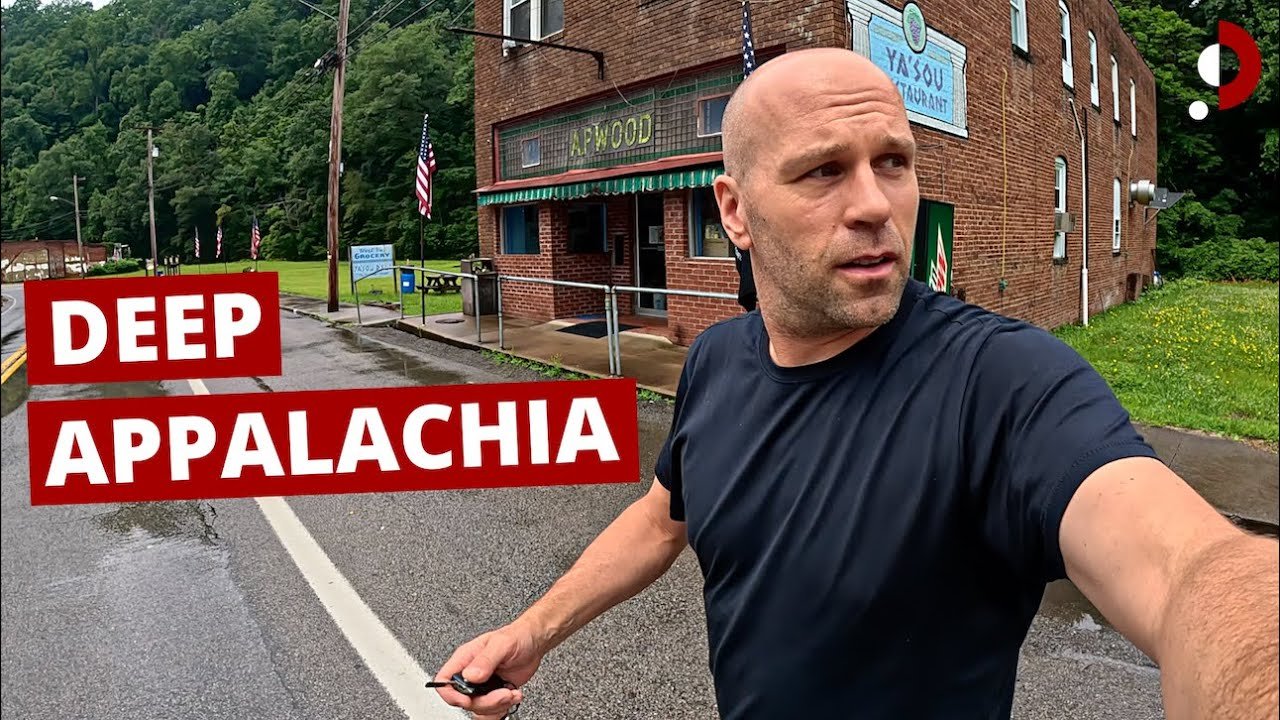
The door of a rental truck clicks open somewhere in Bluefield, West Virginia, and Peter Santenello steps out into a morning that smells like coal dust and pine. He is headed south and west, tracing a back-road arc through McDowell County into Virginia, four-plus hours toward the Kentucky line, into a stretch of Appalachia that carries the distinction of being among the most economically distressed regions in the country. The story of how a place this lush and this tight-knit ended up this hollowed out is not a simple one. And the only way to understand it is to drive in, knock on doors, and listen.
McDowell County sits at the center of this journey, with an average family income of $25,600. The main street in Welch, the county seat, tells the story quietly: beautiful old brick buildings, a Panda Garden restaurant marked ‘Closed permanently 3/13/23,’ storefronts locked up one after another. A coal truck rumbles past. The rails that once hauled out ‘tons and tons of coal’ are still there, running alongside streets that used to be bumper-to-bumper on a Saturday.
The men who stayed and the ones who never left the holler
On a sidewalk in Welch, Santenello meets a 77-year-old man everyone calls T, vouched for by his neighbor Clarence as the best man in all of McDowell County. T grew up in Tazewell, Virginia, spent 43 years repairing mining motors and steel mill motors, and has watched the county change underneath him. Asked about the younger generation, T does not hesitate: ‘They’re gone.’ The ones who stayed, he says plainly, are split. Some are on drugs. Some are working harder than anyone will ever know.
That split keeps coming up. Two men in their early forties outside a building in Welch confirm it without prompting. One did three weeks underground before deciding coal mining was not for him. The other served in Baghdad from 2005 to 2006. Both describe the hollers in the same terms: everybody knows everybody, if you got in trouble as a kid, five people had already called your mother before you made it home.
Up one of those hollers, on a one-lane road called Bartley Branch Road, a woman who has lived there since 1969 meets Santenello at her door holding a worn booklet documenting every mine in McDowell County. She worked the mines herself for years, crawling on her knees in low seams, and she describes a shift where water backed up behind 12 breaks and blew the coal out ‘just like an explosion.’ She and the seven others on that evening shift got out. Ninety-one men at the Bartley mine did not, and their names are all in the booklet. Her father was killed in a different mine in March, months before she was born the following August. She hands Santenello a cold bottle of water before he leaves.
The fork in the road that every young person here faces
In Grundy, just over the Virginia line, Santenello stops at a small business where a 23-year-old named Shay has worked since she was 16. She is weeks from finishing her associate’s degree in criminal justice. She estimates that roughly 50 percent of her graduating class are working adults now. The other half are either incarcerated, on drugs, or drawing disability checks and living with parents. Her best friend from high school is currently in prison for drugs. Fentanyl, she and her manager agree, is bad. Very bad. The manager describes an employee who finished 1,400 hours of community service for a drug-related situation and is now one of their best workers, driving nearly an hour each way after shifts that run from five in the morning.
Down by the river, Santenello finds a group of teenagers and young men fishing. One of them, 18 years old, has rebuilt every vehicle he has ever owned, helped his mother gut and restore a house built in 1910, and is six months into a college program for diesel mechanics and Class A CDLs. He has carried his father, who was badly injured in a motorcycle accident, from the house to the truck and back again more times than he can count. He rattles off this biography between casts, then, at his friends’ urging, sings an original song about Appalachia that stops the whole riverbank cold.
That same young man looks out at the water and puts it simply: ‘I want to show people that Appalachia is not, that we are more than just drugs and coal mining.’
The gravestone that stopped him cold
Deep in the Dunford Family Cemetery, about 20 minutes up one of the hollers, a small headstone marks a life of 18 years: Gus Ciphers.
The name sits in the middle of a long row of Dunfords, surrounded by the same forest that has been slowly reclaiming the houses and storefronts further down the valley, and there is nothing around it that explains what cut that life short or what it meant to the people who placed the stone there.