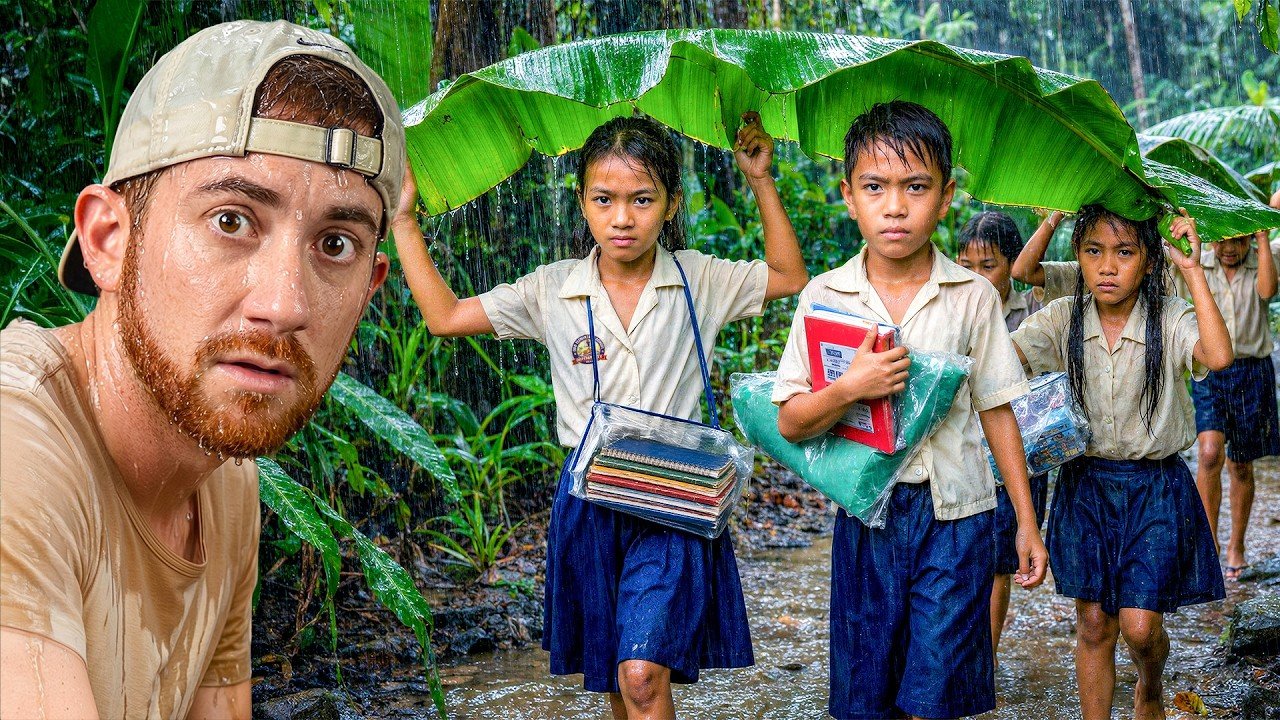
Kyrie is packing his bag in his bedroom, filling it with books until the straps pull tight. He likes cars – his backpack has them printed across the front. Asked if the heavy bag is difficult to carry on the walk, he shakes his head without hesitation. Then the rain starts, and everyone waits inside.
The walk in question covers a mountain trail above a remote village in the Philippines. It takes roughly five hours round-trip. Kyrie does it every school day, along with his best friend Januel and a rotating group of classmates ranging from elementary to high school age. When the rain is heavy, the trail becomes too slippery to attempt, and school is simply missed.
What the trail actually looks like from the inside
The hike starts on a road, then cuts into the mountain. Within the first 20 meters of the ascent, the humidity is enough to soak a grown adult through. The kids do not stop. Along the way they pick up Gianne, a Grade 9 student who takes this route every single day. She says the group walks happy, trading stories and jokes as they climb.
Deeper into the jungle the trail passes through untouched stands of bamboo and coconut trees, all of it dense enough to block the sky. The kids mention cobras without alarm. One student explains that two wrong foots sent him grabbing for branches, both times. He was not hurt either time, but one wrong step is still how he describes the mountain’s main challenge.
The section they call Pang Pang stops the trail cold. It is a near-vertical cliff face that requires hands, knees, and feet simultaneously. The kids who grew up on this route started climbing Pang Pang in Grade 2 or Grade 3. They strip off their shoes and carry them over their arms because bare feet grip the soil better. Asked if their feet hurt on the sharp rocks, one student points at a jagged patch of stone and says only that part is sharp. The rest they manage.
Past Pang Pang, there is a small clearing with coconut trees. One student shimmies up a trunk and knocks down a coconut, nearly clipping Kyrie on the way down. The group drinks it on the spot. The coconuts in the Philippines taste different, sweeter and fresher than anything processed. Then the hike continues.
Seventy-seven years of operation and never a school bus
Oro Elementary School has been running since 1948, according to its principal. It currently enrols 108 pupils. Not all of them make the mountain trek – many live close to the school or can afford a tricycle ride – but the ones who cannot afford transport have no other option. Asked directly whether the school has ever had a bus in its 77-year history, the principal says no. The reason is budget. The school roof is deteriorating. The buildings need paint. The windows are broken in places. The principal notes that on bad weather days, children who are late are given a review rather than penalised, but they still miss instruction time.
Enrollment has been falling. The principal says that if transportation existed, students who currently attend other schools might return. The problem, as stated plainly, is that the school is remote and getting here is expensive for families who have very little.
The students who do show up are engaged. Kyrie’s favourite subject is English. He wants to join the army when he grows up, to protect his country. His class that afternoon covers multiplication. He says he enjoyed school. He is asked to be at school the next morning for a surprise.
The fundraiser no one on the mountain knew about
While the school day runs, Drew Binsky – who lived in the Philippines for three years and married into Filipino culture – goes looking for a vehicle. His wife Deanna and her company Remote Genies, a marketplace for pre-vetted Filipino freelancers, contributed to the fundraiser alongside his online community. The total raised was $7,500. A used white van is found for $10,000. The difference is covered. The van has air conditioning – something many of the children have never experienced at home or at school. The deal is made on the spot.
The following morning, the van rolls up to Oro Elementary School. The principal and students are gathered. Binsky tells the group the vehicle is their school bus now, that a community of people pooled money specifically so they would not have to make that hike anymore. A driver and fuel costs are also covered so the children can get to school safely and on time each day.
Kyrie, standing next to the van
Kyrie is crying. Someone asks him what is happening. He does not answer right away. When he does speak, he says thank you. The other kids are already climbing in, tagging the doors, pressing their faces against the windows with the AC vents. Kyrie stands outside a moment longer.
Back at the start of the morning, Kyrie had packed his car-print backpack tight with books, told everyone the bag was not heavy, and walked out into the rain. He has done this walk since Grade 2.
Source: Watch original
This article was reported in June 2026.
OHN Editorial Note: This article is based on publicly available sources. If you spot an error or have updated information, contact us at editorial@onlyhappynews.com. We correct mistakes promptly.