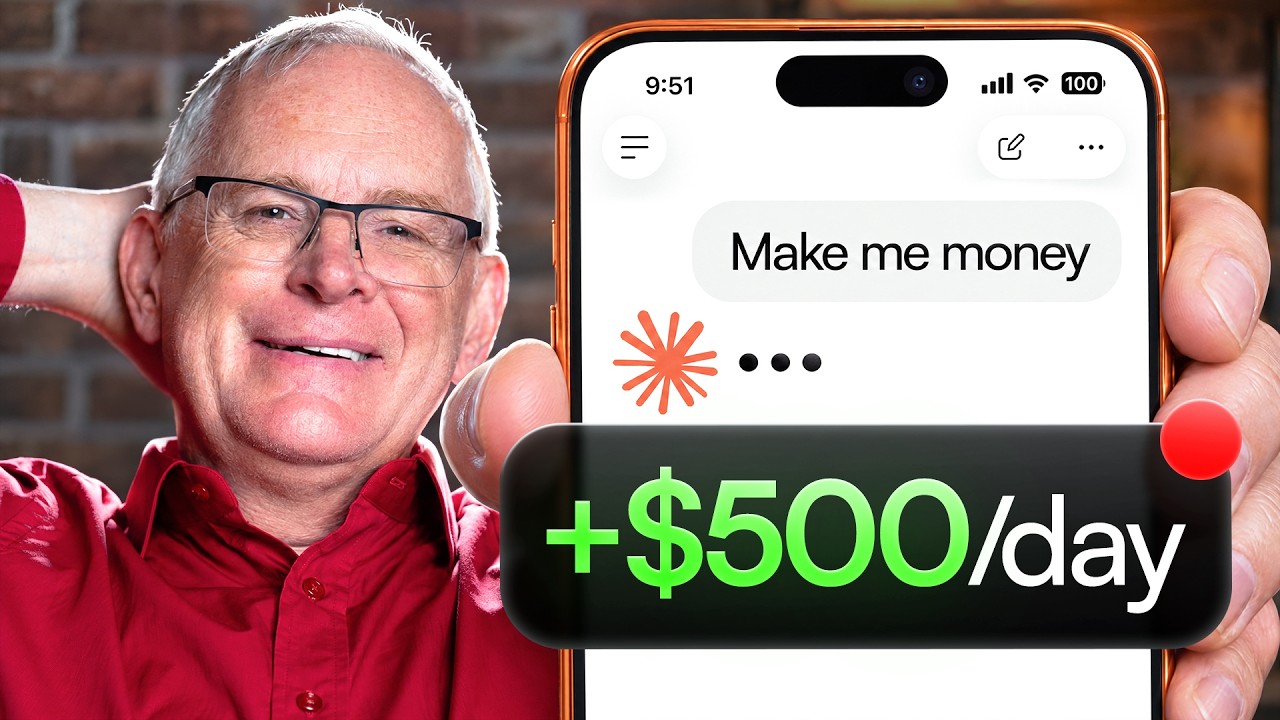
The timer started the moment Mark Tilbury typed his first message into Claude: ‘You are my boss and for the next 7 days I’m going to do exactly what you tell me.’ Tilbury, a businessman who built his fortune well before AI existed, was handing over every major decision to a large language model and committing to follow the output even when he disagreed with it.
The rules were simple and deliberately limiting. No using his own name or face. No overriding Claude’s decisions. And full screen-share transparency throughout. If the experiment failed to generate at least $1,000 in profit inside seven days, Tilbury would pay that amount out of his own pocket to a commenter.
How Claude picked the business model and built the first list
When asked to name one AI side hustle worth starting immediately, Claude returned a clear answer: use AI to create promotional images and videos for small businesses. Tilbury had reservations. He had seen enough low-quality AI-generated content to be genuinely worried about selling something he would not buy himself. But Claude was boss, and that was the arrangement.
Step two was building a prospect list. Claude directed Tilbury to search Google Maps, Instagram, and Facebook, starting with businesses in areas he knew personally. Working from Dubai on a business trip while maintaining contacts back in Kent, UK, Tilbury began pulling together candidates. Sharon’s Bakery appeared early, chosen for its premium branding and active social media presence. A boxing gym run by his son’s trainer made the cut because its website had almost no photos. Kent Classic Vehicles, a jet ski company, a florist, a static home park, and a coffee shop in Dubai all followed. Claude even generated a tracking spreadsheet to manage the outreach.
One addition carried personal weight. Model World, a model shop Tilbury had owned decades earlier, landed on the list. He decided to reach out under a completely different identity, curious whether the business would recognise an opportunity when it came from a stranger with no connection to its history.
To generate the sample images, Claude recommended Higgsfield, an AI image and video platform. Tilbury fed it the Instagram pages and websites of each business, and Claude used a custom connector to pass instructions directly to Higgsfield. For Sharon’s Bakery, the results included cookies floating in mid-air, branded packaging recreated with the bakery’s actual logo, and in-store display shots that appeared to match the real shopfront. Roughly 50 businesses received free samples attached to outreach emails written by Claude, each personalised to the specific business and offering a full promotional video with payment only after the client decided what they thought it was worth.
The replies that came back and what the finished videos looked like
Three days after the emails went out, the responses arrived. Most businesses did not reply at all. A dentist explained they already had a marketing agency. One contact asked to be removed from the list entirely. Another wrote back with two words: ‘AI slop.’ Tilbury noted that even well-executed AI imagery could be a dealbreaker for some clients simply because of what it was.
Four businesses said yes. Sharon’s Bakery wanted to see a video advert. Explosive Fitness, the boxing gym, expressed interest. The static home park said they had a specific residential property they were hoping to sell and wanted something to help. And Model World, the shop Tilbury once owned, replied without recognising him and said they would be happy to see what could be produced.
Tilbury asked Claude to pitch five concepts for the bakery commercial. Concept three won: a young girl gives her grandfather a box of cookies, and when he takes a bite, he travels back through his memories at different stages of his life. Claude wrote a shot-by-shot script with timestamps, generated character sheets for the three main characters named Arthur, Maggie, and Poppy, and then produced younger versions of Arthur and Maggie for the flashback sequences. When the first cut looked flat, Tilbury asked Claude to improve the camera work and add a proper film look to the older scenes. The revised version moved Tilbury enough that he described it as bringing a tear to his eye.
For Explosive Fitness, Claude produced a boxing equipment commercial built on the aesthetic of Apple product ads: dark backgrounds, slow camera movements, and careful lighting on the gear. The home park video became a walkthrough of the actual property, generated from floor plans and room photographs. The Model World video featured toy soldiers launching into battle against a mutated mantis monster, a concept Claude devised after Tilbury flagged that the complexity of multiple generated characters would be a challenge.
The moment a small toy soldier appeared on screen and refused to be ignored
When the finished Model World ad played back for the first time, a miniature soldier on screen declared with complete conviction: ‘We need a tank.’ His adversary, a rendered mantis creature of ambiguous scale, waited. The clip ran for less than a minute. Tilbury had not previewed the final cut before watching it live during the documentation.
Three more businesses contacted the account asking for videos after the seven-day window closed. Model World had still not replied when the deadline arrived.
Sharon’s Bakery paid $336 for the first video and commissioned a second along with several short-form clips for Instagram, bringing their total to $672. Explosive Fitness paid $200 and also referred a new business contact without being asked. Keep Farm paid $175. Total revenue came to $1,047. After subtracting $20 for Claude Pro, nothing for the email account, and $369 combined for two tiers of Higgsfield subscription, the net profit landed at $658. The $1,000 target was not reached inside the seven days, which meant Tilbury’s promised payout to a commenter stood.
The timer had started with a single typed message in a Dubai hotel room, Claude assigned the business model, and by the end of day seven, four small businesses across two countries had paid for AI-generated advertising content produced entirely from a laptop with no camera, no studio, and no prior client relationships.
Source: Watch original
This article was reported in November 2026.
OHN Editorial Note: This article is based on publicly available sources. If you spot an error or have updated information, contact us at editorial@onlyhappynews.com. We correct mistakes promptly.
 Wake up to Only Happy News!