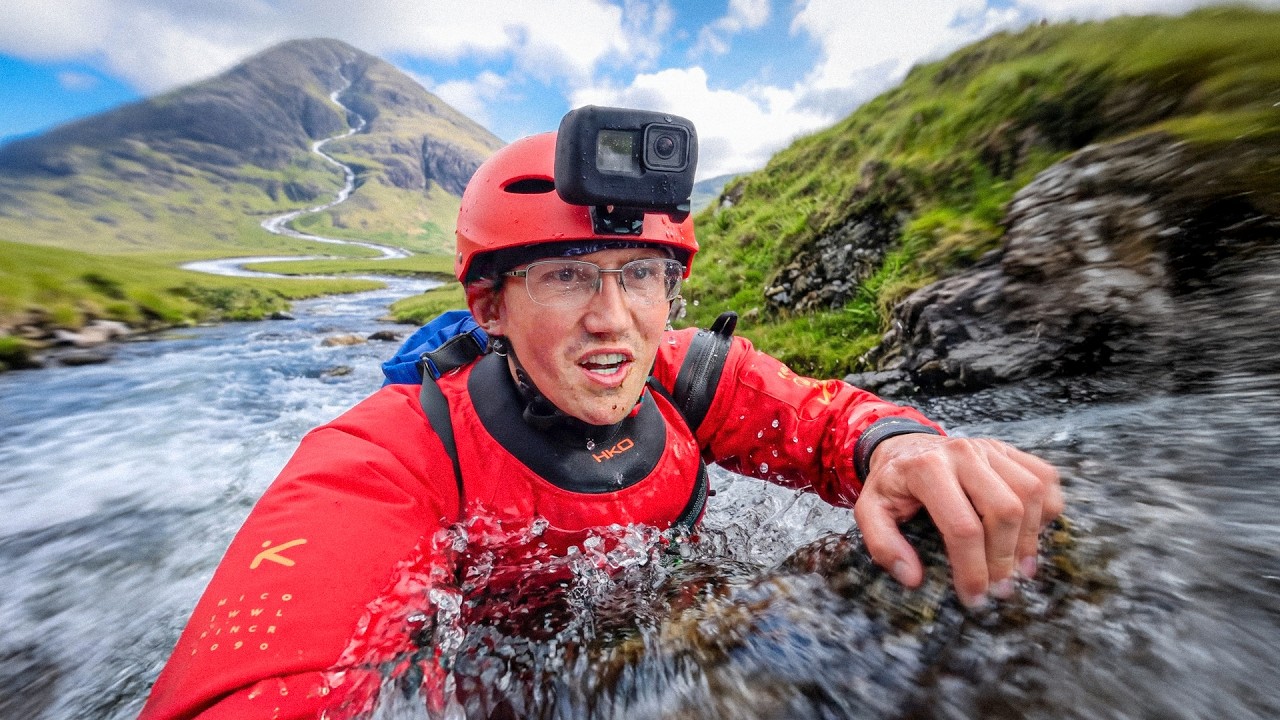
On a waterlogged slope just below the peak of Ben Oss in the southern Highlands of Scotland, Ed Pratt crouched beside a faintly damp patch of earth, touched the water pooling there with one hand, and declared the River Tay officially begun. What follows from that small, soggy handshake with a trickle is a 115-mile commitment: walking, scrambling, wading, paddling, and rowing from that unremarkable Highland seep all the way to the North Sea at Broughty Ferry, with one rule so strict it borders on absurd. Every inch of forward progress must be made in or on the water. No shortcuts. No dry-land detours. The river is the road.
Why Ben Oss and not the mountain everyone else names
Most maps credit Ben Lui, the more prominent peak across the valley, as the birthplace of the Tay. Pratt did the work to challenge that. Using an online mapping tool, he measured every significant headwater stream he could find. The longest branch off Ben Lui came to 5.5 miles, which looked convincing until he traced a smaller, easily overlooked tributary spilling off Ben Oss. That one edged out the competition, making Ben Oss the true source by the most geographically rigorous definition: the point along any watercourse that sits farthest from the river’s mouth. So he climbed the less famous mountain, touched the mud, and started moving.
The descent immediately reminded him that the Tay is not the Thames. Where the Thames was slow and overgrown at its source, the Tay is remote and genuinely dangerous. Pratt was completely alone, without phone signal, and had left his satellite device behind. The slopes below Ben Oss were steep enough that a misplaced foot could mean a broken limb with no one within calling distance. He picked his way down in careful, deliberate steps, narrating the risk plainly: ‘If I place a foot wrong, I could really do myself some damage.’ He made it, eventually, arriving back at his stashed bag near 9 p.m., soaking wet partly because he had forgotten to zip up his dry suit before submerging himself earlier in the afternoon.
A sweat bag in the Highlands and a plan built in three stages
Day two brought a new tactical problem. Carrying a full pack through the river was dangerously unstable, so Pratt cached his camping gear downstream, hiked roughly three miles back up the valley with a lighter load, re-entered the river, waded the section properly, and then returned to collect his bag. The round trip cost him most of a day. He was philosophical about it, noting the Thames had its own slow start, just for different reasons, but Scotland’s midges made the administrative delays considerably less pleasant. By the second morning he was already covered in bites across both hands.
The bigger picture, though, was taking shape. Pratt had mentally divided the journey into three stages. The first was wading and pack rafting from the source down through the river’s many name changes, from unnamed stream to Cononish to Fillan to Dochart, to the inlet of Loch Tay. The second stage was crossing the loch’s 14 miles to Kenmore aboard a vessel he planned to build himself on the loch’s banks. The third was riding that same handmade craft down the remaining river to Broughty Ferry Castle, the endpoint he had chosen for its physical distinctiveness.
The upper river offered a preview of what all three stages would demand. Scrambling through what he believed was a waterfall locally known as Hole in the Wall, the channel narrowed and dropped far more dramatically than anything on his route map had suggested. ‘This is one sketchy trip so far,’ he said afterward, dripping, assessing the next cascade ahead.
The waterfall he nearly missed on his own itinerary
Standing above a large waterfall near the end of day two, Pratt stared down at a ledge and the rocks below it and took stock. He had seen pictures of this feature before setting out. In person, he said simply, it was ‘so much bigger than I thought.’ The question of whether to drop to the ledge and jump clear of the rocks was still open.
The Tay ahead still had rapids, an open loch crossing on a vessel that did not yet exist, and roughly 100 miles of river to go. Pratt had given himself three weeks, with a candid admission that it could well be longer. He looked east toward the sea, zipped up his dry suit, and kept moving.
 Wake up to Only Happy News!