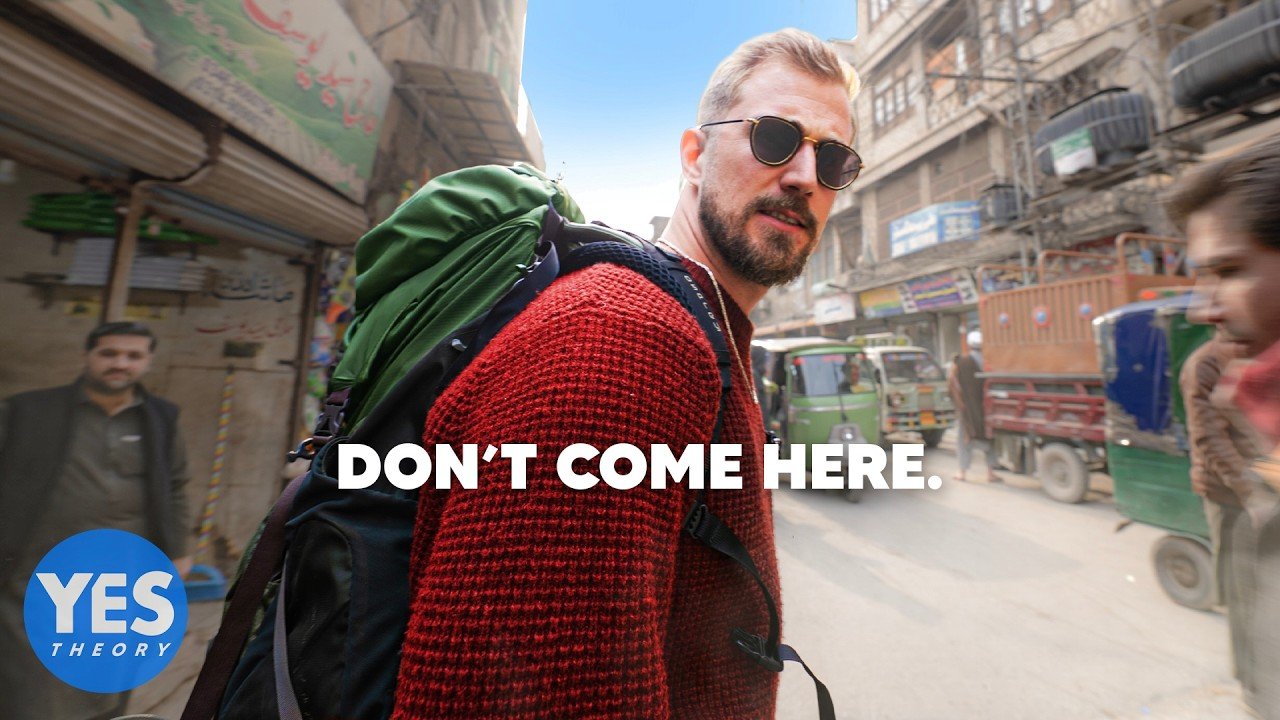
Thomas and Quentin from Yes Theory land in Peshawar – Pakistan’s oldest city, pressed right up against the Afghan border – with two clear targets: meet as many locals as possible on foot, and sleep at a stranger’s house without a single booking. Within five minutes of clearing the airport, a man offers to drive them three hours to his home in the mountains. The police escort comes one hour later.
What unfolds over 48 hours is a street-level portrait of a city that absorbed decades of bombings, lost people in almost every family, and still insists on pouring tea for every foreigner who walks through.
The Escort Nobody Could Skip
The hotel manager flags them before they reach the door. A suicide bombing hit a paramilitary headquarters the previous month, and local authorities have been tracking credible threats against foreign nationals ever since. A police escort is not a suggestion – it is the condition for leaving the building. Thomas tries to sign a waiver declining the escort. An undercover officer sitting in the lobby vetoes it on the spot.
So the pair head into the bazaar with armed police flanking them – officers who, critically, speak no English. That detail matters. It means every conversation with a local happens without a government filter in the middle of it. Shopkeepers pull them inside. Street vendors press food into their hands before any money changes hands. A nursing student on his hospital internship tells them Sweden is his favorite country. A long-bearded man named Zafur Hussein waves them over purely to share tea and explain, through a local interpreter, that a guest arriving at your door – even mid-quarrel – means the conflict is finished the moment they knock.
Quentin, who is Swiss and has been told his entire life that he looks Pakistani, gets addressed in Pashtu within the first minute on the ground. People on multiple street corners pull him aside and tell him he is finally home. The police officer eventually agrees.
What the City Absorbed and What It Kept
Peshawar has been ruled by 30 different kingdoms over 2,600 years – Greeks, Persians, Mughals, Afghans, the British – because its position at the mouth of the Khyber Pass made it the main land gateway between Central Asia and the Indian subcontinent. That geography that made it rich also made it a consistent target.
Since 2001, the modern version of that pressure arrived as terrorism. By 2009, coordinated bombings were hitting markets, mosques, hotels, and police stations on a rhythm that locals describe as nearly weekly. One man in the park tells Thomas and Quentin that his mother and sister were shopping when a blast went off a few streets away. His family used to say goodbye to their elders each morning without knowing if they would be back by evening. Pakistan’s military launched sweeping counterterror operations and by 2015, attacks dropped sharply. Then 2021 arrived – the Taliban returned to power in Kabul, militant networks regrouped across the border, and threat levels in Peshawar climbed again. Today the city is officially high-risk, which is precisely why the relay chain of police escorts follows the pair all the way out of the city toward Islamabad – one unit handing off to the next like a baton.
Still, a local man named Jawad – a longtime Yes Theory viewer who spots them in the street and cannot quite believe it – puts the framing plainly: the Taliban does not represent the people of Peshawar. He says it with the calm certainty of someone who does not need to argue the point.
The Engagement Strategy
Yes Theory‘s approach here works because the format is built around friction, not comfort. Dropping two foreigners into a heavily policed city with no accommodation booked and a standing instruction to find a stranger willing to host them creates a structural tension that no scripted travel show can fake. The failure to actually sleep at a local’s house – blocked by government regulations requiring that any host be vetted – does not deflate the episode. It redirects the energy toward what the streets themselves produce: an unbroken sequence of invitations, shared meals, and candid history that no pre-arranged itinerary would have surfaced. Audiences follow that format because the outcomes are genuinely uncertain, and the people encountered are never props.
The mission of staying with a stranger remains open – Thomas and Quentin leave Peshawar under military escort headed for Islamabad, where they plan to finish what they started.