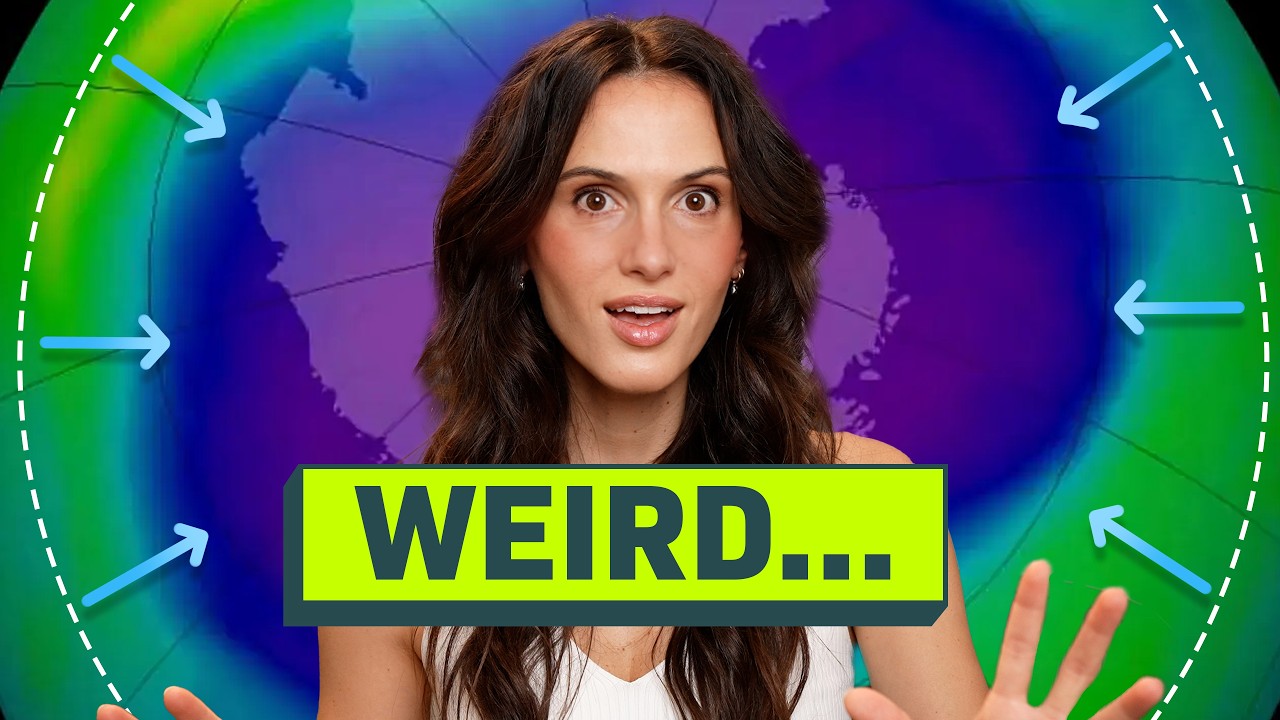
Science journalist Cleo Abram was scaling a glacier in Antarctica, crampons biting into ice that has been frozen for thousands of years, when the absurdity of the moment hit her: she was standing at the center of the world, and almost nobody knows it. The ozone hole that dominated headlines in her childhood has quietly been closing for decades, and the continent where scientists first spotted it is still the place where they confirm it is healing. This is not a story about disaster avoided. It is a story about two of the most consequential decisions in human history, how they were made, and why a third decision of equal weight is now overdue.
The dinner party that stopped a land grab
To understand why the ozone hole closed, you have to go back to a problem that had nothing to do with ozone. In the early 1950s, Antarctica was one of the last unclaimed territories on Earth, and Cold War powers were carving it up with overlapping territorial claims. Then, on April 5th, 1950, a small group of geophysicists gathered for a dinner party. Someone suggested pausing the land grabs for 18 months to actually study what was happening down there. That proposal, improbably, worked.
The result was the International Geophysical Year, an 18-month global research effort beginning in July 1957. Cold War rivals who had been racing to plant flags were suddenly building research stations side by side. And what they learned was staggering. Antarctica is bigger than all of Europe and twice the size of Australia. Its ice sheet holds around 91 percent of the world’s total fresh water. The ocean freezing and melting around its edges each year drives global currents that determine weather patterns from California to India to Australia. Scientists started calling it the heartbeat of the planet, and the name stuck because it is literally accurate.
The IGY was so successful that by 1958, nobody wanted to stop. In 1959, governments signed the Antarctic Treaty, turning the continent into the world’s only science continent. It remains one today, home to about 70 research stations with no single owner and no military presence.
The chemical hiding in refrigerators and spray cans
One of those stations had been collecting ozone data continuously since the IGY. By 1985, with 30 years of records in hand, researchers noticed something alarming: ozone levels directly above Antarctica had dropped sharply. A 30-year-old scientist named Susan Solomon led a team south to investigate. Abram called her up. ‘A lot of people didn’t believe it at first,’ Solomon recalled. ‘How can this be happening? What could possibly cause this?’
Solomon’s team determined that chemicals found in everyday products, used in foam, spray cans, and refrigerators, were rising into the stratosphere, breaking apart, and destroying ozone molecules. Without action, ozone depletion would have spread to the Northern Hemisphere, and by 2040 the hole would have covered the entire planet. By 2065, a five-minute walk outside would have caused sunburn at many latitudes. That is the world that didn’t happen.
Solomon was in Antarctica making measurements the day the Montreal Protocol was signed. ‘It was an interesting feeling of being under the ozone hole,’ she said, ‘knowing that half a world away, an incredible change had just occurred.’ By 2009, every country on Earth had signed. The chemicals were banned, substitutes were found for every application, and the ozone layer began to recover. Satellites now track the recovery from orbit while researchers at the Indian base Maitri and other stations continue monitoring from the ground.
The glacial melt water that tastes like a warning
After five hours of hiking across the ice, Abram reached a formation called the Blue Rivers, seasonal channels of liquid glacial melt water that exist only during Antarctic summers, likely flowing in liquid form for the first time in hundreds or thousands of years. Scientists confirmed it was safe to drink. ‘That’s really genuinely delicious,’ she said, standing in the middle of it.
But that same melt is part of a newer and unresolved problem. Around Antarctica’s coasts, winter sea ice is not reliably reforming the way it once did. In 2023, it crashed to the lowest level ever recorded and has not recovered. The global currents that the Antarctic Treaty’s scientists first mapped are beginning to destabilize. Disruptions here translate into more intense storms, losses in global fish populations, and ecosystem collapse in regions far from the ice.
A scientist on the expedition, Steven, kept repeating a phrase that stayed with Abram long after the hike: ‘the current future is not the future future.’ The path in front of us is not fixed.
Still on the ice, still watching
The Blue Rivers carved through the glacier and disappeared beneath the ice shelf at the edge of the field camp, blue and cold and completely indifferent to the calculations being made about them a few meters away.
Two generations made decisions that bent the arc of history when it would have been easier not to. The Antarctic Treaty happened because a handful of scientists at a dinner party believed in a different kind of future. The Montreal Protocol happened because researchers, including one who was literally standing under the hole when it was signed, kept measuring long enough to prove the danger was real. The ozone layer is healing. The ice, for now, is still watching.