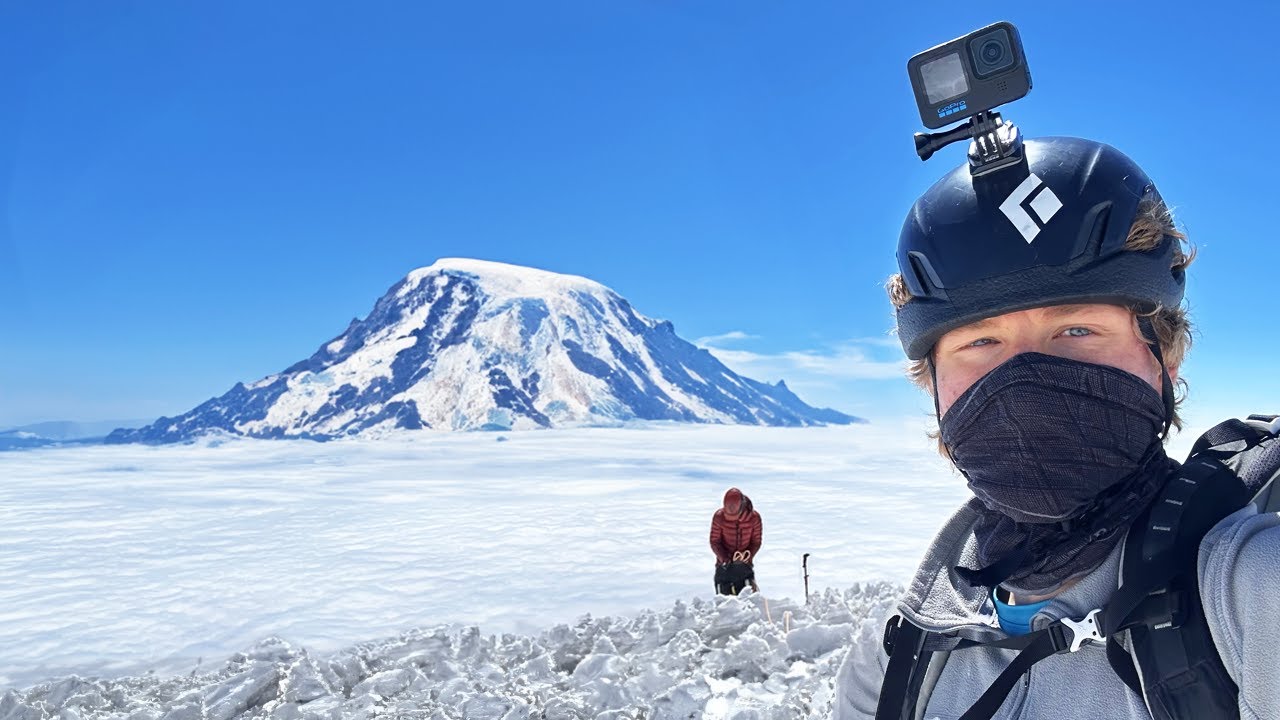
Ryan Mitchell stood at the trailhead below Mount Rainier with a 60-pound pack on his back and 11,000 vertical feet between him and the summit. The Couch Glacier route is not the standard way up Washington‘s highest peak. It demands ice climbing, rope work, anchor-setting, and a willingness to cross a glacier that, by mid-August, has fractured into a maze of crevasses and chest-high ice spikes. For anyone who has ever wondered what it actually takes to reach the top of an American volcano, this four-day climb answers that question with total honesty.
Four days, one route, zero margin for easy decisions
The plan was methodical. Day one from the trailhead at roughly 3,800 feet up through dense forest, then grinding scree, then snow, to a camp near 8,000 feet on the Van Trump snowfield. Day two a push of around 3,000 feet up through the Van Trump snowfield and the Turtle snowfield to Camp Hazard at 10,000 feet, directly below the Couch Glacier. Day three the summit push. Day four out.
Guiding the climb was Justin, who at that point had logged around 50 total Rainier summits and seven or eight via the Couch specifically. That experience mattered the moment they stepped onto the glacier. As Mitchell put it before leaving for the mountain: ‘He did the same route recently and he said it was nuts.’
The scree on day one was relentless, loose rock on an uphill grade with heavy packs pulling backward. By late afternoon they were above tree line, boots on, moving up snow. Camp that first night was a flat rock shelf with a direct view of Mount Adams in the distance and the Couch Glacier looming above them.
Day two was a slog in the truest sense. The Van Trump snowfield required crampons and ice axes even before the real technical climbing started. Red algae streaked through the snow at altitude. By the time they ground up the Turtle snowfield, a series of relentless switchbacks at 35 to 40 degrees, Camp Hazard felt like it had been earned at significant cost.
Summit day started at first light and lasted 11 hours
Leaving Camp Hazard before 5 a.m., the first move was a careful downclimb onto the glacier itself. From there, four pitches of technical ice climbing up the Couch ice shoot, with Justin setting V-thread anchors and ice screws at each belay station. The first two pitches were steep but manageable. The third and fourth pushed vertical, with ice chimneys requiring Mitchell to get his knees involved to clear the overhangs.
Above the ice shoot, the glacier had deteriorated badly for mid-August. Enormous crevasses forced constant route-finding detours. Then came the penitentes, ice spikes four feet tall and tightly packed, forming across the upper glacier because the sun had been converting snow directly to vapor without melting. Moving through them burned roughly twice the energy of normal travel. The footing was never reliable. The indigestion from the strange body positions was real.
At 13,800 feet they cleared Point Success, one of Rainier’s three summits, and pushed the final 200 feet to Columbia Crest at 14,400 feet, the true summit. Thirty minutes at the top, then back down through the penitentes, a series of rope rappels down the ice shoot using V-thread anchors cut into the glacier, a stop to fill water bottles from a dripping icicle on the way down, and finally back to Camp Hazard.
Camp to camp: 11 hours. Estimated calories burned the previous day according to their tracking: more than 5,000.
The crack that almost wasn’t there
On the upper glacier, Mitchell paused at one point and looked down into a crevasse opening directly at his feet. The snow bridge spanning it was thin enough that he could see it flexing. ‘I bet you in a few days where we just stepped will be completely open,’ Justin said.
The four-day descent back to the parking lot ended with Mitchell’s quads and calves comprehensively destroyed and 7,500 feet of elevation shed on the final day alone. That crack in the glacier was still somewhere up there, quietly widening in the August heat.