A drone descended over a public park on the outskirts of Shanghai, lowered a sealed box onto a dedicated landing platform, and delivered a cup of jasmine tea without spilling a single drop. That moment – captured by travel creators Kara and Nate during a 72-hour technology expedition across Shanghai and Beijing – crystallized what their month-long journey through China had been building toward: a firsthand encounter with infrastructure that is already operating at a scale most of the world has yet to imagine.
From Drone Deliveries to Driverless Taxis in Shanghai
The drone delivery sequence unfolded at Meituan Hangqing Park, one of a small number of designated drone delivery zones within Shanghai. After enlisting the help of a local couple – who declined any extra payment and returned the offered cash – Kara received her order at 11:43 a.m., exactly within the predicted window. The delivery required a four-digit retrieval code, and the packaging was recyclable. The drink turned out to be jasmine tea rather than coffee, a detail Kara described as entirely irrelevant given the circumstances.
Later that day, Kara and Nate summoned an autonomous taxi through the WeChat app for a fare of one U.S. dollar. The vehicle – an unmanned Lexus equipped with roof-mounted cameras and a real-time environmental display screen – navigated Shanghai’s dense mixed traffic, including motorbikes, pedestrians mid-crosswalk, and a vehicle that abruptly cut into their lane. The car braked firmly and correctly each time. Nate noted the onboard screen was functionally similar to Tesla’s interface, mapping every surrounding car, cyclist, and pedestrian in real time. The ride covered highway-speed roads at 50 kilometers per hour with no human operator present at any point.
Huawei Showrooms, a Six-Hour High-Speed Train, and Beijing’s Robot Mall
At the Huawei flagship store, Kara and Nate explored vehicles featuring automatic doors that open without physical contact, ceiling-mounted retractable screens, fully blacked-out privacy glass, in-seat refrigerators, and zero physical rearview mirrors – replaced entirely by rear-facing cameras. A fully equipped Huawei vehicle carried a price tag of $50,000. A separate brand’s minivan offered zero-gravity seating, a built-in massage function, and an airplane-style fold-out tray table from the seat back.
The journey from Shanghai to Beijing covered roughly 1,200 kilometers aboard a high-speed rail service traveling at 130 miles per hour. Business class carriages featured lay-flat seating, a hot meal of shrimp, vegetables, and black rice, and a train attendant who covered Nate with a blanket while he slept. China’s high-speed rail network accounts for more than two-thirds of the entire global total, spanning over 24,000 miles – a figure that dwarfs every other nation’s investment in the technology combined. The Shanghai Maglev, which Kara and Nate originally planned to ride, reaches 268 miles per hour and represents the fastest regularly scheduled passenger train service on Earth.
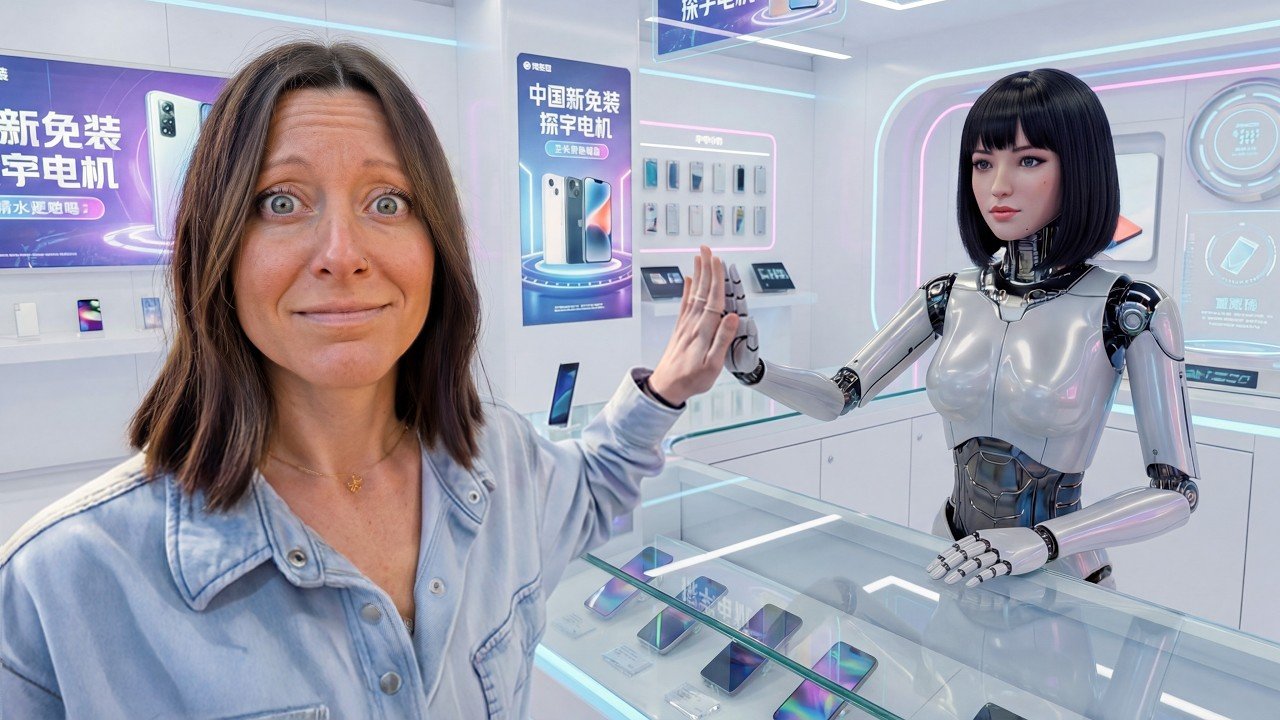
In Beijing, the destination was the world’s first shopping mall dedicated entirely to humanoid and performance robots. Highlights included a Michael Jordan robot available for $35,000, a Cristiano Ronaldo robot that performed a celebratory dance after scoring a goal, an Albert Einstein robot that delivered a monologue on E=MC², and a panda performing Tai Chi. A barista robot produced lattes with customers’ faces printed in foam using cocoa powder – Kara’s face appeared on her cup within seconds of the order.
Kara and Nate’s seven-week Asia series, documented across Shanghai and Beijing, reflects a broader global inflection point: autonomous vehicle deployments, drone logistics networks, and humanoid robotics are no longer prototype demonstrations but live commercial services available to ordinary consumers. The jasmine tea that arrived by air at a Shanghai park – on time, intact, and in recyclable packaging – is perhaps the simplest proof that the infrastructure gap between concept and daily life has already closed in ways much of the world has yet to experience firsthand.