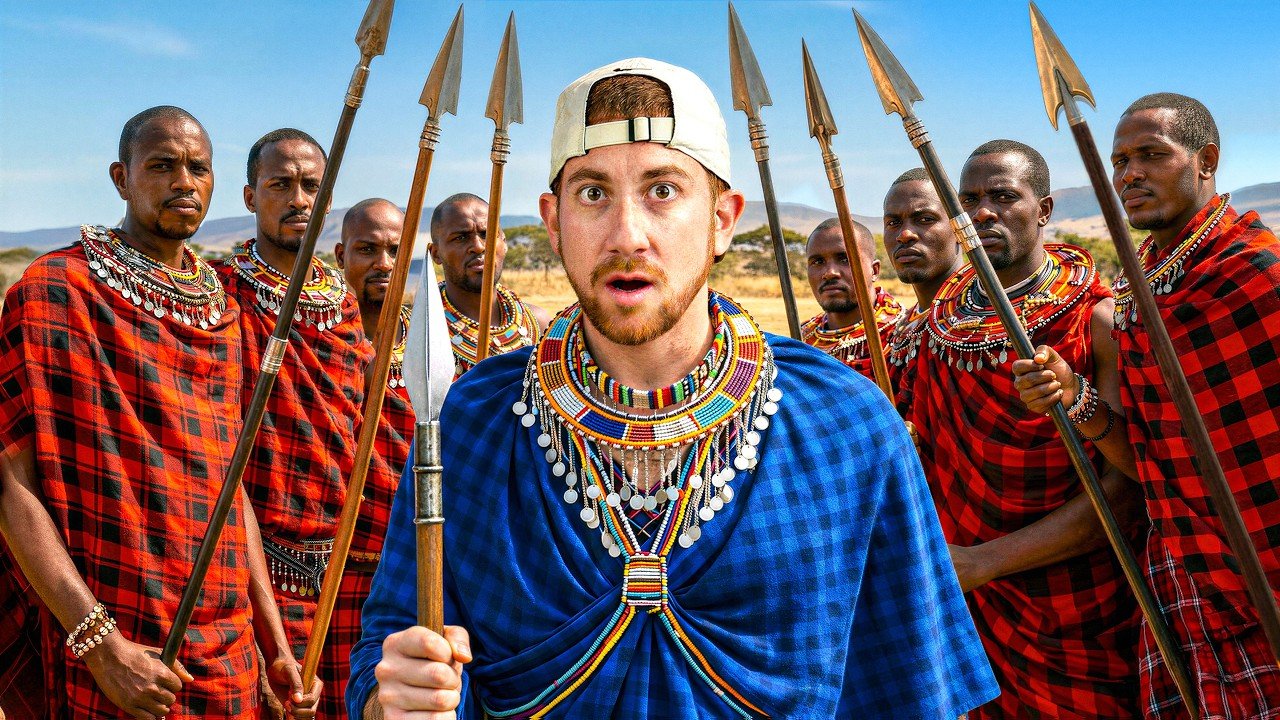
What does it mean to live in a way that has remained essentially unchanged for a thousand years? Travel creator Drew Binsky found out firsthand when he accepted an invitation to stay inside a rural Maasai boma near the Ngorongoro Crater in Tanzania, living alongside warriors, sharing meals of freshly prepared goat, and witnessing traditions that most outsiders never get to see. His guide throughout the experience was Moses, a Maasai man who speaks fluent English after years of study in Arusha – and who has devoted himself to bridging ancient custom with the world around him.
Life Inside the Boma: Cattle, Cowhide, and Community
The Maasai boma Moses calls home is a compound of small, low-doored mud-and-thatch huts, each reinforced with a thorn-wood fence designed to keep hyenas and lions away from the cattle herd. Moses explained that a single compound may house multiple wives and children belonging to one man, with the number of wives a man may take directly tied to how many cattle he owns. Moses himself has one wife for now – though he noted, with a laugh, that more cattle could change that calculation. Inside the sleeping hut, Drew discovered that Maasai families use cowhide in place of mattresses, cook over an open interior fire, and resurface their roofs with fresh grass every six months before the rains arrive. Roughly ten people sleep inside a single hut. The community around the boma numbers more than three thousand people across the broader area, with around twenty members of Moses’s extended family living within the immediate compound.
Cattle are not merely livestock here – they are currency, identity, nourishment, and spiritual anchor. Moses walked Drew through how fresh blood drawn from a living cow’s neck using a small bow and arrow is mixed with milk and consumed as both food and a source of strength, particularly during dry seasons when other food sources grow scarce. The practice is not ceremonial but practical, rooted in millennia of pastoral survival. The same animals provide the cowhide bedding, the dung used to wash hands after butchering, and the bride price – roughly twenty to thirty cattle – paid to a woman’s family at marriage. As Moses put it simply: if you have no cattle, you have no wealth.
Moses Builds a Village School While the Next Generation Chooses Its Own Path
One of the most quietly powerful moments of Drew’s visit came when Moses led him to a small schoolhouse he personally established for children in the surrounding community. Moses explained that historically, Maasai children did not attend formal school, but he sees education as the pathway to a better life – and critically, a pathway that can fund a return to traditional values. His logic was straightforward: a child who goes to school, earns money in the city, and then comes back to buy more cattle for the family has served both worlds well. His own sons, Lazaro, Lucas, and Jodlove, attend private school and already speak English confidently.
Yet Moses also acknowledged the tension openly. Young Maasai who leave for cities like Arusha, Dar es Salaam, or Nairobi rarely come back to the village. Drew confirmed this by speaking with two Maasai women living and trading in a nearby town, both of whom said they preferred urban life and had no desire to return to the boma. When Drew pointed out that the village elders he had spoken with said the exact opposite – that they had no interest in city life – one of the women smiled and offered the most honest answer of the entire trip: fifty-fifty. Where you were born is your origin. That is why.
At sunset, Moses and the other warriors gathered outside the huts to perform the traditional Maasai adumu – the jumping dance that signals warriors have returned from the meat camp and that fresh milk from the cows is ready. The competitive high-jumping between Moses and a younger warrior named Kuya drew laughter, debate, and a genuine athletic rivalry that ended, diplomatically, in a declared tie. Drew attempted several jumps himself and admitted the practice was far more exhausting than it looked. The children of the boma, meanwhile, played a spirited barefoot football match on the open plain with Ngorongoro as their backdrop, the kind of scene, Drew noted, that had no equivalent anywhere else on earth.
Context
The Maasai are a Nilotic people whose ancestors migrated southward from the Nile region and built an entire civilization around cattle herding across what is now Kenya and Tanzania. By the nineteenth century they were among the most feared warrior peoples on the East African savanna. Colonialism, drought, and disease later cost them vast tracts of land and dramatically reduced their numbers, but the Maasai retained their language, Maa, their distinctive red shukas, their age-grade warrior system, and a cultural identity that remains one of the most recognizable on the African continent. Today an estimated one to two million Maasai live across both countries, with communities existing on a spectrum from entirely traditional bomas like Moses’s to fully urbanized families in major cities. Organizations focused on indigenous cultural preservation note that the Maasai represent one of the clearest living examples of a society successfully negotiating modernity without abandoning its foundational identity – a negotiation Moses himself embodies every single day.
Moses’s parting message to Drew’s viewers carries a weight that outlasts the visit itself: honor your culture and recognize the communities of indigenous peoples. In a world where traditional ways of life are disappearing at an accelerating pace, the Maasai of Tanzania stand as a reminder that strength, joy, and belonging do not require electricity, mattresses, or city skylines – only cattle, community, and the willingness to pass something worth keeping on to the next generation.