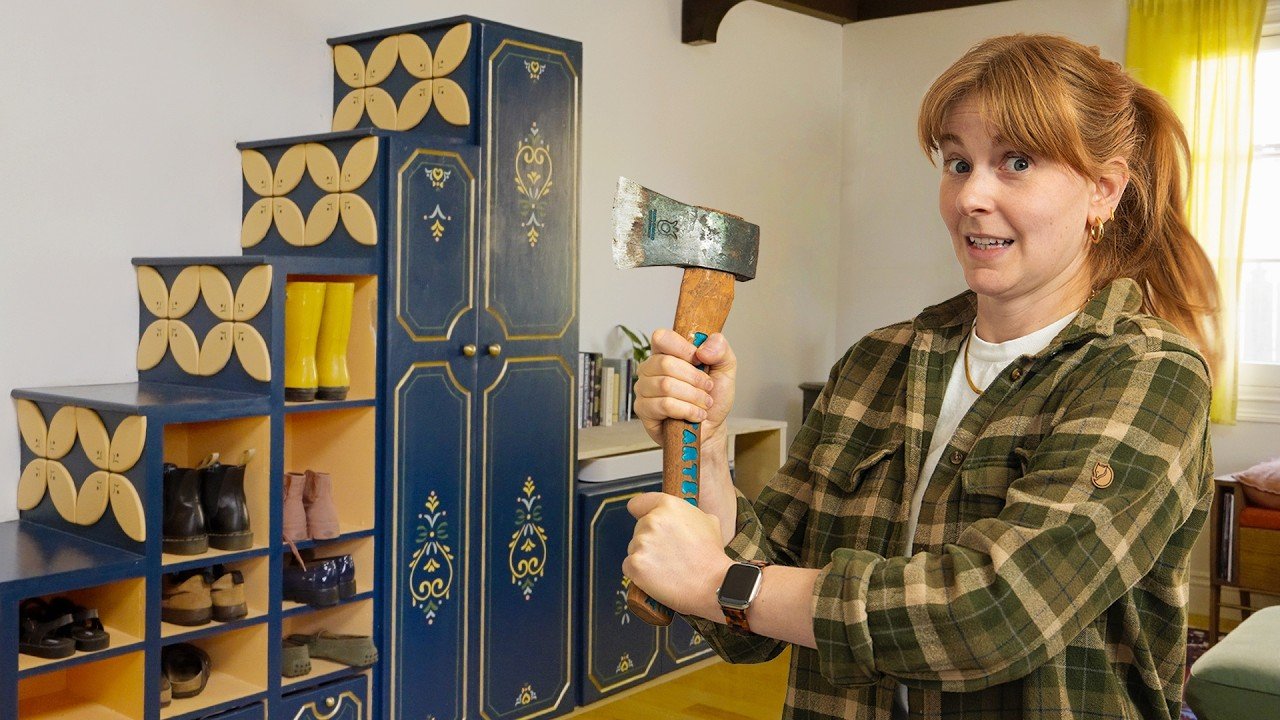
Simone Giertz had three concrete problems with her existing loft staircase: it looked amateurish, the floor had been cut too wide leaving an awkward gap, and a wall-mounted projector made daytime viewing impossible. The fix wasn’t a quick patch job – it meant tearing the whole thing out and rebuilding from scratch, complete with new molding, a redesigned shelving unit, and a taller fireplace base. Then came the TV problem, and that’s where things got interesting.
Here’s how the project unfolded: a new staircase build, a custom painting mounted on tambour to conceal the screen, a family-sourced art commission, and a living room that ended up feeling sharper without losing its Scandinavian warmth.
Building the Staircase – and Handing It Off
With contractors Jesus and Ramon holding down the build, Giertz left for Vancouver to attend TED, returning to find serious progress on the new staircase structure. The rebuilt design sits closer to a load-bearing beam than the original – close enough that her first look back prompted a sharp ‘oh no’ before the clearance confirmed it was fine. Precision on the cut landed about one millimeter over target. The new staircase includes integrated storage running the full length: shoes, bags, jackets, scarves, hats – all tucked in. A rug Giertz sewed down from a larger IKEA piece anchors the base, with leftover material turned into throw pillows.
The Tambour Reveal and the Painting Commission
Covering the TV was the trickier engineering problem. Giertz landed on tambour – the flexible, slat-based material used in roll-top desks – as a sliding panel to hide the screen behind a painting when it’s not in use. She described tambour as ‘one of the scariest things I’ve ever worked with,’ citing how easily the slats can pinch during handling. Getting an image printed onto the panel required an unexpected solution: at a community meetup, a man named Max offered access to his college’s UV print shop. The painting itself came from her father Paul, an artist who worked from childhood reference images Giertz sent him – producing a piece layered with family history. Framed photographs of her maternal grandmother, her paternal grandparents, and an old telegram header are mounted alongside it. With wax applied to the slats, the panel slides cleanly. One push reveals the screen; another push brings Paul’s painting back into view. Even the picture frames were split with tambour to match the mechanism.
The Bigger Picture
Giertz’s approach here reflects something real about how DIY content is shifting. The build isn’t dressed up as aspirational home renovation – it’s treated as problem-solving with aesthetic consequences. Looping in a college UV print shop, commissioning a parent’s original artwork, and sourcing a couch described as ‘way too big’ but kept anyway because it ‘looks chubby’ all point to a creator who’s making decisions based on what actually fits the space rather than what photographs cleanly. That kind of specificity tends to hold audience attention longer than polished before-and-after formats.
The room Giertz ended up with is the one she described wanting at the start – whimsical and cozy, but a degree more refined. The staircase that once had an awkward gap in the floor is gone, the projector that blocked daytime viewing is gone, and in their place is a wall that looks like a family gallery right up until someone hits a button and it becomes a home cinema – which, per Giertz, she immediately used to watch Frozen for the fifteenth time.