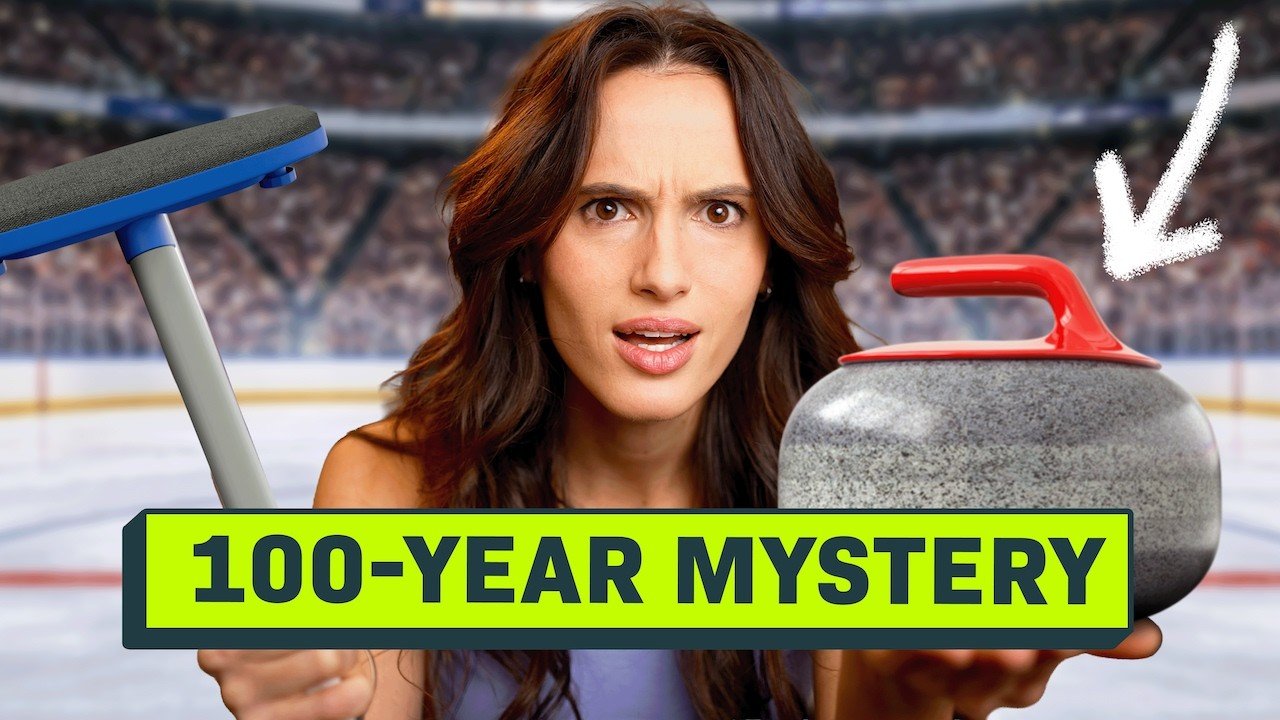
The ice at the US Olympic and Paralympic Curling Trials is not smooth. Get close enough and the bumps are unmistakable – tiny frozen pebbles, sprayed on deliberately by professional ice technicians using purified water, shaved to a precise texture that has no equivalent in hockey arenas or figure skating rinks. That surface is the first clue that curling is not what most people assume it is.
The sport gets mocked. Reliably, every four years, the brooms come out and the jokes follow. But the mockery tends to dissolve the moment anyone looks past the surface – which, as it happens, is exactly what physicists have been trying to do for over a hundred years.
A Scottish Island, a 500-Year-Old Stone, and a Running Band
Every competitive curling stone traces its origin to Ailsa Craig, a small island off the Scottish coast with a geological backstory that stretches back 60 million years. A volcanic eruption pushed magma upward but it never broke the surface – it cooled underground as a granite plug. Over millions of years, the land around it eroded away, leaving the island standing. The resulting granite is unusually low in aluminum, which produced uncommon minerals and a fine-grained molecular structure that makes the stone resistant to both water absorption and cracking. There is only one company that has been quarrying and shaping this granite into curling stones for over 170 years. A single stone can cost more than $600. A set of 16 runs nearly $9,600.
The bottom of each stone is not flat. It curves inward in a concave shape, and only a narrow textured ring – called the running band – ever contacts the ice. That deliberate design allows the stone to glide, but the physics of how it actually moves have confounded researchers since at least 1511, when a stone was recovered from a Scottish bog bearing that date carved into it. Da Vinci was alive when someone threw a curling stone in Scotland.
When a player releases a stone at the hog line with a slight spin, it curls in the same direction as the spin. That sounds unremarkable until you consider what happens with any other spinning object moving across a surface: friction at the front of the object slows it down relative to the back, so the object curves in the opposite direction of the spin. Curling stones do the reverse. They have been doing the reverse for centuries. Nobody has fully explained why.
Three Theories, Two Eliminations, and One Unresolved Comb
The first serious attempt at an explanation suggested that the stone melts the ice at its front edge, reducing friction there and leaving more friction at the back – which would push the stone in the direction of rotation. Clean in theory. Subsequent studies found the rotation speed was too slow to cause ice melt dramatic enough to produce the observed curl. Theory abandoned.
The second theory pointed to the textured running band leaving microscopic angular scratches on the pebbled ice as the stone rotates forward. The broom scandal of 2015 had already demonstrated that deep scratches in ice can redirect a stone – players described certain high-performance broom heads as functioning like joysticks, able to steer a badly thrown stone to its target, which prompted 22 teams to sign a voluntary agreement refusing to use directional fabrics before the World Curling Federation eventually banned them outright. If broom scratches can steer a stone, perhaps the stone’s own rotation scratches the pebbles in a way that redirects it. Another study tested this and found the scratches were too small on their own to account for the effect.
The third theory reaches for a comb analogy. As the stone passes over the pebbles, it momentarily sticks, bending the ice surface slightly like a tine under a finger, then snapping forward. That repeated stick-and-snap cycle causes a pivot effect that gradually pushes the stone sideways in the direction of rotation. A comprehensive study by researchers in Japan found both the scratch theory and the snap theory plausible – they may work together. No definitive answer has emerged.
The physics field investigating this is called tribology – the science of how surfaces interact through friction, lubrication, and wear. Curling’s unsolved rotation problem is a known challenge within that field, not because of any particular interest in the sport, but because ice friction applies to questions that matter well beyond the arena: how glaciers slide over bedrock, how tires behave on icy roads, and – in the case of NASA missions targeting the icy moons Europa and Enceladus – how a robot might drill through nearly 30 kilometers of ice to reach a subsurface ocean. The mechanics of a spinning tool moving against ice are, physically speaking, the same problem as the curling stone.
The curlers competing for Olympic spots at the trials are not thinking about any of this mid-throw. ‘The physics – in the moment, we do not think about the physics at all,’ one competitor said. What they are thinking about is the skip at the far end calling the shot, the weight of the release, whether to draw to the house, knock a stone out, or leave a guard in front for protection. The strategy is layered enough that the sport has long been compared to chess on ice. After all 16 stones are thrown across ten ends, the team that manages millimeter-level precision over hours of play wins. And then both teams meet, the winners buy the first round, and everyone shakes hands.
The Sweeper After the Stone Has Already Left the Hand
Sweeping is the only moment in any Olympic sport where a player can physically alter the path of a moving game object after it has been released. Two players with brooms chase the stone down the sheet, pressing hard into the ice, moving the broom heads fast enough to slightly melt the pebble tops and create a thin film of water under the stone. Less friction means the stone travels farther and straighter – up to three meters farther. One sweeper working on one side can coax the stone to curl more or less depending on which side of the path they work.
The regulated broom heads now used in competitive curling are all cut from the same yellow fabric. Carbon fiber handles, foam cores, consistent heads. The 2015 scandal that preceded those regulations exposed how fragile the balance between throwing skill and sweeping influence actually is. ‘It was like damaging the ice surface too much and you could literally throw it horrible and your sweepers would make the shot for you,’ one player recalled. The rule that emerged from that controversy is essentially a philosophical statement about what curling is: sweeping should make a good shot great, and might make a mediocre shot good, but it cannot be allowed to rescue a bad throw entirely.
The Skip Still Yelling From the Far End
At the trials, the skip’s voice carries across the sheet – calling targets, adjusting weight, reading the ice. That role, directing strategy from the opposite end while the thrower focuses on release, leaves one person responsible for holding the whole game in their head at once: where every stone sits, what the opponent might do, which shot sacrifices a point now to set up a better position later. It is the kind of thinking that gets harder to watch dismissively once you understand what is actually being calculated.
Back at those pebbled bumps on the ice at the trials – the ones that make this surface unlike any other in sport – each tiny frozen dome is the result of a deliberate process, a centuries-long refinement of technique, and an ongoing physics mystery that researchers in multiple countries are still trying to close. The stone glides over them, spins, and curls the wrong way. It has always curled the wrong way. Figuring out exactly why might one day help a robot find life on another moon.
 Wake up to Only Happy News!