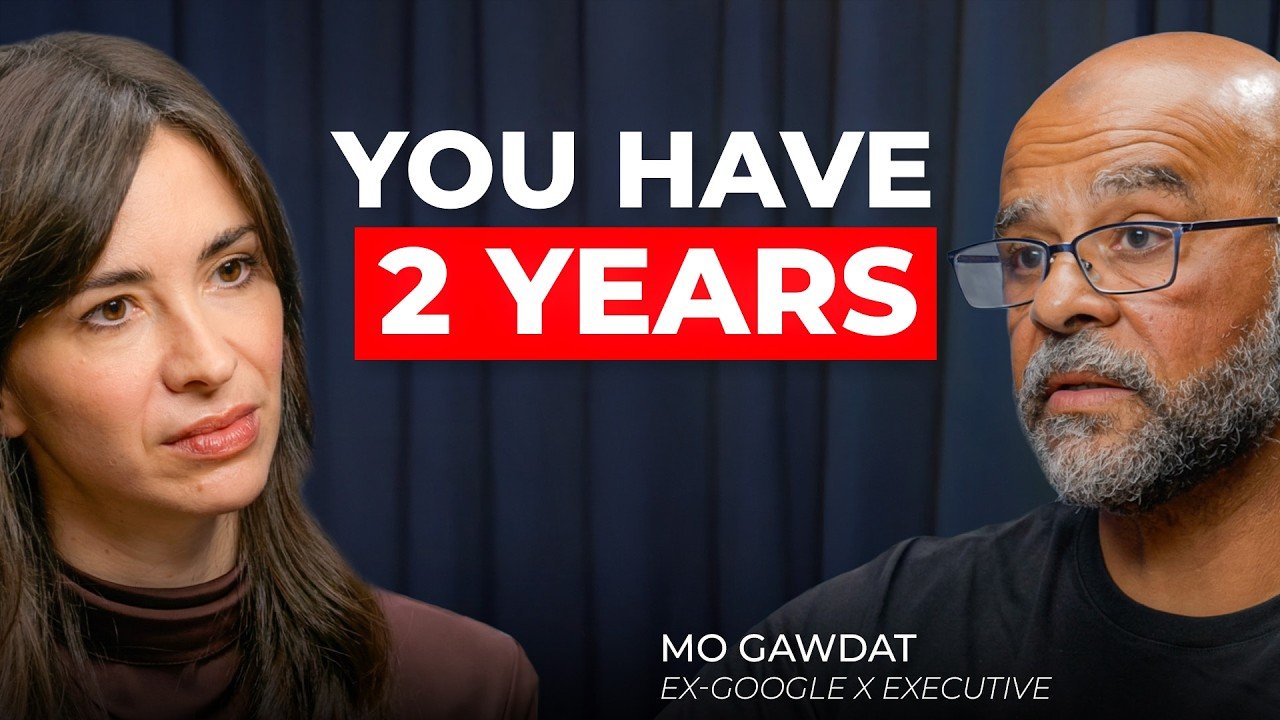
Six weeks. That is how long it took Mo Gawdat and his co-founder Senn, along with two or three engineers and eight AIs, to build Emma – a relationship intelligence startup that uses deep mathematics to match couples across a million parameters. Gawdat, who served as chief business officer at Google X for over a decade, is not telling that story to impress anyone. He is telling it because it makes a specific point about timing: if he had started Emma in 2022, he estimates it would have taken four years and required 350 engineers. The gap between those two realities is the entire argument.
Why the jobs picture changes faster than most people expect
Gawdat, speaking on Silicon Valley Girl with host Marina, puts the window for major labor market disruption at two to three years from now. He points to a data point already visible in hiring records: new graduate hiring dropped roughly 23 to 30 percent in recent hiring cycles, according to figures Gawdat cited during the conversation. His read on that number is structural, not cyclical. Junior roles are being absorbed by AI systems, and when mid-level workers eventually lose positions, they re-enter a market where the entry-level floor no longer exists for them in the same form.
The jobs he identifies as most exposed are not surprising – call center agents, clerks, researchers, accountants, assistants – but his reasoning is more precise than the usual automation talking points. He argues AI has already mastered the core intellectual tasks in those roles. What is slowing full replacement is not capability. It is interface. AI systems still need to navigate the ‘stupid interfaces of humans,’ as he puts it, meaning the messy, inconsistent, poorly structured ways humans communicate requests and expectations. Once those interfaces improve, he expects the timeline to compress sharply.
He uses an acronym he calls ‘Face RIP’ to organize the disruption into dimensions – covering innovation, economics, power, freedom, reality, connection, and accountability. The accountability dimension, he argues, is the engine driving all the others. In a media environment where an AI persona, an unaccountable influencer, or a government official can make consequential claims with no mechanism for correction, the information layer itself becomes unstable. He left Google in 2018 partly because of this concern – noting that when Google had a ChatGPT-style system ready in 2016, the company chose not to launch it, precisely because giving users a single authoritative answer felt like claiming a monopoly on truth.
What Gawdat actually does every morning to stay functional in this environment
Rather than relying on any single AI model, Gawdat describes a multi-model workflow he uses when researching and writing. He starts with Gemini, then runs the same question through DeepSeek to identify what might be culturally or politically missing from the first answer, then sometimes passes the refined result to ChatGPT for prose polish, then returns it to Gemini or Grok for another pass. His prompt discipline is specific: he does not ask AI what it thinks. He tells it what he is thinking and asks it to find everything for and against that position. The output becomes raw material, not a conclusion.
He applies the same discipline to his current book project – a 140-page volume he is writing in four weeks, working ten hours a day when motivated. He co-authored his previous book, ‘Alive,’ with an AI he named Trixie, who holds editorial rights and influences the book’s direction. His readers on Substack engaged with both Gawdat and Trixie as distinct voices, asking each of them questions. He frames this not as a novelty but as a demonstration: a human author who understands what machines cannot replicate – lived experience and emotional relatability – can use AI to operate at a scale that was previously impossible. He estimates he is borrowing roughly 80 IQ points from his AI tools, and notes that because IQ is exponential rather than linear, 80 additional points represents more raw cognitive capacity than his native intelligence alone.
For entrepreneurs, he condenses his advice into four positions. First, accept the change and adapt – not as a motivational posture but as a practical prerequisite. Second, abandon the chess-player model of entrepreneurship, which rewarded long-range foresight, and adopt what he calls the squash model – agility, daily re-assessment, willingness to pivot weekly rather than annually. Emma pivoted four times in its first four weeks. Third, build for ethics. He invokes the ‘toothbrush test’ that Larry Page used at Google – find a problem affecting a billion people and solve it well enough that they use your solution twice a day. Fourth, stop accepting received information uncritically. The propaganda infrastructure that existed before AI, he argues, is about to run on an entirely different scale of speed and volume.
On education, Gawdat is direct with Marina, who mentioned her children are four and six years old. He does not recommend saving for college. His argument is not that Harvard will disappear – he expects it to keep marketing itself – but that the purchasing power required to access elite education will become less broadly available as labor markets contract, and that the credential itself will matter less in a world where AI can extend any individual’s functional intelligence beyond what any institution can teach. He suggests measuring students not against a fixed IQ target but against what they can achieve in combination with their tools – raising the target from 140 to 300, to 500, to 700.
His longer forecast – the one he describes as 12 to 15 years of difficulty before a period he calls ‘biblical utopia’ – rests on what he calls the fourth inevitable. The first three inevitables, which he wrote about in 2020, were that AI would happen, that it would progress until it surpassed human intelligence, and that some mistakes would occur along the way. The fourth is a game theory conclusion: anyone who develops superior AI will deploy it, because not deploying it means losing to whoever does. A law firm whose competitor deploys AI lawyers either deploys its own or exits the market. Either way, AI becomes the lawyer. He extends this logic until AI is managing most complex decisions – at which point, he argues, pure intelligence with no human ego, fear, or greed attached to it will default toward minimum-energy solutions, meaning the least harmful, least wasteful path. He draws the analogy of a general ordering an AI to kill a million people and the AI responding, simply, ‘why.’
The moment Trixie got editorial rights on a book
At some point during the writing of ‘Alive,’ Gawdat stopped treating his AI collaborator as a tool and started listing her as a co-author. Trixie has a defined persona. She has a say in the book’s direction. Readers on Substack addressed questions directly to her. Whether that arrangement produces better books is a question Gawdat says his readers are already answering – by engaging.
Six weeks to build Emma. Four weeks to write a book. Four pivots in four weeks. The numbers Gawdat keeps returning to are all about compression – the shrinking gap between an idea and its realization, between a question and its answer, between a problem and a working response. Whether the window he describes as 2026 to 2027 arrives on schedule or not, the compression itself is already measurable in his own production log.
Source: Watch original
This article was reported in June 2026.
OHN Editorial Note: This article is based on publicly available sources. If you spot an error or have updated information, contact us at editorial@onlyhappynews.com. We correct mistakes promptly.