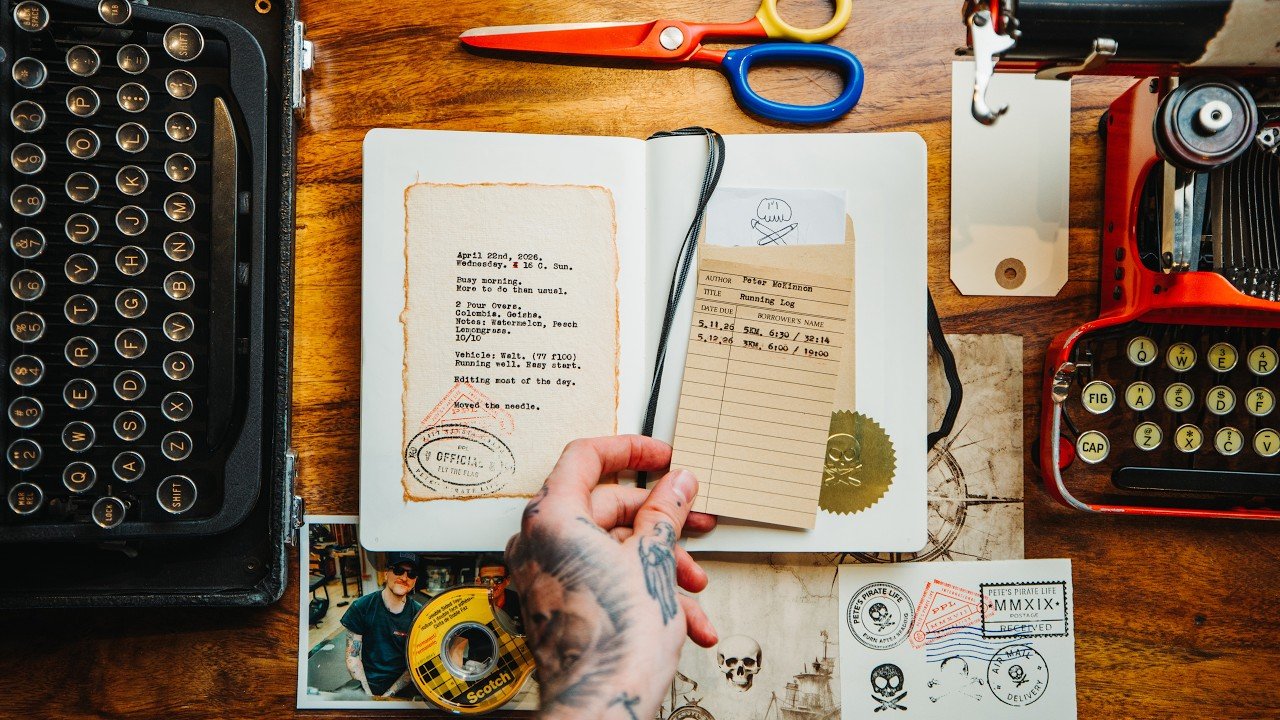
The first page of the journal holds a typewritten note on an old two-dollar bill. That detail alone says a lot about how Peter McKinnon approaches the no-handwriting journal he has been keeping for the past 90 days – nothing in it arrives casually, and nothing is scribbled.
What goes into a journal with no pen marks
The premise is exactly what it sounds like. McKinnon – a Toronto-based photographer and filmmaker – decided to fill an entire notebook without writing a single word by hand. Every entry is either typewritten, printed, or physically fastened onto the page. Library cards, envelopes, printed photos on vellum paper, rubber stamps with a postal theme – all of it gets taped or affixed into the pages of a Leuchtturm1917 A5 soft cover notebook in black with a graph interior, which McKinnon describes as his go-to for larger projects. Smaller, everyday carry goes to Field Notes in his pocket.
The entries themselves can be short. One example McKinnon read aloud noted a busy morning, two pour-over coffees with ratings, the vehicle he drove that day – a 1977 Ford F100 – and a note that editing had ‘moved the needle.’ That is a full entry. Notes from his kids, folded and slipped into dated envelopes taped to the page, count too. Workout logs, run cards filled out at the end of each month, gear lists, photo trip notes – all of it lands in the same book, formatted by typewriter rather than ballpoint.
A note McKinnon is careful to make: the typewriter is not required. Printing pages from a computer and taping them in produces the same effect. The typewriter is the hobby within the hobby, as he puts it.
The typewriter shop that moved upstairs
To demonstrate the Corona 3 folding typewriter he uses for roughly 85 percent of his entries – a compact machine that folds flat into a hard case – McKinnon walked up a flight of stairs in his building to a typewriter repair and sales shop run by a man named Chris, who McKinnon convinced to open a second location in the same building. The shop is stocked floor to ceiling with machines, including a Smith Corona Skyrider and several Royal typewriters from the 1930s and early 1940s.
Chris, speaking on camera, put the entry point for a working typewriter at roughly $3.99 to $5.99 – referring to hundreds of dollars in the collector market shorthand he uses – with the note that a well-maintained machine will likely outlast its owner. The trade-off is ribbon replacement and a willingness to learn basic mechanics. McKinnon typed a short entry live in the shop, made a couple of typos, and left them in. The machine is nearly 100 years old. The imperfections, he said, are part of what makes the object feel real in 2026.
For those in the greater Toronto area, Chris’s shop is accessible from Main Street in Newmarket, and McKinnon noted the links are in the original video’s description for anyone who wants to browse in person.
Three printers and why one stays gatekept on Instagram
The journal runs on three Canon printers. The smallest is the Ivy – credit-card size, sticky-backed photo paper, low cost. The next up is the QX20, which handles the same small format plus a square size that echoes old Polaroid proportions and produces noticeably better image quality. Both use peel-and-stick paper suited for taping directly into a notebook.
The third is the Canon Selphy CP1500 – a 4×6 printer that McKinnon says he has watched appear on Instagram feeds for years without anyone in the comments ever naming it. People photograph it printing photos of cars and leaving 4×6 prints under windshield wipers. The comments fill up asking what printer it is. Nobody answers. McKinnon named it. A battery pack accessory allows wireless printing anywhere without a power outlet.
One spread in the journal shows two photos from a stay at the Bowery Hotel in New York City – printed, taped in, and then overlaid with a sheet of vellum paper on which McKinnon typed the film stock, camera body, lens, location, and time of day. Kodak Tri-X. Leica MP. 28mm Summicron. Room 811. Late afternoon. The vellum is opaque enough that the text is readable over the image without obscuring it.
The run log card from May, still incomplete
Tucked into the journal is a typed run log card for the month of May. As of filming, McKinnon had not yet filled in the final entries. The card will get fed back through the typewriter to finish out the month, then a fresh card for June will slide in behind it. The card itself sits in a small adhesive plastic pocket – the same kind he attaches to the back page of every Field Notes booklet to compensate for the brand’s lack of a built-in pocket.
The May card, half-finished, sits in the notebook in the meantime.
Back at that two-dollar bill on page one – the journal that started from a brief mention in an earlier video, and then grew because viewers like Shane Murray and Adam Scott reacted publicly enough that McKinnon felt the full explanation was owed. McKinnon estimates it will take many more months to fill. He said he could see himself losing steam. He also said he keeps going back to one particular spread – printed photos, vellum overlay, typed details – at least 50 times already, and that each time he does, he wants to make another one.
Source: Watch original
This article was reported in June 2026.
OHN Editorial Note: This article is based on publicly available sources. If you spot an error or have updated information, contact us at editorial@onlyhappynews.com. We correct mistakes promptly.