The notification arrived on a phone screen the same way it always does, quietly, between other alerts. Jack Dorsey’s company Block, the parent of Square, Cash App, and Afterpay, was cutting more than 4,000 people, dropping its headcount below 6,000. The difference this time was the language Dorsey used. He did not blame a slow quarter or a cooling economy. He pointed at intelligent tools and AI agents, saying smaller, flatter teams could now do the same work and that most companies would eventually follow the same path.
That announcement landed on top of a feed already full of similar stories. Atlassian cut roughly 1,600 people and said it was self-funding bigger bets on AI. Across 2025 and into early 2026, companies from Amazon and Microsoft to fintech startups cited AI in their layoff announcements. In the US alone, employers explicitly blamed AI for tens of thousands of job cuts in 2025, according to publicly reported figures compiled across those announcements, a sharp jump from previous years.
When the excuse is real and when it is just good branding
Sadia Zahidi, Managing Director at the World Economic Forum and the person behind its Future of Jobs Report, has a more precise read on what is happening. When asked directly whether AI layoffs are real, she described a pattern she hears from senior figures inside major firms: that some companies are using the current anxiety around artificial intelligence to address overhiring that happened during the last boom. The AI label, in those cases, is a convenient frame for decisions that had already been made for other reasons.
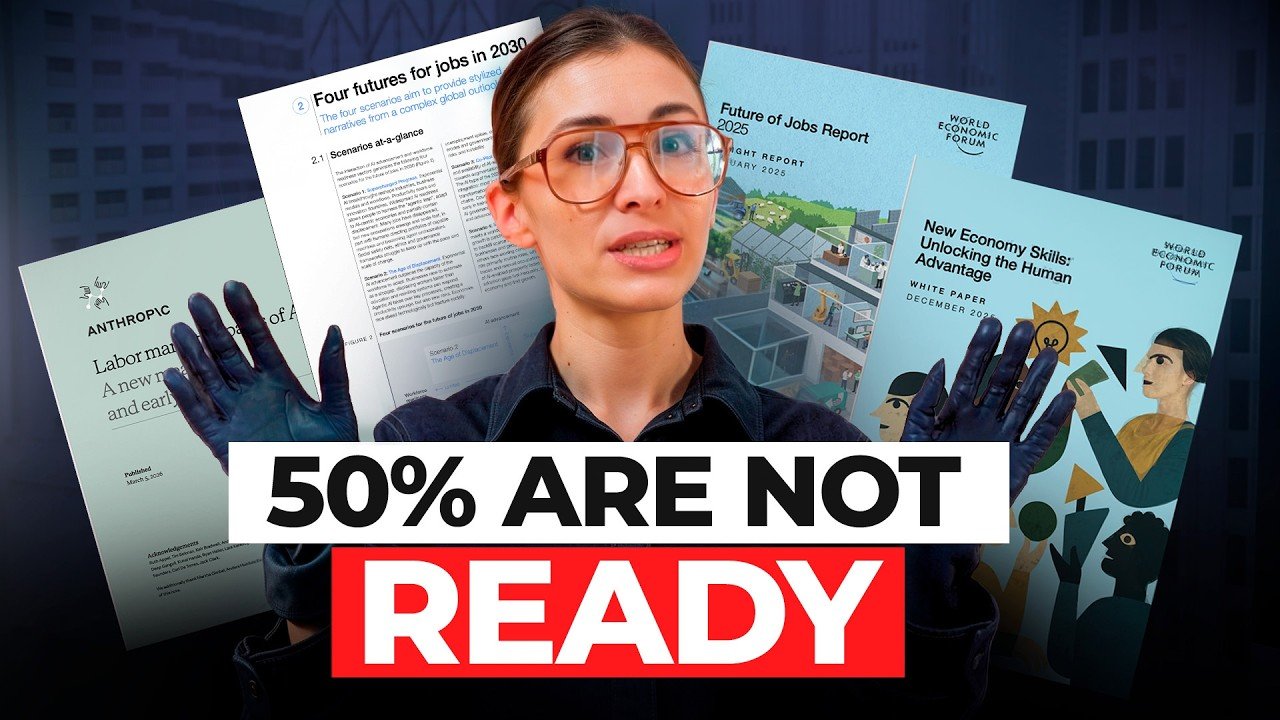
But that does not mean the AI component is fictional. In early March 2026, Anthropic, the company behind Claude, released a study called ‘Labor Market Impacts of AI: A New Measure and Early Evidence.’ Instead of asking theoretically whether AI could complete certain tasks, the researchers looked at observed exposure, meaning they tracked where workers are already using tools like Claude in their actual jobs. For computer and math roles, software engineers, and data scientists, large language models could technically touch more than 90% of tasks, according to the Anthropic report. In practice, workers report using AI on only a fraction of them. The jobs with the highest exposure today are white-collar roles: business and finance, computer science, law, and office administration.
Roughly 30% of the global workforce currently has almost zero AI exposure, according to the same report. Cooks, bartenders, mechanics, cleaners, and in-person service workers are largely untouched so far. The more telling finding is not a spike in unemployment among AI-exposed workers. It is a slowdown in hiring into those roles, particularly for younger people trying to enter those fields for the first time.
What the 100-person model reveals about the next five years
Zahidi uses a straightforward way to explain the scale of what is coming. Picture the entire global workforce as 100 people. Around 50 of them will need rapid reskilling by 2030, according to the World Economic Forum’s Future of Jobs Report. About two-thirds of those could be reskilled within their current role, based on what employers told the WEF researchers. One-third would need to be retrained and moved into a different role within the same organization. That leaves roughly 11 people out of every 100 who do not have a clear place to go inside their current industry at all.
Those 11 are spread across multiple industries. Zahidi identifies administrative assistants and parts of customer service as roles under direct pressure from automation. But she is equally specific about where growth is appearing: agriculture, education, and healthcare are among the highest-growth sectors in the WEF data. There is a documented global shortage of teachers, according to Zahidi, and that profession is not one that technology is close to replacing.
The Anthropic findings align with this picture in a specific way. For white-collar roles, AI can technically handle more than 90% of tasks, but workers are currently using it on only 30 to 40% of them, and that number is growing every six months. The practical question for any worker is not whether their job category appears on a risk list. It is what percentage of their actual day involves rule-based, templated, repeatable work versus judgment, relationships, and decisions that require real context. Zahidi describes a consistent finding across every edition of the Future of Jobs Report: creativity, empathy, interpersonal communication, leadership, and self-management keep rising in the list of skills employers say they want most. The paradox she names is that most employers say those human skills are the priority, but interview processes rarely test for them directly.
Silicon Valley Girl, the YouTube channel behind this report, offers a three-part framework drawn from the combined WEF and Anthropic research. Human skills form the base: communication, empathy, leadership, negotiation, and the ability to manage oneself through rapid change. AI fluency sits alongside that, not building models from scratch but knowing how to use tools like Claude, ChatGPT, or Copilot to handle research, drafts, summaries, and data analysis so more time is available for judgment work. Domain expertise rounds out the picture: real depth in a field, enough to evaluate whether an AI output is actually right and to turn it into decisions that matter.
For students and early-career workers, Zahidi’s most direct advice is to take on group projects. Hackathons, side projects, volunteering, any environment where negotiating and shipping something with other people is required. She points to universities that are already moving away from purely competitive, individualistic assessment models toward collaboration-based learning, partly because employers are asking for it.
A practical 90-day approach emerges from the conversation: spend the first 30 days using one AI tool every day for current work, whether for writing, summarizing, or planning. In the second 30 days, ship one small AI-powered improvement, an automated report, a smarter template, or a content workflow. In the final 30 days, pick one human skill from Zahidi’s list and deliberately practice it in a real project with other people.
The producer who stopped writing first drafts from scratch
Somewhere inside that shift, a producer at Silicon Valley Girl is no longer spending hours on research or writing first drafts from the beginning. Those hours moved somewhere else: more episodes, quality control, judgment calls. What that person does in a day has changed entirely.
The same road sign was there at the start: a notification, a headline, a number. Block cut 4,000 people and named AI as the reason. Whether that reason is fully accurate or partly convenient, the underlying pressure on routine office work is not going away. The practical question, as Zahidi frames it, is whether a person chooses to move before the reshuffling happens or waits until the decision is made for them.
Source: Watch original
This article was reported in June 2026.
OHN Editorial Note: This article is based on publicly available sources. If you spot an error or have updated information, contact us at editorial@onlyhappynews.com. We correct mistakes promptly.