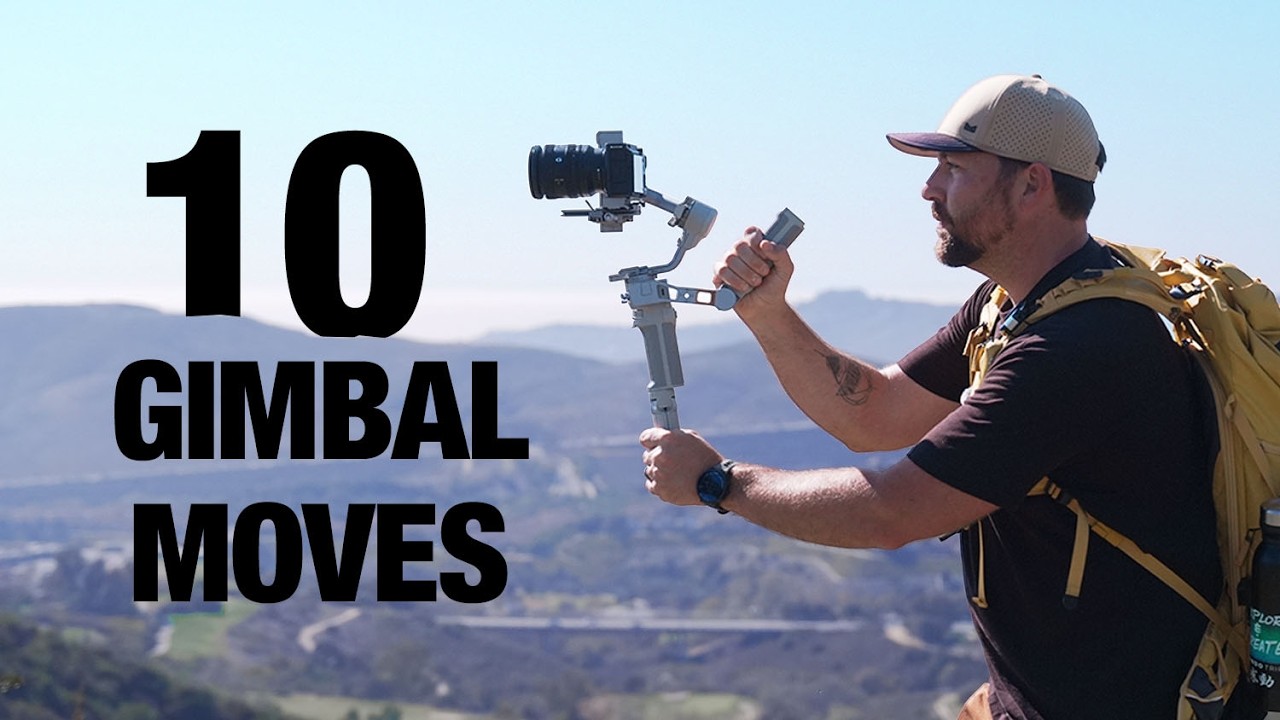
A tree on a ridge line becomes the subject. The camera is already rolling. Jeven Dovey is walking a slow arc around it, heels first, weight low, keeping exactly the same distance from the trunk as he circles. That single movement, the orbit, is the first of ten gimbal techniques he works through at a location that gives him open sky, a bench, direct sunlight, and enough foreground to make every shot meaningful.
The logic behind all ten moves is the same, and Dovey states it clearly before demonstrating anything: every shot needs a beginning, a middle, and an end. Walking from point A to point B without deciding those two points first produces footage that wanders. Deciding them first produces a story. That principle drives every technique he covers.
What each mode on the gimbal actually does to the image
Dovey works through the modes methodically. Pan follow locks the tilt axis so the camera always looks straight out to the horizon as the operator rotates left or right. That is the mode for the orbit, where he walks a sideways heel-to-toe stride, legs absorbing the motion, body staying level. Pan tilt follow releases both axes so the camera tilts down when the operator pushes forward and tilts up when pulled back. That is the mode for reveal shots, starting low on the ground with nothing visible, walking forward while lifting the arm, and letting the tree and the sun flare come into frame together.
Flashlight mode, or locked mode, holds the camera pointing exactly forward regardless of how the operator moves. Dovey activates it by pressing and holding the trigger. It makes the push-in clean: walking heel to toe directly toward the tree, no unwanted pan, no drift. He runs the same move in reverse to demonstrate a pull-back reveal, starting close enough that the subject is unidentifiable, then stepping backward until the full tree is visible.
FPV mode unlocks all three motors. The tilt goes up and down. The roll goes left and right. When Dovey swings his arms, the camera follows the roll axis and dips the way a drone does through a banking turn. He notes that the effect is easy to overdo, and that a small amount of left-right roll on a swooping downward move, from sky level to the bench, creates a floating quality that reads well on action and fitness content in his client work.
The joystick setting most operators leave at default
One of the less obvious techniques Dovey covers involves the joystick speed setting. He dials it down to 13 in the custom range. At that speed, pulling the joystick left produces a pan so slow it takes noticeable time to cross the frame. He uses it to arc from a low starting position up and to the right, revealing the bench and the wider scene at a pace that feels deliberate rather than mechanical. He switches back to a medium speed afterward so repositioning between shots stays quick.
The double-press trigger reset comes up repeatedly. At any point when the camera has drifted off center, a double press snaps it back to level and facing forward. For operators moving through multiple setups, that function keeps transitions between shots clean without stopping to manually realign.
The point-of-view approach is not a mode so much as an operating decision. Using pan tilt follow or FPV, Dovey holds the gimbal at eye level, the handle vertical like a lollipop, and walks while looking at whatever the camera should look at. The result is footage that feels like a person exploring a space. He switches the responsiveness setting to slow for this, which smooths out the reaction of the motors and keeps the motion from feeling twitchy.
The side-track shot requires the locked trigger again. Dovey holds it in underslung mode, the gimbal inverted below his hand, camera facing out perpendicular to his direction of travel. He walks left to right at a steady pace. With a subject in the frame moving at the same speed, the camera stays locked on them from the side throughout the shot. He describes it as one of his favorite setups.
Where the bench comes back into frame
Near the end of the session, Dovey puts the back handle on the gimbal, switches to pan tilt follow, and runs a continuous flow sequence through the entire location rather than stopping between individual moves. He starts facing forward, walks toward the tree, tilts up to catch the sun, comes down low to a second smaller tree, moves past it toward the bench, tilts down to frame the bench directly, then pulls up to reveal the wider scene. He describes the result as imperfect but usable as a demonstration of how the individual moves connect into something that reads as a single camera journey through a space.
Dovey mentions that DJI gimbals continue to function even when the balance is slightly off, which matters when operators are shooting in vlog mode with the camera flipped toward themselves, a configuration he demonstrates by clicking the trigger three times and bending his wrist to keep himself centered in the frame.
The backpack comes off at one point. Dovey notes that he frequently operates with a full pack when traveling or doing documentary work, and that the counterweight at the back partially offsets the gimbal weight at the front, but that removing it when possible reduces fatigue during longer shooting sessions.
The ridge line, the light, and the bench that kept showing up
The bench at the edge of the ridge appears in at least four of the ten demonstrations, sometimes as the subject being revealed, sometimes as the endpoint of a slow pan, sometimes just passing through frame on a flow sequence. It is never introduced by name or explained. It simply keeps arriving at the end of whichever arc Dovey is walking.
Back at the tree where the session started, the orbit move closes the loop. The same heel-to-toe sideways stride, the same low crouch, the same distance held between the lens and the trunk. The beginning and the end are visible from the same spot.
Source: Watch original
This article was reported in June 2026.
OHN Editorial Note: This article is based on publicly available sources. If you spot an error or have updated information, contact us at editorial@onlyhappynews.com. We correct mistakes promptly.