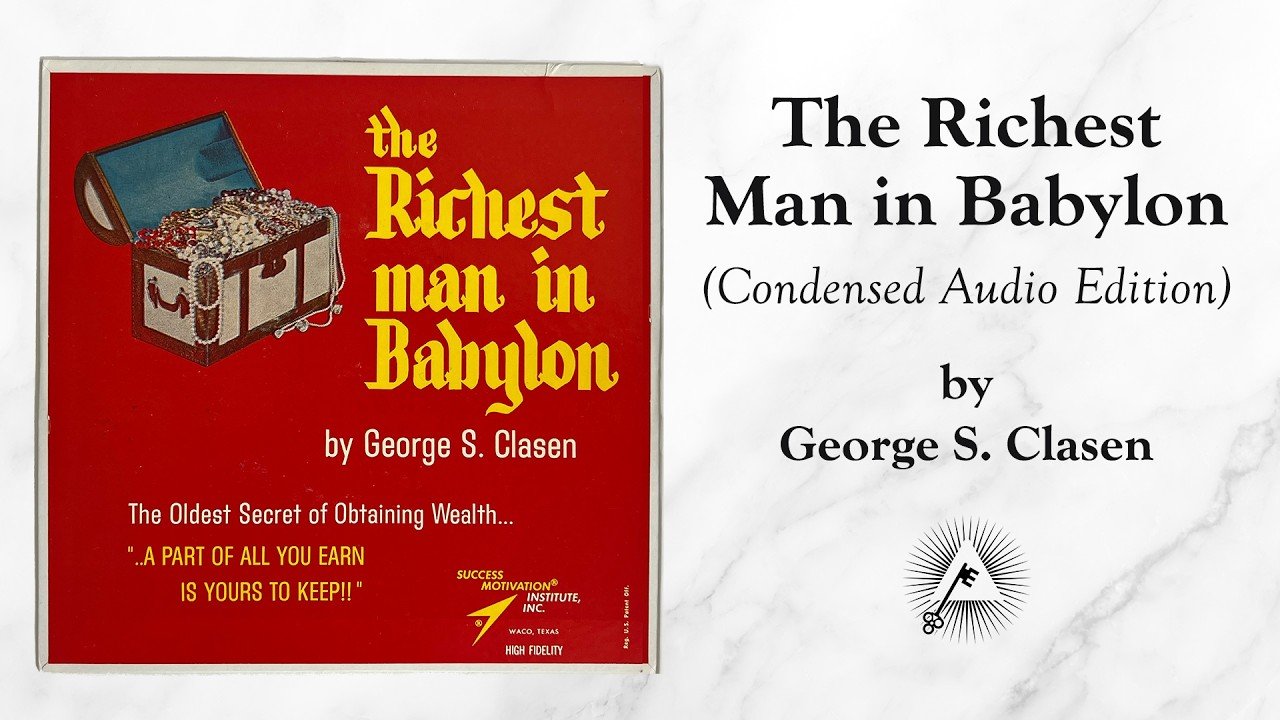
Arkad was a scribe in the Hall of Records, carving clay tablets by lamplight until his back ached and the smell of the burning wick gave him headaches, and yet month after month he had nothing to show for his labor. That gap between effort and reward is the oldest financial frustration in human history, and it still visits most households every payday. The condensed 1963 audio edition of George S. Clason’s ‘The Richest Man in Babylon,’ originally published in 1964 and exclusively licensed to Master Key Society by Success Motivation International, tells the story of how Arkad closed that gap, and why the path he took is as navigable today as it was in ancient Babylon.
The night a scribe traded a job for a secret
Arkad’s turning point arrived not through inheritance or luck but through a negotiation. When Algamish the money lender arrived at the Hall of Records needing a copy of the ninth law finished within a single day, Arkad refused the offered bonus. Instead, he proposed a different payment: finish the tablets, and Algamish would explain how a man becomes wealthy. Algamish agreed. Arkad worked through the night, back aching, head pounding, and delivered the completed work at sunup.
The answer Algamish gave was so compact it felt almost insulting. ‘I found the road to wealth when I decided that a part of all I earned was mine to keep.’ Arkad pushed back immediately, asking whether everything he earned wasn’t already his. Algamish’s reply cut straight through: ‘Far from it. You pay the garment maker, the sandal maker. You pay everyone but yourself. You labor for others.’
The prescription was precise. Save no less than one tenth of every payment, regardless of how small. Then put those savings to work so that each coin earned children, and those children earned more children. ‘Wealth, like a tree, grows from a tiny seed,’ Algamish told him. ‘The first copper you save is the seed from which your tree of wealth shall grow.’
Two costly lessons before the wealth finally took root
Arkad’s first year of saving ended in disaster. He handed his accumulated tenth to a brick maker named Azmur, who was traveling far seas and promised to return with rare jewels from the Phoenicians. Algamish, returning to check on his young protege, was blunt: ‘Why do you trust the knowledge of a brick maker about jewels? Would you go to a bread maker to inquire about the stars?’ The Phoenicians sold Azmur worthless bits of glass. The savings were gone.
Algamish’s response was four words: ‘Plant another tree.’
Arkad did. He entrusted the next round of savings to a shield maker named Aggar, who paid a reliable rental on the bronze purchased with the funds. But when Algamish discovered Arkad was using the rental income to fund feasts of honey, spice cake, and wine, along with a scarlet tunic, the old money lender shook his head. ‘You are eating the children of your savings.’
After two more years of disciplined practice, a much older Algamish returned for the last time. He found Arkad now understood all three principles: live on less than you earn, seek counsel only from those with real experience in the matter at hand, and make your savings work continuously. Satisfied, he made Arkad his partner over properties in Nippur, and when Algamish died, Arkad shared in the estate.
What Arkad told his friends when they asked why fate had chosen him
When old friends accused Arkad of being simply fortunate, he rejected the word entirely. He pointed out that he had proven his commitment through four years of consistent action before Algamish offered him any partnership. ‘Opportunity is a haughty goddess who wastes no time with those who are unprepared,’ he told them.
On the question of willpower, he was equally direct. As he put it: ‘Willpower is but the unflinching purpose to carry a task you set for yourself to fulfillment. When I set a task for myself, I complete it. Therefore, I am careful not to start too difficult and impractical tasks because I love leisure.’ It is a candid admission rarely heard in financial advice: the system works precisely because it is designed to be sustainable, not heroic.
His final counsel to his friends was the same instruction Algamish had given him decades earlier. Repeat the words until they are fixed: a part of all you earn is yours to keep. Start with a tenth if a tenth is comfortable. Do not overstrain. Enjoy life while living it.
The clay tablet Arkad filled in one sleepless night
The copy of the ninth law, the one Arkad carved through the night while his back ached and the lamp stung his eyes, the work he traded for a financial education instead of extra pay, sits somewhere in the exchange unremarked upon after the deal is struck. No one ever checks whether the copy was accurate.
One friend left the conversation with a new light in his eyes. The other left in silence, unable to imagine the path at all. The recording does not say which of the two was more common.