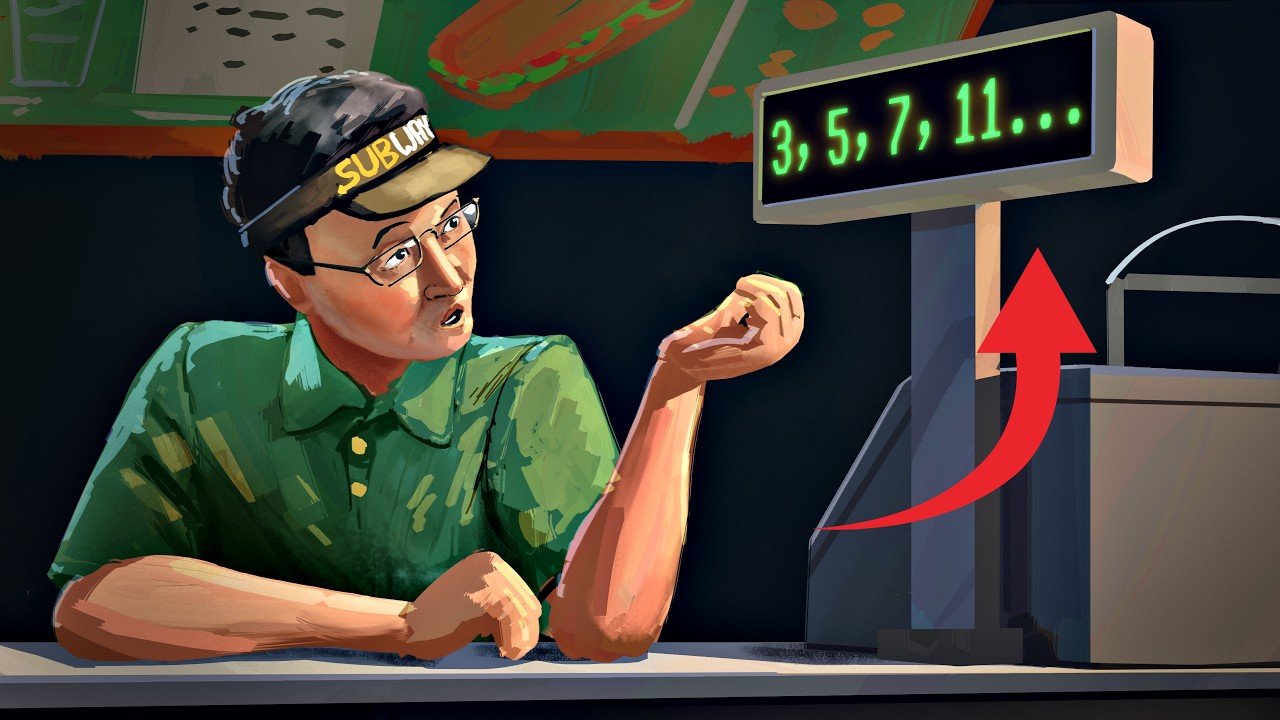
Yitang Zhang had spent years sorting receipts and keeping the books at a Subway restaurant, occasionally driving to the local library on his own time to read journals on number theory. That detail alone would seem unremarkable, even sad, if it were not for what happened next. On the morning of April 17, 2013, the journal Annals of Mathematics received a 50-page email proof from a name nobody recognized, addressing one of the oldest unsolved problems in mathematics, a problem that the great mathematician Edmund Landau had once called unattackable. The referees expected to find the mistake in an afternoon. They did not find it in a week.
The problem nobody could finish
The twin prime conjecture asks a deceptively simple question: are there infinitely many pairs of prime numbers separated by just two, like 11 and 13, or 17 and 19? As numbers grow larger, primes become rarer, and twin primes rarer still. The average gap between consecutive primes near a trillion is already enormous. Yet every time mathematicians have looked, twin primes keep turning up. The largest known pair is a number 388,342 digits long, roughly 260 printed pages per number, paired with a neighbor just two away.
The trouble is that finding examples is not a proof. A century of serious attempts had produced powerful tools but no final answer. Norwegian mathematician Viggo Brun adapted a 2000-year-old sieve method during the First World War and proved something related but weaker: infinitely many pairs of numbers two apart where each has at most nine prime factors. Decades of refinement by successive mathematicians got that number down to two prime factors, a result proved by Chinese mathematician Chen Jingrun in 1973. Close, but not there.
A separate line of attack focused on the gap between consecutive primes rather than the factor count. By 2005, mathematicians Goldston, Pintz and Yildirim had proved that infinitely often, two primes can sit arbitrarily close together as a fraction of the average gap, meaning the gap could be one ten-thousandth of normal, infinitely often. Spectacular, but still not a fixed bounded gap. That same year, a gathering of the world’s leading experts spent an entire week at the American Institute of Mathematics in California trying to push past the barrier. The conclusion, according to one attendee, was that it was impossible.
Zhang was not at that meeting.
The backyard in Colorado
Zhang had arrived in the United States around age 30 to complete a PhD in mathematics, but without recommendation letters, academic jobs were out of reach. He lived in his car for a period and worked odd jobs for seven years, including at Subway, before a friend helped him land a lectureship at the University of New Hampshire in 1999. He had told himself since childhood, in his own words, that ‘there would be a day that I would solve a major math problem.’
By 2010, he had identified that problem. He spent two years internalizing the GPY method that had stopped everyone else, working through nights trying to find a way past the wall the 2005 meeting had declared permanent. By the summer of 2012 he had nothing to show for it. Visiting a friend in Colorado, waiting one evening to leave for a concert, Zhang stepped outside alone to look for deer that usually crossed the property. No deer came. Walking and thinking in that quiet backyard, the answer arrived. He had no paper, but he trusted the idea.
What he had seen was a way to reorganize the error terms that had defeated everyone else. GPY needed primes distributed across arithmetic progressions with all kinds of step sizes, which pushed them into unreachable territory. Zhang restricted himself to step sizes built only from small prime factors, and found that in this narrower class, most of the error terms canceled each other out. It let him push past the critical boundary by a fraction, just one over 584. His stencil held 3.5 million slots across a span of 70 million. The proof showed that two of those slots always catch primes, establishing a bounded gap of 70 million between infinitely many prime pairs.
Referees read through the 50 pages expecting, as one described it, to find the corner of the carpet that would never lie flat. Every time they anticipated a failure point, Zhang had cut it exactly right.
One mathematician who nearly missed the announcement
Andrew Granville, one of the world’s top analytic number theorists, read the paper and initially suspected the author might be a well-known colleague working under a pseudonym to avoid embarrassment if the proof failed.
Within a year, Zhang received the MacArthur Genius Grant. The mathematical community then moved fast. Terence Tao organized an online collaboration called Polymath to sharpen the method, and researchers brought the bounded gap down from 70 million progressively until it reached 4,680. Then a young postdoc named James Maynard, fresh from his PhD at Oxford, came at the problem from a completely different direction on his own, bringing the gap down to 600, and also proving that three primes could be trapped inside a bounded window. His approach revealed something stranger still: the one-half barrier that had blocked GPY and defeated the 2005 meeting was, as Granville put it, ‘a pure mirage.’ It was a red herring. Maynard’s method needed any level of distribution greater than zero. After Maynard joined Tao’s Polymath group in 2014, the record fell further. The current bound stands at 246. In 2022, Maynard was awarded the Fields Medal, mathematics’ highest honor. The twin prime conjecture itself remains open.
The proof on 260 pages per number
Somewhere in a library archive in New Hampshire, or possibly still filed under ‘curious email’ at the Annals of Mathematics, sits the document that moved the number from infinity to 70 million.
The gap between 246 and 2, the actual twin prime distance, is still enormous. Whether one more large idea closes it, as Granville suggested it might, or whether it stays open for another century, the story of how a former sandwich shop bookkeeper rewrote the limits of the possible has already changed what mathematicians believe is within reach.