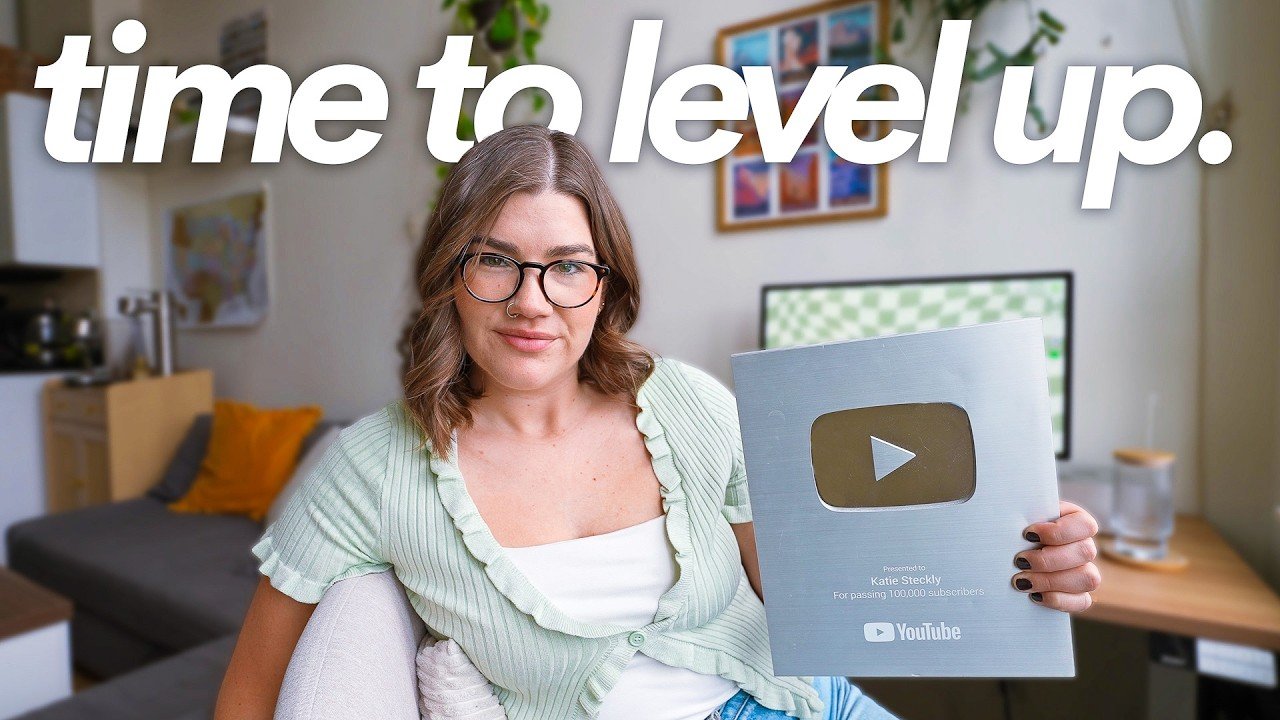
Katie Steckly was sitting down for a matcha when she decided to skip the tips-and-tricks format entirely and just talk. What followed was a frank, five-stage breakdown of exactly how someone goes from watching videos on their phone to building a sustainable career as a full-time creator, and more importantly, why skipping any single stage tends to end badly. The stakes are real: the majority of aspiring creators either stall out before finding an audience or burn themselves into the ground before seeing a dollar. Steckly’s framework treats both failure modes as predictable, and preventable.
From passive scrolling to a show worth watching
The first stage is the consumer. Everyone starts here, and Steckly argues that is not a problem so long as the watching is active rather than passive. Drawing on writer A.O. Scott’s framing from his book ‘Better Living Through Criticism’, she describes two kinds of learning: direct tutelage, meaning deliberately studying craft and strategy, and what Scott calls ‘dreamy osmosis’, the kind of absorption that happens when you watch creators you genuinely love and let their instincts seep into your own. Neither alone is enough. The goal is to transform awe into understanding.
For anyone stuck at this stage, the obstacle is rarely knowledge. It is momentum. Steckly cites a Substack essay by writer Erophile Gerani, whose advice lands hard: ‘I would take advantage of the momentum of inspiration immediately and act on it. That’s the main trait I attribute good outcomes to. It comes from being impatient.’
Stage two is the hobby creator, and Steckly calls simply starting ‘the most crucial filter that holds back the vast majority of people.’ At this level the practical advice becomes specific. She recommends taking about three months to experiment without worrying about growth, because once an audience forms, creators get pigeonholed by expectations. Enjoy the freedom while it exists. After that window, the work is to identify a signature format, something that functions like a show. She points to Shameless Nerd, a smaller channel hosted by a creator named Reed, whose videos follow a consistent cold-open structure, a reflective essay body, and a casual after-video chat. That repeatability gives new viewers a reason to return.
Consistency then becomes the bridge to stage three: the side hustle creator. At this point someone is posting regularly, sitting somewhere between 10,000 and 50,000 subscribers, and picking up occasional brand deals. Steckly’s own turning point came when she built a personal brand deal tracker, a database logging every brand contact, every email exchange, and a follow-up alarm set for one month after each completed project. ‘I went from making around 70k a year to multiple six figures,’ she said plainly, crediting that level of organization above everything else. Alongside brand deals, she points to digital products as an underused option, noting she has personally bought custom Google Maps, destination travel guides, and a language-learning resource hub from creators she follows.
Why burning out is almost part of the plan
Stage four is full-time and burnt out, and Steckly frames it as close to inevitable. Running a YouTube channel alone requires competency across roughly six or seven distinct roles: scripting, camera operation, editing, graphic design for thumbnails, and search optimization. Add in the business layer and the cognitive load becomes unsustainable. She identifies a less obvious trap she calls golden handcuffs: not just the salary a creator grows used to, but the validation that comes from high view counts. ‘My brain is so conditioned to have a certain level of success with my content that having less would feel really bad,’ she admitted.
The resolution is stage five: work-life balance. Steckly describes it in terms borrowed from agriculture. Creators have planting seasons and harvesting seasons. Trying to harvest continuously depletes the soil. She points to the album cycle of musicians as a healthier model, noting that Harry Styles running marathons between records is not laziness but maintenance. For creators fighting algorithmic relevance, disappearing for two years is not realistic. But cycling through a few months of high output followed by a few months of lighter posting and genuine rest, she argues, is entirely possible. As she put it, quoting creator Tess Barclay: ‘it really is that deep.’
The detail that stays with you
Reed’s channel, Shameless Nerd, with its consistent cold open, its essay body, and its quiet after-video wind-down, sitting there as an example of what a format that earns trust actually looks like.
For anyone who has spent months watching other creators and filling a notes app with ideas they have never acted on, Steckly’s framework offers something more useful than a growth hack. It offers a map with a current location marked on it, and a clear next step that does not require going viral first.